IntroductionIf you're designing something that needs to see into tight spaces—a medical scope, an industrial inspection tool, or even a DIY gadget—size is everything. The camera module has to fit through whatever opening you have. Too big, and it won't go where it needs to. Too small, and you might
What is an Endoscope Camera Module? A Complete Technical OverviewIn the fields of modern medicine and industrial maintenance, the ability to see into inaccessible spaces is not just a convenience—it is a necessity. At the heart of this capability lies a remarkably sophisticated piece of technology:
1. Introduction: When High-Definition Imaging Meets Confined SpacesIn the intersection of minimally invasive medical procedures and industrial precision inspection, a common technical challenge increasingly arises: how to obtain sufficiently clear, smooth, and realistic visual information within a c
IntroductionIf you're buying an endoscope—for medical use, industrial inspection, or DIY projects—you'll probably wonder about resolution. How clear will the image be? Can you see small details? The answer depends on what you're using it for. Resolution standards have come a long way, from basic sta
IntroductionAn endoscope camera module is the tiny camera that lets doctors see inside your body or inspectors look inside machinery. At the core of most modern endoscopes is a CMOS image sensor. CMOS technology has made these cameras smaller, cheaper, and more efficient. This article explains what
1. Introduction: When Detection Space Meets Device Volume ConstraintsIn the development of automated inspection equipment, specialized robots, and portable instruments, imaging system selection faces a fundamental contradiction: the target is deep inside narrow cavities, while control equipment is b
In the field of minimally invasive surgery, the "eye" of the instrument—the endoscope camera—is perhaps the most critical component. It must be small enough to navigate the human body's delicate pathways, yet powerful enough to provide surgeons with crystal-clear, lag-free imagery.At the heart of th
If you are sourcing imaging components or developing a vision-based product, you have likely come across two terms: endoscope and camera module. They are closely related, but they are not the same thing. Mixing them up can lead to the wrong purchasing decision or unnecessary development work.This ar
In both modern medicine and high-end industrial maintenance, the ability to see into inaccessible spaces is critical. Whether a surgeon is performing a minimally invasive procedure or an aerospace engineer is inspecting a turbine blade, the primary tool at work is the endoscope.At the heart of these
IntroductionIn industrial nondestructive testing, medical device development, and embedded vision systems, a recurring challenge arises when the target lies on the sidewall of a pipe or within narrow cavities, particularly at millimeter-scale diameters. Traditional forward-view endoscopes fail in su
IntroductionAn endoscope camera module is the small imaging system inside every borescope or medical scope. It lets you see into tight spaces—inside engines, behind walls, or inside the human body. Despite its tiny size, this module contains several precision parts that work together to capture and
IntroductionA USB endoscope camera module is a small camera designed to look into tight spaces. Plumbers use them to check inside pipes. Mechanics use them to inspect engines without taking things apart. Homeowners use them to see inside walls. If you need to see somewhere you can't physically fit y
OV9734 Sensor 3.6mm Micro HD Endoscope Camera Module: Engineering Guide for Confined-Space Vision SystemsIntroductionIn the realm of industrial inspection, precision equipment maintenance, and embedded vision systems, the ability to visualize the interior of narrow structures often determines the su
Technical Logic and System Integration Considerations for Selecting 8mm 2MP Endoscope ModulesIn the practice of medical endoscope equipment development and industrial inspection system integration, the selection of imaging modules often faces a set of coupled engineering constraints: physical dimens
In the imaging technology spectrum of medical endoscopes and industrial inspection equipment, the evolution of product specifications has always followed two parallel development paths: one continuously ascends toward higher resolution, wider dynamic range, and greater intelligence in the high-end m
Technical Selection and System Adaptation Considerations for 2MP HD UVC Camera ModulesIn the development practices of consumer electronics peripherals, industrial vision terminals, and open-source hardware projects, the selection of imaging modules often faces a set of interrelated engineering const
In the industrial landscape of vision imaging technology, products at different resolution levels occupy distinct ecological niches. While market attention increasingly gravitates toward frontier areas such as tens-of-megapixel sensors, multi-camera fusion, and computational photography, 2MP (1080P)
In applications such as industrial nondestructive testing, precision equipment maintenance, and medical diagnostics, selecting an imaging system often involves balancing a set of interdependent engineering constraints: the physical diameter of inspection channels restricts the module’s front-end siz
In the evolution of endoscopic imaging technology, the continual reduction of sensor size and module diameter has consistently been a key driver of industry innovation. The 4.5mm-diameter miniature USB endoscope module, centered on the BF2013 sensor, represents a critical node along this technologic
In the technological lineage of industrial inspection and medical辅助 imaging equipment, the evolution of endoscope modules has consistently followed a clear trajectory: continuously reducing front-end physical dimensions while maintaining or improving image quality, thereby expanding the boundaries o
| Availability: | |
|---|---|
| Quantity: | |
SF-SJN1050-USB
SINCEREFIRST
This 7mm Diameter 5MP 1080P 6PCS LED Endoscope Camera Module features a GC5035 sensor at its core. Its 5 million effective pixels provide ample sampling for microscopic details. Paired with an 82° diagonal field of view lens, it expands the single-shot imaging range while balancing edge distortion and light transmission efficiency. To address insufficient illumination caused by cavities or obstructions, the module integrates a ring of 6 white LEDs for ambient lighting. This eliminates reliance on external light sources, transforming the imaging system into a self-contained visual unit. The optical design sets the depth of field at 30-80mm, aligning with common working distances between endoscopes and inspected surfaces. This allows target features to remain in focus without frequent adjustments, enhancing imaging usability under dynamic or non-ideal distance conditions. Mechanically, the lens diameter is strictly controlled at Φ7.0±0.1mm for compatibility with standard endoscope channels. Precision layout of sensors, lenses, LEDs, and circuitry within limited space, coupled with effective thermal management, demands rigorous design and manufacturing expertise. The power supply design prioritizes adaptability: LEDs operate at 3.3V low voltage, while core circuits support wide voltage input. This facilitates integration with host device power sources, simplifying system design complexity. This module is specifically engineered for visualization inspections in enclosed, narrow, low-illumination spaces: while in medical assistance scenarios, it provides visual information for body surfaces and shallow cavities. Its value lies in encapsulating high-definition imaging capabilities within a miniature front-end, serving as a plug-and-play visual terminal integrating optics, illumination, and a compact structure. The core objective is to capture clear visual data suitable for analysis within the constraints of confined spaces. | ![]() |
1. Active lighting, usable in low light: Built-in 6 LED ring lights solve insufficient lighting in enclosed/obstructed environments, enabling clear imaging in darkness/low light without relying on external light sources.
2. Depth-of-Field Adaptation for Efficient Operation: 30-80mm depth-of-field matches common working distances in endoscopic inspection. Targets automatically focus within standard ranges, reducing frequent refocusing and enhancing imaging stability in dynamic scenes.
3. Compact Packaging for Versatility: Lens diameter of only Φ7.0±0.1mm, compatible with standard endoscopic channels; Integrates sensors, lenses, and illumination components within a compact space, delivering full imaging functionality in a small form factor.
4. Flexible Power Supply, Easy Integration: Separate power supplies for illumination and imaging circuits: LEDs operate at 3.3V low voltage, while core circuits support wide voltage ranges. This enables flexible connection to various host device power sources, simplifying system integration complexity.
Product Name | Mini Endoscope Camera Module |
Features | Multi Camera Module |
Pixel | 5MP |
Sensor | GC5035 |
Diameter | 7mm |
Interface | USB |
Focusing Range | 30-80mm |
Trademark | SINCERE FIRST |
Fov(D) | 82° |
Focus | Auto Focus |
Gynecological Examination
Colposcopes
Product Packaging
Endoscope Camera Module
USB Cable
User Manual Shipping
Ships within 1-2 business days
Free shipping within the US
International shipping available for an additional fee
Tracking number provided
1. Industrial Non-Destructive Testing: Specially designed for assessing pipeline inner wall corrosion, inspecting weld quality, and examining internal wear in mechanical equipment. Its miniaturized design and integrated lighting meet visualization requirements for confined, elongated spaces.
2. Medical Auxiliary Imaging: Compatible with endoscopic instruments for observing surface lesions, examining superficial cavities, and assisting in dental/ENT diagnostics. Its compact structure and controllable illumination meet medical environments' requirements for operational stability.
3. Precision Equipment Monitoring: Used for electronic component structural inspection, precision instrument assembly verification, and aerospace component defect detection. High-definition resolution and specific depth of field ensure clear imaging of microscopic structures.
4. Scientific Research and Environmental Observation: Serves material microstructure analysis, in-situ observation of biological specimens, and internal structure investigation of cultural relics. Its environmental adaptability and customizable features support visualization research in specialized scenarios.
FAQ
1.What is the effective working distance of the camera module?
The module supports auto focus from 5cm to infinity, making it suitable for a wide range of inspection distances, from close-up internal examinations to mid-range visual monitoring.
2.Does the module require external lighting in low-light environments?
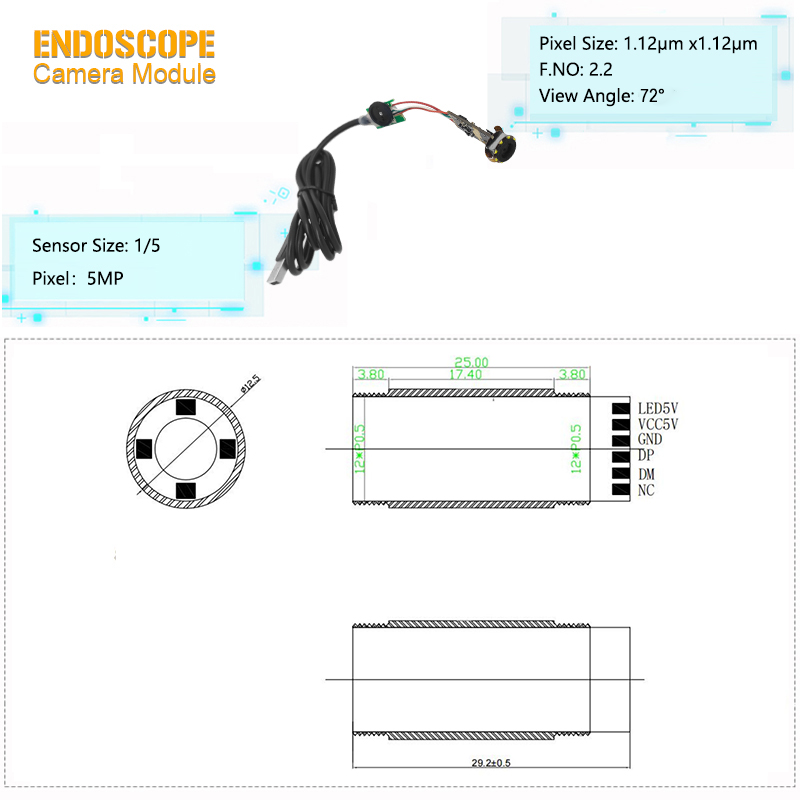
No, the module is equipped with 4 integrated white SMD LEDs (6000-6500K color temperature) that provide uniform fill lighting, ensuring clear imaging in dark or enclosed environments without additional lighting equipment.
3.Which operating systems are compatible with this camera module?
The module supports Windows XP and Windows 7 via USB 2.0 plug-and-play interface, and no additional driver installation is required for standard operation.
This 7mm Diameter 5MP 1080P 6PCS LED Endoscope Camera Module features a GC5035 sensor at its core. Its 5 million effective pixels provide ample sampling for microscopic details. Paired with an 82° diagonal field of view lens, it expands the single-shot imaging range while balancing edge distortion and light transmission efficiency. To address insufficient illumination caused by cavities or obstructions, the module integrates a ring of 6 white LEDs for ambient lighting. This eliminates reliance on external light sources, transforming the imaging system into a self-contained visual unit. The optical design sets the depth of field at 30-80mm, aligning with common working distances between endoscopes and inspected surfaces. This allows target features to remain in focus without frequent adjustments, enhancing imaging usability under dynamic or non-ideal distance conditions. Mechanically, the lens diameter is strictly controlled at Φ7.0±0.1mm for compatibility with standard endoscope channels. Precision layout of sensors, lenses, LEDs, and circuitry within limited space, coupled with effective thermal management, demands rigorous design and manufacturing expertise. The power supply design prioritizes adaptability: LEDs operate at 3.3V low voltage, while core circuits support wide voltage input. This facilitates integration with host device power sources, simplifying system design complexity. This module is specifically engineered for visualization inspections in enclosed, narrow, low-illumination spaces: while in medical assistance scenarios, it provides visual information for body surfaces and shallow cavities. Its value lies in encapsulating high-definition imaging capabilities within a miniature front-end, serving as a plug-and-play visual terminal integrating optics, illumination, and a compact structure. The core objective is to capture clear visual data suitable for analysis within the constraints of confined spaces. | ![]() |
1. Active lighting, usable in low light: Built-in 6 LED ring lights solve insufficient lighting in enclosed/obstructed environments, enabling clear imaging in darkness/low light without relying on external light sources.
2. Depth-of-Field Adaptation for Efficient Operation: 30-80mm depth-of-field matches common working distances in endoscopic inspection. Targets automatically focus within standard ranges, reducing frequent refocusing and enhancing imaging stability in dynamic scenes.
3. Compact Packaging for Versatility: Lens diameter of only Φ7.0±0.1mm, compatible with standard endoscopic channels; Integrates sensors, lenses, and illumination components within a compact space, delivering full imaging functionality in a small form factor.
4. Flexible Power Supply, Easy Integration: Separate power supplies for illumination and imaging circuits: LEDs operate at 3.3V low voltage, while core circuits support wide voltage ranges. This enables flexible connection to various host device power sources, simplifying system integration complexity.
Product Name | Mini Endoscope Camera Module |
Features | Multi Camera Module |
Pixel | 5MP |
Sensor | GC5035 |
Diameter | 7mm |
Interface | USB |
Focusing Range | 30-80mm |
Trademark | SINCERE FIRST |
Fov(D) | 82° |
Focus | Auto Focus |
Gynecological Examination
Colposcopes
Product Packaging
Endoscope Camera Module
USB Cable
User Manual Shipping
Ships within 1-2 business days
Free shipping within the US
International shipping available for an additional fee
Tracking number provided
1. Industrial Non-Destructive Testing: Specially designed for assessing pipeline inner wall corrosion, inspecting weld quality, and examining internal wear in mechanical equipment. Its miniaturized design and integrated lighting meet visualization requirements for confined, elongated spaces.
2. Medical Auxiliary Imaging: Compatible with endoscopic instruments for observing surface lesions, examining superficial cavities, and assisting in dental/ENT diagnostics. Its compact structure and controllable illumination meet medical environments' requirements for operational stability.
3. Precision Equipment Monitoring: Used for electronic component structural inspection, precision instrument assembly verification, and aerospace component defect detection. High-definition resolution and specific depth of field ensure clear imaging of microscopic structures.
4. Scientific Research and Environmental Observation: Serves material microstructure analysis, in-situ observation of biological specimens, and internal structure investigation of cultural relics. Its environmental adaptability and customizable features support visualization research in specialized scenarios.
FAQ
1.What is the effective working distance of the camera module?
The module supports auto focus from 5cm to infinity, making it suitable for a wide range of inspection distances, from close-up internal examinations to mid-range visual monitoring.
2.Does the module require external lighting in low-light environments?
No, the module is equipped with 4 integrated white SMD LEDs (6000-6500K color temperature) that provide uniform fill lighting, ensuring clear imaging in dark or enclosed environments without additional lighting equipment.
3.Which operating systems are compatible with this camera module?
The module supports Windows XP and Windows 7 via USB 2.0 plug-and-play interface, and no additional driver installation is required for standard operation.