In industrial on-site maintenance, automotive diagnostics, and laboratory auxiliary detection, imaging system selection often faces a practical dilemma: operators need quick deployment and intuitive observation, but are unwilling to spend time installing drivers, debugging software, or configuring c
IntroductionEver used an endoscope where bright areas turned completely white and dark areas were pitch black? That’s a dynamic range problem. Dynamic range is the camera’s ability to capture detail in both the brightest and darkest parts of a scene at the same time. It’s a key image quality spec, y
In the fields of minimally invasive medical procedures, precision industrial inspection, and micro-instrument development, the probe diameter is often the first threshold determining inspection feasibility. When the inner diameter of the target channel falls below 2mm, traditional endoscope modules
IntroductionWhen you look through an endoscope—for a medical procedure, industrial inspection, or plumbing check—the smoothness of the video matters. A choppy, laggy image makes it hard to see what you’re doing. That’s where frames per second (FPS) comes in. FPS measures how many images the camera c
Learn how frame rate affects endoscope video quality in an Endoscope Camera Module, UVC endoscope camera module, USB endoscope camera, or TV Endoscope Camera Module. Explore how fps influences smoothness, motion handling, bandwidth, and live inspection performance.
Learn the latest technologies in endoscope cameras, including miniaturized Endoscope Camera Module design, HD and 4K imaging, AI-assisted visualization, and advanced optics from today’s Endoscope Camera Module Manufacturer and Endoscope Camera Module Brand landscape.
Learn what a 4K endoscope camera module is and how it differs from standard HD endoscope systems. Explore Endoscope Camera Module design, image detail, optics, lighting, and OEM selection for a 4k endoscope camera project.
IntroductionEver used an endoscope to look inside a pipe or a body cavity, only to find bright spots completely white and dark areas pitch black? That’s a dynamic range problem. High Dynamic Range (HDR) solves it. HDR lets an endoscope camera capture detail in both the brightest and darkest parts of
IntroductionWhen shopping for an endoscope camera—for medical diagnostics, industrial inspection, or DIY projects—you’ll see two terms: HD and Full HD. But what’s the actual difference? Is Full HD always better? The answer depends on your application, lighting, and budget. At Sincere, we’ve been man
IntroductionWhen selecting an endoscope camera—for medical procedures, industrial inspection, or plumbing diagnostics—one of the first questions is: what resolution do I need? Higher resolution sounds better, but it comes with trade-offs in cost, low-light performance, and physical size. The “best”
IntroductionIn industrial pipeline inspection, precision electronics repair, automotive diagnostics, and medical observation, selecting the right imaging system involves balancing multiple engineering constraints: extremely narrow channels, short working distances, and limited lighting, while requir
IntroductionIn industrial inspection, equipment maintenance, and medical support, visual inspection tools are evolving along two clear trajectories: continuous miniaturization of the probe diameter and wireless connectivity. When 4.5mm-class miniature imaging modules are combined with WiFi technolog
Learn what affects endoscope image quality, including sensor performance, lens design, lighting, working distance, and image processing. Explore how to choose the right Endoscope Camera Module or HD Endoscope Camera Module from a reliable Endoscope Camera Module Manufacturer.
Industry Overview: The Growing Need for Miniaturized ImagingIn industrial manufacturing, automotive maintenance, precision electronics repair, and medical research, inspection targets are becoming increasingly confined, while the demand for accurate detection continues to rise. Microchannels in pipe
Endoscope camera modules have become essential components across a wide range of industries. Whether used for medical diagnostics, industrial inspections, or specialized research applications, these miniature imaging devices allow users to see inside spaces that would otherwise remain inaccessible.
Learn what affects the typical lifespan of an Endoscope Camera Module. Explore how handling, cleaning, storage, heat, and application conditions influence the service life of an Endoscope Camera or Endoscope Module in OEM projects.
Learn what a forward-view endoscope camera module is, how it works, and how it compares with a Side-View endoscope camera module. Explore OEM endoscope camera solutions for inspection, maintenance, and hard-to-reach internal viewing applications.
Endoscope camera modules are among the most widely used optical imaging components in both medical and industrial fields. Whether you are designing a diagnostic device, inspecting machinery, or developing a new surgical tool, understanding how these modules work and what options are available is ess
1. Introduction: When Detection Channels Shrink to Millimeter ScaleIn fields such as precision electronics repair, automotive diagnostics, and medical experimental observation, one growing challenge is the ever-shrinking physical scale of the objects being inspected, alongside rising demands for det
Learn what a flexible endoscope camera module is and how it is used in inspection tools and OEM devices. Explore flexible inspection camera design, flexible endoscope camera applications, and flexible IP67 endoscope camera solutions for hard-to-reach visual inspection.
| Availability: | |
|---|---|
| Quantity: | |
SF-C3010TV-D4.0
SINCEREFIRST
| This VGA CMOS CVBS Analog Output 4.0mm Diameter Endoscope Camera Module,is a practical, easy-to-deploy imaging solution tailored for close-range narrow space detection, compliant with RoHS standards. Designed to solve the core pain points of complex deployment, limited accessibility and unstable imaging in confined space detection, combines compact design with user-friendly features to adapt to diverse on-site application needs. Its 4.0mm ultra-micro probe diameter is engineered to access tiny spaces—such as ultra-thin pipelines, narrow gaps and small cavities—that conventional detection equipment cannot reach, ensuring that no hidden area is missed during inspection. Unlike digital modules that require additional processing units, this module adopts CVBS (AV/TV) analog signal output, enabling direct connection to common display devices for real-time observation, which greatly simplifies the system structure, reduces deployment time and lowers the risk of equipment failure, making it ideal for on-site personnel with limited technical experience. The optical system is thoughtfully optimized for daily endoscopic scenarios: a 1.08mm focal length, F2.8 aperture and 65° field of view work with a 30–80mm focusing range to deliver clear close-range imaging, while TV distortion controlled within -1.5% ensures true picture restoration, helping users make accurate judgments on defects or status. Equipped with a 4PIN PAD interface (GND, VOUT, LED+, VCC), it supports optional installation of 4 0402 white light LEDs to address low-light environment challenges, ensuring clear imaging even in dark narrow spaces. The image direction register comes with factory default settings, allowing immediate entry into standard working mode after power-on without complicated configuration. With its focus on practicality and ease of use, this module integrates micro size, plug-and-play analog output, low distortion and flexible supplementary light, becoming a reliable companion for on-site inspection, maintenance and experimental exploration in various fields. | ![]() |
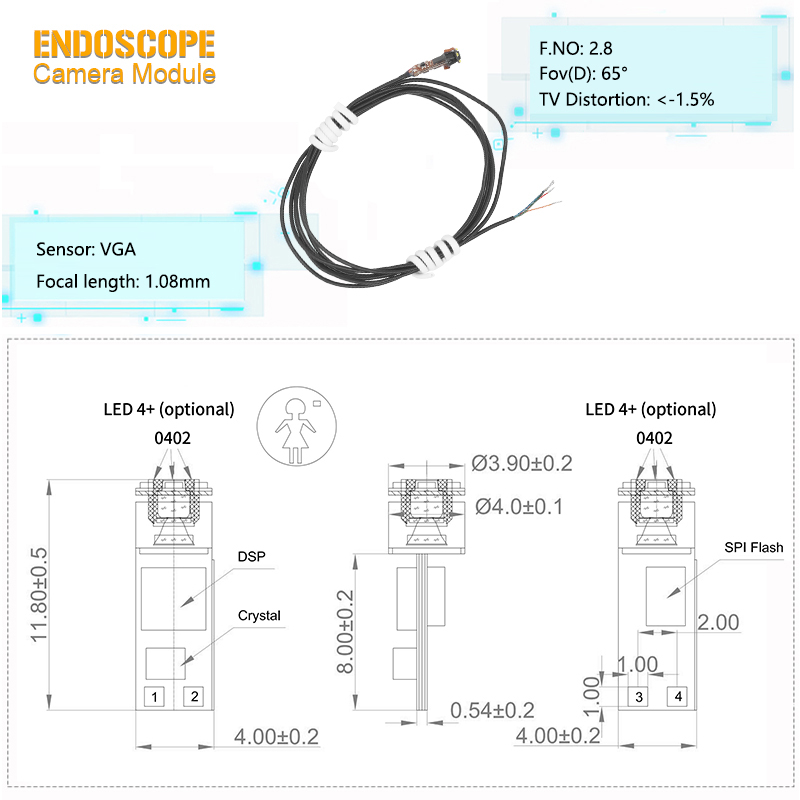
1.Ultra-Micro & Accessible Design:4.0mm probe diameter easily penetrates tiny spaces like ultra-thin pipes and narrow gaps, ensuring comprehensive detection without blind spots.
2.Plug-and-Play Analog Output:CVBS analog signal directly connects to display devices, no additional digital processing units needed, simplifying deployment and operation.
3.Scene-Optimized Close-Range Imaging:30–80mm focusing range and <-1.5% low distortion ensure clear, true imaging, perfectly matching daily endoscopic detection needs.
1.On-Site Industrial Thin Pipe Inspection:It can be used for on-site visual detection of small-caliber pipelines (above 4mm), checking inner wall status, defects and blockages; its 4.0mm probe and direct analog output allow quick deployment and real-time observation.
3.Precision Electronic Maintenance:It is used for close-range inspection of solder joints, cables and components inside smart devices; its close-focus optimization and clear imaging assist in rapid fault troubleshooting.
4.Laboratory & Medical Auxiliary Detection:It can be adapted to small cavities and experimental devices; its analog output facilitates real-time display and recording, meeting the needs of basic visual detection.
Product Name | 4mm Endoscope Camera Module |
Led | 4pcs |
Mounting Type | USB |
Sensor | VGA |
Focusing Range | 30-80mm |
Output Format | CVBS output |
Focal Length | 1.08mm |
Trademark | SINCERE FIRST |
F Number | 2.8 |
Fov(D) | 65° |
It uses a CMOS VGA sensor with a resolution of 640x480 pixels, delivering standard high-definition analog video output.
Optional 4 LED lamp beads for fill light.
SMT and AA processes achieve precise optical alignment, ensuring consistent and clear images for each module, minimizing deviation risks.
4.What is the practical significance of distortion < -1.5% in endoscopic inspection?
A low-distortion design ensures the accurate reproduction of the target’s shape and dimensions, thereby improving the accuracy of inspection data and preventing misjudgments caused by image distortion.
