


| Quantity: | |
|---|---|


SF-SJYL7-FT+SF-SJN73310
SINCEREFIRST
This is a OV9734 3.3mm Separated USB Endoscope Camera Module with 102° Wide Angle for OEM devices that need the imaging section and USB processing section arranged apart from each other. Its 102° field of view and six 0201 LEDs support compact close-range inspection while the separated signal architecture gives the device designer more freedom in board placement. The current product configuration uses a Type-C/MIPI connection between the imaging section and processing board, with USB 5Pin output on the host side. Difference: This model is selected primarily for its separated 3.3mm integration architecture, especially when front-end space is limited but the processing board can be positioned elsewhere in the device. | 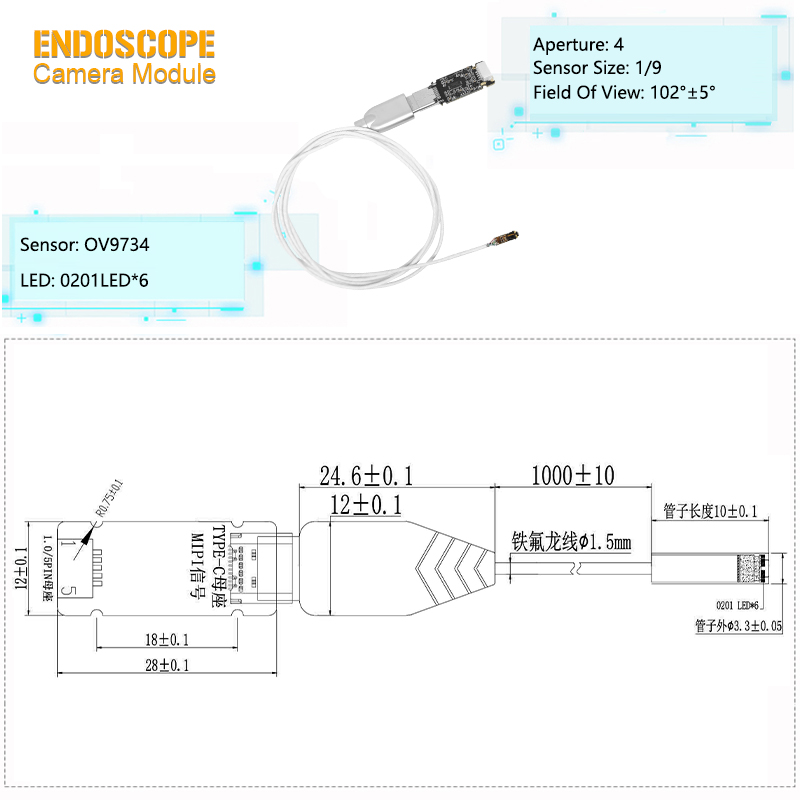 |
Selection Requirement | Standard Configuration | Selection Note |
Front-end space | 3.3mm module direction | Use this model when the imaging section must remain compact and the processing board can be placed separately. |
Board placement | Separated architecture | Confirm the available location for the processing board and the route between front-end imaging and host output. |
Viewing coverage | 102° ±5° | Confirm that the wide close-range coverage matches the target size. |
Lighting | 6 × 0201 LEDs | Confirm whether the target surface and working distance suit the standard front lighting. |
Host connection | USB 5Pin output | Confirm pin definition, host USB architecture and application software during sample integration. |
1. 3.3mm Separated Structure — keeps the imaging section compact while allowing the processing board to be placed elsewhere in the device.
2. 102° Field of View — provides wide close-range coverage for internal observation.
3. Six 0201 LEDs — provide integrated illumination around the compact imaging section.
4. OV9734 Sensor Platform — offers a familiar 1MP-class imaging direction for USB endoscope integration.
5. USB 5Pin Host Output — supports connection to the host-side USB architecture after the separated processing stage.
The separated architecture is useful when the optical section must fit into a compact front end but the device has more room farther back for processing electronics. The engineering focus is therefore cable routing, board placement and connector definition—not only the camera diameter. If the device can accommodate a complete integrated camera section at the front, an integrated model may simplify assembly.
Portable Medical Detection Equipment: In simple ENT detection at primary care clinics, the stable connection between the Type-C interface and the DSP board ensures real-time imaging. The USB 5Pin interface can be directly connected to a laptop, and detection can be quickly initiated via the UVC protocol without complex configurations.
Industrial Portable Inspection Equipment: When inspecting the interior of small pipelines or precision instruments, the separated design, paired with the wear-resistant plugging performance of the Type-C interface, facilitates frequent lens disassembly and assembly by operators. The USB 5Pin interface can be directly connected to handheld inspection terminals, and the stable transmission of USB 2.0 ensures non-stuttering 30FPS imaging.
Consumer-Grade Repair Tools: When repairing small electronic devices such as mobile phones and earphones, the 3.3mm lens can penetrate deep into the interior of the device. The Type-C interface’s connection to the DSP board ensures clear transmission of details, and the USB 5Pin interface can be plugged into a computer to view images via general-purpose software, lowering the operational threshold for repair personnel.
Educational Demonstration Equipment: In medical or industrial training, the module can be connected to display devices such as projectors via the USB 5Pin interface. Relying on the UVC protocol, it enables synchronous display across multiple terminals, while the low-latency transmission between the Type-C interface and the DSP board ensures that the demonstration images are synchronized with the operation in real time.
Product Name | 720P 30FPS Endoscope Camera Module |
Image Sensor | OV974 CMOS Sensor |
Pixel | 1MP |
Diameter | 3.3mm |
View Angle | 102° |
F NO | 4.0 |
Product Type | Separated Endoscope Camera Module |
Led | 6pcs 0201 Led |
Interface | USB 5Pin |
Feature | CMOS sensor Endoscope Camera Module |
1. Board and cable layout: If the standard separated arrangement does not match the device, board position, interconnect route and cable length can be evaluated. Please provide the enclosure drawing and host-board position.
2. Front-end diameter: If the 3.3mm imaging section does not fit the available opening, the mechanical limit should be reviewed before other changes. Please provide the actual access diameter and insertion depth.
3. FOV and working area: If 102° coverage is too wide or too narrow, the optical requirement can be evaluated. Please provide target size and working distance.
4. Lighting and host output: If six 0201 LEDs or the USB 5Pin output does not suit the device, lighting and connector/pin requirements can be reviewed. Please provide brightness needs, pin definition and power constraints.
Final configuration should be confirmed through engineering review and sample verification before mass production.
Type-C transmits MIPI signals to the DSP board (high-speed, low-latency for 30FPS raw images); USB 5Pin outputs via USB 2.0 (supports UVC). This avoids signal interference & enables plug-and-play with computers/inspection tools.
Q2: Is 720 resolution + 30FPS enough for medical/industrial use?
Yes. OmniVision OV9734 sensor (1MP, 1.75μm pixel) + F4.0 aperture captures clear details (ENT lesions, chip pin defects); 30FPS ensures lag-free real-time viewing.
Q3: Benefit of manual focus? Easy to use?
Fits diverse depths (0.1mm chip close-ups, 102° wide shots). Adjust the lens focus ring slightly — no complex calibration.
Q4: Why Separated design? Affects portability?
Q5: Which systems is the module compatible with, and is it easy to connect?
It supports the UVC Protocol, enabling plug-and-play functionality with mainstream systems (Windows, Linux, Android, MacOS) without extra drivers. The Separated design also allows flexible arrangement of the lens and control board to fit installation spaces.
CTA
Please provide the front-end diameter limit, insertion depth, board placement, cable route, target size, working distance, lighting condition and USB pin requirements. We can then review the standard separated architecture for your device.


