


| Quantity: | |
|---|---|


SF-EU1200PD7A15
SINCEREFIRST
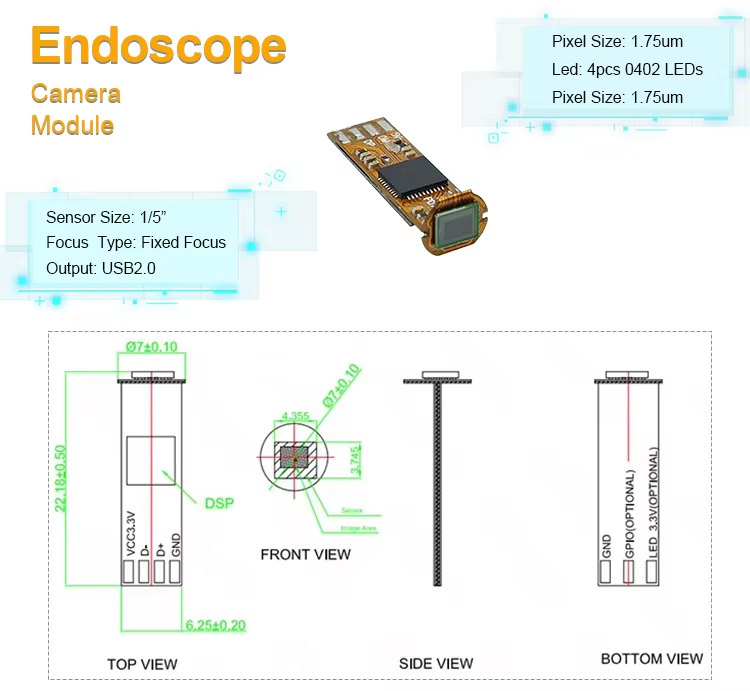
This is a 2MP USB Endoscope Camera Module with 4 LEDs for Dark-Cavity Inspection ,When your inspection device needs to observe a dark internal surface and the target is mainly static or moving slowly, image detail and local illumination can matter more than high frame rate. The SF-EU1200PD7A15 combines 2MP 1600×1200 YUV output, a 1/5-inch CMOS sensor with 1.75 μm pixels, four 0402 LEDs, fixed focus, and USB2.0 connectivity for close-range inspection-device evaluation. Its maximum 5 fps output should be treated as a selection condition rather than described as smooth video. This model is better suited to image capture, slow probe movement, and static observation than to fast-moving targets or real-time navigation. Difference: Choose this model when 2MP image detail and front LED illumination are more important than high-frame-rate video. |
 |
Product Advantage ◢
1. 2MP 1600×1200 Output: Provides more image detail for static surfaces, component gaps, and close-range image capture than a basic 720P output.
2. Maximum 5 fps: Fits slow-moving or static observation, but should not be selected for fast motion or smooth navigation video.
3. Four 0402 LEDs: Adds local illumination when the camera head enters an enclosed area where external light cannot reach.
4. 1.75 μm Pixel Size: Provides a confirmed imaging specification for sensor evaluation without making unsupported low-light performance claims.
5. USB2.0 Interface: Supports host-side image testing with a widely used physical interface; final protocol and software compatibility should be confirmed.
6. Fixed Focus: Reduces focus-control requirements, but the expected viewing distance must match the final optical setup.
Technical Parameters ◢
Product Name |
Camera Module Endoscope |
Features |
endoscope camera module |
Pixel Size |
1.75um |
Sensor |
1'5" 2MP |
Image Sensor |
CMOS |
Certification |
1.08mm |
LED |
3.3V |
Trademark |
SINCERE FIRST |
Interface |
USB2.0 |
Frame rate |
YUV1600*1200@Max 5fps |
Typcial Application◢
1. Static Internal Surface Inspection: The 2MP output supports detailed image capture when the target remains mostly stationary.
2. Equipment Cavity Maintenance: Four front LEDs help illuminate enclosed areas during slow probe movement and maintenance checks.
3. Electronic Assembly Gap Observation: The compact camera-module structure can be evaluated for observing component gaps and internal board areas.
4. Medical Endoscope Device Imaging Evaluation: The module can be evaluated as an imaging component during device development; final compliance and finished-device requirements must be verified separately.
FAQ ◢
1: What is a endoscope camera module?
The Endoscope camera module is a very compact and miniature imaging device designed primarily for visual inspection of internal structures in medical, industrial and research applications. It usually consists of a camera lens, light source, and a flexible or rigid tube that can be easily navigated into narrow Spaces. In medical Settings, it is used to visualize organs such as the stomach, intestine or respiratory tract, vagina. Help with diagnosis and minimally invasive surgery. The camera can capture high-resolution images and videos that can be displayed in real time on an external monitor. Some modules come with additional features such as video recording, photo-taking capabilities, and micro-scissors to enhance the capabilities of real-time intervention. In industrial applications, endoscopic camera modules are used to inspect machinery, pipes and other inaccessible, unseen areas, helping to identify problems such as leaks or deterioration, and rust.
2: Are you factory or trade company?
We are an original equipment manufacturer (OEM) specializing in smart camera modules, operating our own production facility that includes ten dust-free and sterile workshops. Adhering to internationally recognized quality standards, we execute our production processes with efficiency. Our dedicated team follows standardized protocols to guarantee a high level of consistency and dependability in manufacturing.Each member of our workforce has completed comprehensive professional training and adheres to rigorous operational guidelines. Additionally, they don specially designed dust-free garments to maintain a clean and sterile production environment. This meticulous approach ensures that we deliver top-quality products while safeguarding both the integrity of our camera modules and the health of our workspaces.
3: How to control an endoscope camera module?
The control endoscope camera module usually connects the camera module to a computer, tablet, or smartphone using a communication interface such as USB, HDMI, or Wi-Fi. Install dedicated software or apps compatible with the camera to easily manage Settings such as zoom, focus, and resolution. Easily adjust camera parameters such as brightness, contrast, and recording options through the software's graphical user interface (GUI). Monitor live video streams and adjust as necessary.The control endoscope camera module usually connects the camera module to a computer, tablet, or smartphone using a communication interface such as USB, HDMI, or Wi-Fi. Install dedicated software or apps compatible with the camera to easily manage Settings such as zoom, focus, and resolution. Easily adjust camera parameters such as brightness, contrast, and recording options through the software's graphical user interface (GUI). Monitor live video streams and adjust as necessary.
4: What does an endoscope camera module see?
An endoscopic camera module exam uses an endoscope inserted into the body to take pictures or videos of organs and other structures. Healthcare providers use them to screen, diagnose, and treat disease. There are many types of endoscopic camera module exams that can view different organs.
5: What can be customized for endoscope camera modules?
The endoscope camera module can be selected as integrated or separated, and the diameter size, and whether it comes with a steel sleeve and LED light can also be customized.
6. Is the maximum 5 fps output suitable for live inspection?
It can support image preview for static or slowly changing targets, but it is not the preferred choice for fast-moving objects or smooth real-time navigation. For those projects, evaluate a 30 fps or 60 fps model.
7. What working distance should be used with the fixed-focus lens?
The current page does not provide a confirmed focus range. Please share the expected camera-to-target distance so the lens setup can be checked before sample evaluation.
8. Are LED brightness adjustment and independent LED control supported?
The current product information confirms four 0402 LEDs, but it does not clearly confirm dimming, independent control, or whether every sample includes the same LED configuration. These items should be confirmed with the final project specification.
9. Can this module be used in medical endoscope device projects?
It can be evaluated as an imaging component for medical endoscope device development. The current page does not establish medical-grade, clinical, diagnostic, sterilization, or finished-device certification claims.


