Technical Logic and Application Guide for Selecting the OVM6946 Ultra-Compact Waterproof Endoscope ModuleIn visualization applications across industrial inspection, precision manufacturing, and medical assistance, imaging system selection often faces a set of extreme constraints: observation channel
Technical Logic and Application Guide for Selecting 0.3MP Micro Endoscope Modules In visualization applications across industrial inspection, precision manufacturing, and medical assistance, imaging system selection often faces unique physical constraints: observation channel diameters measured in m
In-Depth Analysis of Sony's IMX811 Monochrome/Color Sensor: A New Era of Ultra-High-Definition ImagingWhat can you see in a 247-megapixel photo? A speck of dust on a precision circuit, or a distant galaxy in the vast cosmos. In the realm of image sensing technology, Sony Semiconductor Solutions Corp
Sibling Rivalry: A Deep Dive into BYD's BF20A6 vs. BF2013 Image SensorsIn the realm of miniature CMOS image sensors, BYD Semiconductor has carved out a significant niche with its advanced CIS technology and highly integrated ISP designs. Its BF series sensors are widely used in medical endoscopy, in
In the portfolio planning of image sensors, external observers are often perplexed by the release of models with highly similar specifications. Taking OmniVision's OH0FA10 and OH0TA10 as examples, both employ a 1.008µm pixel size, PureCel®Plus-S stacked die technology, analog output interfaces, and
Olympus officially released the research results of the EAGLE Trial, which validated the core value of its CADDIE™ cloud-based computer-aided detection (CADe) solution in the clinical detection of colorectal lesions. The real-time and efficient analytical capability of this AI solution is underpinne
Within an endoscope camera module, LED dimming strategy influences not only luminous intensity but also exposure stability, thermal behavior, and overall imaging fidelity. The distinction between hardware dimming and software dimming should therefore be interpreted as a structural differentiation in
In minimally invasive diagnostics and industrial non-destructive testing domains, the optical performance of endoscopic camera modules is directly constrained by illumination subsystem design precision. Given the highly heterogeneous optical characteristics of inspected cavities (ranging from highly
Sony Industrial Sensor Matrix Analysis: From IMX927 to IMX949, How to Match Precision Vision for Machine VisionIn the field of industrial machine vision, there is no one-size-fits-all sensor—only the most suitable solution. Sony's newly launched IMX927 series comprises 16 models, covering a wide ran
Comparative Analysis of Technical Principles Between Motorized and Manual ZoomDuring the selection process for optical imaging systems, technical differences in zoom mechanisms often rank among customers' primary concerns. A frequently asked question recently has been: What defines motorized zoom, a
The Evolutionary Logic of Airway Visualization Technology and the Industrial Value of Ultra-Thin Imaging ModulesThe history of medical endoscopy technology is fundamentally the evolutionary history of humanity's ability to explore the “dark spaces” within the body. Within this process, the evolution
The Mystery of Dynamic Vision: Decoding the Technology Behind High-Frame-Rate, Low-Distortion Imaging ModulesThroughout the evolution of imaging technology, humanity has pursued two seemingly simple yet profoundly challenging goals: seeing clearly, without missing any detail; and keeping up, without
Technical Explanation on the Correspondence Between Endoscope Steel Shell Structure and IP67 Protection RatingDuring technical discussions with customers, a frequently raised question is whether endoscopes equipped with standard steel shells inherently possess an IP67 waterproof rating. While seemin
Technical Logic and Clinical Adaptation Framework for Selecting Visualization Modules in Airway ManagementIn the field of minimally invasive airway management, selecting visualization modules fundamentally involves a systematic balancing act among three factors: clinical requirements, physical const
Why is the SF-C1011USB-D3.9 HD Endoscope Module the Top Choice for Micro Imaging? 1. What is this product?The SF-C1011USB-D3.9 is a high-definition endoscope camera module specifically designed for detailed observation at medium to close distances. Featuring a 1/11-inch 720P sensor paired with a 1.2
关键词:Autofocus camera mdoule,CMOS camera module,high-definition camera mosdule, USB camera module How to Select Core Imaging Modules for High-Precision Endoscopy Systems — A Selection Guide for 12MP Autofocus Modules In the development and selection of high-precision endoscopy systems, the performanc
Side-View 0.9mm Ultra-Thin Bore Endoscope Imaging Module Selection Recommendations In precision industrial inspection and minimally invasive observation applications, visual system selection decisions often begin with defining the physical aperture limits. When the observation channel diameter falls
Technical Trade-offs and Application Adaptation Analysis for Selecting 0.9mm Ultra-Compact Visual Probe Modules In industrial inspection, equipment maintenance, and scientific observation, selecting visual systems often faces a fundamental contradiction: the conflict between observation invasiveness
Recommendations for Selecting 1080P Endoscope Camera Modules and Technical Compatibility Analysis
720P Separate Mini Endoscope Camera Modules Technology Evolution and Market Strategy Positioning Against the backdrop of continuous miniaturization and integration in industrial inspection and medical auxiliary equipment, the core of embedded vision systems—micro camera modules—reveals the demand or
| Availability: | |
|---|---|
| Quantity: | |
SF-C16USB-D2.0
SINCEREFIRST
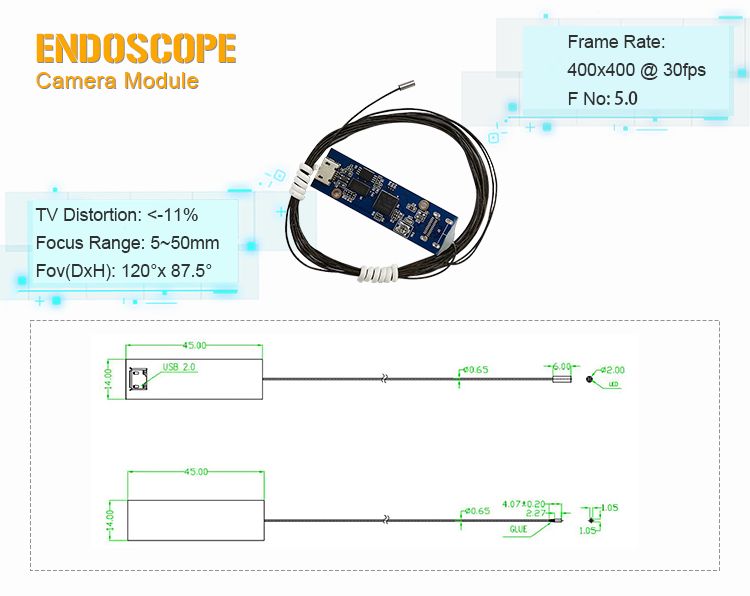
This Ultra Small Wide Angle Waterproof OVM6946 CMOS Sensor USB2.0 Interface Endoscope Camera Module, is specifically designed for endoscopic inspection in confined spaces. It features a 1/18-inch OVM6946 sensor with a USB 2.0 interface, optional 4 high-brightness white LEDs, and a steel sheel with waterproof capabilities. With a depth of field ranging from 5mm to 50mm, it excels at capturing images in close-range micro-spaces. It finds extensive applications in scenarios requiring ultra-compact, close-range inspection, such as: - Industrial micro-pipeline inspection - Endoscopic maintenance inside precision instrument cavities - Medical micro-cavity observation - Automotive micro-component endoscopic inspection - Home appliance micro-internal pipeline maintenance . | ![]() |
Product Advantage ◢
1.Close-Range Imaging: Designed specifically for close-proximity endoscopic applications with a depth of field of 5mm to 50mm. The integrated 120° ultra-wide-angle lens allows a single module to cover the inspection field of view within micro-spaces effectively.
2.Clear Imaging in Low-Light Conditions: Equipped with 4 high-brightness white LEDs. In environments with no ambient light (0 lux), activating the LEDs enables clear image capture.
3.Plug-and-Play Functionality: Utilizes a standard USB 2.0 interface, ensuring plug-and-play operation without complex driver adaptation across various host devices.
4.Wide Temperature Stability: Operates reliably within an ambient temperature range of -20°C to 70°C, with stable image quality maintained between 0°C and 50°C. This makes it adaptable to demanding industrial environments, outdoor inspections, and other scenarios with temperature variations.
1.Industrial Micro-Pipe Inspection: Suitable for inspecting the internal condition of ultra-small-diameter pipes such as thin water pipes, air lines, and oil tubes. It can penetrate micro-spaces inaccessible to conventional inspection equipment.
2.Precision Instrument & Electronic Component Inspection: Enables internal cavity examination of micro-mechanical parts, electronic chips, and precision instruments to identify internal faults or wear issues.
3.Automotive Component Inspection: Facilitates internal viewing of small engine passages, precision fittings, and confined cavities within vehicles, allowing assessment without component disassembly.
4.Basic Medical / Laboratory Micro-Cavity Observation: Applicable for non-invasive observation of small cavities and detailed viewing of miniature laboratory components and specimens.
Technical Parameters ◢
Product Name | wide range Endoscope Camera Module |
Image Sensor | OVM6946 |
Image Device | 1/18" |
F No. | F5.0 |
Fov(DxH) | 120°x 87.5° |
TV Distortion | <-11% @ 0.95Field |
Output Interface | USB2.0 |
Theory | Cmos Imaging |
Focus Range | 5mm~50mm |
Format | YUV&MJPG |
FAQ ◢
1. What should I do if the module fails after high temperature sterilization?
Check whether the tolerance temperature is exceeded (for example, some are only 120°C), turn off the power and remove the battery before sterilization, damage may involve sealant failure or circuit board deformation.
2. Why do some modules differ several times in price?
The difference is due to sensor brands (such as SONY IMX series vs domestic), optical lens groups (aspherical lenses cost more), medical certification (such as FDA process takes 2-3 years) and other factors.
3. What does an endoscope camera module see?
A4: The endoscopic camera module captures detailed images and video of narrow internal structures and is typically used in medical, industrial or research Settings. In medical use, it is inserted into the body through slender tubes, capable of capturing high-definition images in small or hard-to-reach areas. The lens of an endoscope is usually equipped with a light source to provide a clear view in a dark environment. The device can record and transmit images in real time to help doctors look at organs, tissues and other internal structures to identify lesions, inflammation or other health problems. It can help visualize the stomach, intestines, bronchus, ear canal, nasal cavity, esophagus, bladder, prostate, vagina and other organs, allowing diagnosis and monitoring of conditions such as tumors, infections or blockages. The abnormalities of tissues and blood vessels can be seen in real time. In industrial Settings, it can inspect areas of machinery, plumbing or infrastructure that are difficult to see directly with the naked eye, highlighting wear, corrosion or blockage.
4. Regarding imaging clarity: Can it focus at an ultra-close distance of 5mm? Can it clearly show minute scratches?
The module's depth of field ranges from 5–50mm, with a minimum working distance of 5mm. At this distance, it clearly reveals surface textures of inspected objects. Combined with a 120° ultra-wide field of view, a single image captures a circular area approximately 10mm in diameter (at 5mm working distance), sufficient for clearly identifying minute details such as scratches, burrs, and foreign particles. The image sensor size is 1/18 inch, with pixel dimensions and resolution optimized for macro imaging scenarios.
5. Regarding Interface Compatibility: Does the USB 2.0 interface support mobile phones or embedded platforms?
The module employs a standard USB 2.0 interface supporting the UVC protocol, enabling plug-and-play functionality on mainstream operating systems including Windows, Linux, and Android. Connecting to a mobile phone requires an OTG adapter cable and confirmation that the phone supports external UVC devices. Connecting to embedded platforms (e.g., Raspberry Pi, Jetson Nano) enables direct recognition without additional drivers. Pin definitions are standardized as VBUS, D+, D-, and GND, supporting integrated 5V power supply and data transmission for seamless integration into various terminal devices.
This Ultra Small Wide Angle Waterproof OVM6946 CMOS Sensor USB2.0 Interface Endoscope Camera Module, is specifically designed for endoscopic inspection in confined spaces. It features a 1/18-inch OVM6946 sensor with a USB 2.0 interface, optional 4 high-brightness white LEDs, and a steel sheel with waterproof capabilities. With a depth of field ranging from 5mm to 50mm, it excels at capturing images in close-range micro-spaces. It finds extensive applications in scenarios requiring ultra-compact, close-range inspection, such as: - Industrial micro-pipeline inspection - Endoscopic maintenance inside precision instrument cavities - Medical micro-cavity observation - Automotive micro-component endoscopic inspection - Home appliance micro-internal pipeline maintenance . | ![]() |
Product Advantage ◢
1.Close-Range Imaging: Designed specifically for close-proximity endoscopic applications with a depth of field of 5mm to 50mm. The integrated 120° ultra-wide-angle lens allows a single module to cover the inspection field of view within micro-spaces effectively.
2.Clear Imaging in Low-Light Conditions: Equipped with 4 high-brightness white LEDs. In environments with no ambient light (0 lux), activating the LEDs enables clear image capture.
3.Plug-and-Play Functionality: Utilizes a standard USB 2.0 interface, ensuring plug-and-play operation without complex driver adaptation across various host devices.
4.Wide Temperature Stability: Operates reliably within an ambient temperature range of -20°C to 70°C, with stable image quality maintained between 0°C and 50°C. This makes it adaptable to demanding industrial environments, outdoor inspections, and other scenarios with temperature variations.
1.Industrial Micro-Pipe Inspection: Suitable for inspecting the internal condition of ultra-small-diameter pipes such as thin water pipes, air lines, and oil tubes. It can penetrate micro-spaces inaccessible to conventional inspection equipment.
2.Precision Instrument & Electronic Component Inspection: Enables internal cavity examination of micro-mechanical parts, electronic chips, and precision instruments to identify internal faults or wear issues.
3.Automotive Component Inspection: Facilitates internal viewing of small engine passages, precision fittings, and confined cavities within vehicles, allowing assessment without component disassembly.
4.Basic Medical / Laboratory Micro-Cavity Observation: Applicable for non-invasive observation of small cavities and detailed viewing of miniature laboratory components and specimens.
Technical Parameters ◢
Product Name | wide range Endoscope Camera Module |
Image Sensor | OVM6946 |
Image Device | 1/18" |
F No. | F5.0 |
Fov(DxH) | 120°x 87.5° |
TV Distortion | <-11% @ 0.95Field |
Output Interface | USB2.0 |
Theory | Cmos Imaging |
Focus Range | 5mm~50mm |
Format | YUV&MJPG |
FAQ ◢
1. What should I do if the module fails after high temperature sterilization?
Check whether the tolerance temperature is exceeded (for example, some are only 120°C), turn off the power and remove the battery before sterilization, damage may involve sealant failure or circuit board deformation.
2. Why do some modules differ several times in price?
The difference is due to sensor brands (such as SONY IMX series vs domestic), optical lens groups (aspherical lenses cost more), medical certification (such as FDA process takes 2-3 years) and other factors.
3. What does an endoscope camera module see?
A4: The endoscopic camera module captures detailed images and video of narrow internal structures and is typically used in medical, industrial or research Settings. In medical use, it is inserted into the body through slender tubes, capable of capturing high-definition images in small or hard-to-reach areas. The lens of an endoscope is usually equipped with a light source to provide a clear view in a dark environment. The device can record and transmit images in real time to help doctors look at organs, tissues and other internal structures to identify lesions, inflammation or other health problems. It can help visualize the stomach, intestines, bronchus, ear canal, nasal cavity, esophagus, bladder, prostate, vagina and other organs, allowing diagnosis and monitoring of conditions such as tumors, infections or blockages. The abnormalities of tissues and blood vessels can be seen in real time. In industrial Settings, it can inspect areas of machinery, plumbing or infrastructure that are difficult to see directly with the naked eye, highlighting wear, corrosion or blockage.
4. Regarding imaging clarity: Can it focus at an ultra-close distance of 5mm? Can it clearly show minute scratches?
The module's depth of field ranges from 5–50mm, with a minimum working distance of 5mm. At this distance, it clearly reveals surface textures of inspected objects. Combined with a 120° ultra-wide field of view, a single image captures a circular area approximately 10mm in diameter (at 5mm working distance), sufficient for clearly identifying minute details such as scratches, burrs, and foreign particles. The image sensor size is 1/18 inch, with pixel dimensions and resolution optimized for macro imaging scenarios.
5. Regarding Interface Compatibility: Does the USB 2.0 interface support mobile phones or embedded platforms?
The module employs a standard USB 2.0 interface supporting the UVC protocol, enabling plug-and-play functionality on mainstream operating systems including Windows, Linux, and Android. Connecting to a mobile phone requires an OTG adapter cable and confirmation that the phone supports external UVC devices. Connecting to embedded platforms (e.g., Raspberry Pi, Jetson Nano) enables direct recognition without additional drivers. Pin definitions are standardized as VBUS, D+, D-, and GND, supporting integrated 5V power supply and data transmission for seamless integration into various terminal devices.