


| Quantity: | |
|---|---|


SF-N1070(with steel shell)
SINCEREFIRST
This 7mm 1080P Type-C Endoscope Camera Module with Manual Focus & 6-LED Illumination Engineered for high-precision medical and industrial visualization, this ultra-compact endoscope module integrates the GalaxyCore GC2755 CMOS sensor to deliver crisp 1920×1080@30FPS video output. Housed in a durable 7mm steel-shell lens barrel, the module is optimized for low-light environments, achieving clear imaging at illumination levels as low as 0.1 Lux. It features 6 high-brightness SMD LEDs for adjustable fill lighting and supports manual focus for precise depth-of-field control during critical inspections. The plug-and-play design leverages a USB Type-C interface with UVC compliance, ensuring seamless compatibility across Windows, Linux, and Android platforms without additional drivers. Manufactured using SMT and Active Alignment (AA) | 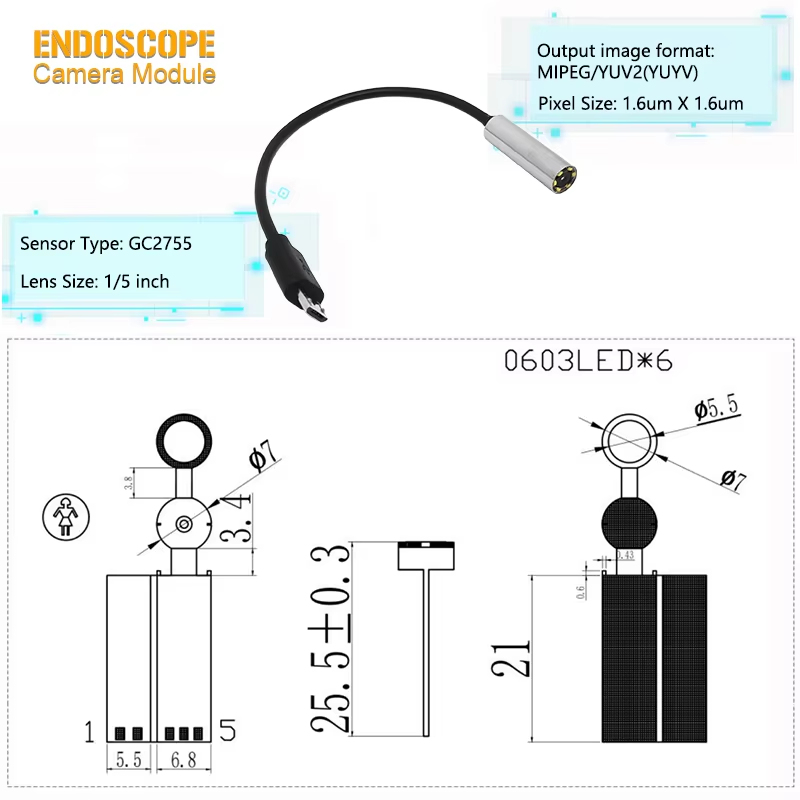 |
1. Superior Low-Light Sensitivity: Equipped with the GC2755 sensor and large 1.6μm pixels, delivering high Signal-to-Noise Ratio (SNR) performance in dark or unlit cavities.
2. Precision Manual Focus: Allows operators to fine-tune the focal plane, ensuring sharp image capture at varying working distances.
3. Ruggedized Miniature Design: The 7mm metal lens housing provides excellent durability and heat dissipation while maintaining a minimal footprint for tight spaces.
4. Universal Plug-and-Play: USB 2.0 Type-C interface with standard UVC protocol support; fully compatible with OTG-enabled devices for instant deployment.
5. High-Consistency Manufacturing: Built on automated SMT and AA assembly lines, ensuring precise optical centering and reliable mass production yields.
6. Integrated Illumination: Six 0603 high-brightness LEDs provide uniform, adjustable lighting to eliminate shadows during inspection.
1.Dental Diagnostics:Manual focus (±0.02mm) allows precise examination of subgingival caries, while 6-LED adaptive lighting eliminates oral cavity shadows. AA-processed optics prevent image distortion during root canal inspections.
2. Disaster rescue: detection of vital signs in debris crevices and remote assessment of dangerous goods leakage site
3. Intelligent hardware integration: robot automatic inspection (the following waterway cleaning robot vision module).
4. Aerospace Engine Maintenance: The SMT-encapsulated module resists vibration (up to 15G) and high temps (85°C), ideal for turbine blade crack detection in confined spaces (Φ≥7mm pipelines).
Product Name | Medical or Industrial Endoscope Camera Module |
Features | 2MP Camera Module |
Pixel | 1.6um*1.6um |
Sensor | GC2755 sensor |
Diameter | 7mm |
Interface | USB2.0 |
Output Image Format | MJPG/YUV2(YUYV) |
Model Number | SF-N1070(with steel shell) |
Lens Size | 1/5 inch |
Interface | 6PIN Soldering |
FAQ
1: Does this module support Auto Focus (AF)?
No, this specific model features a manual focus mechanism. This design is intentional for professional applications where operators need to lock focus at a specific depth or require a fixed focal plane for consistent measurements.2: Is this module suitable for in-vivo medical use?
Yes, the module is designed with biocompatible materials and has passed CE, FCC, and RoHS certifications. It is widely used in disposable endoscopic devices to ensure sterility and prevent cross-contamination.3: Can the brightness of the 6 LEDs be adjusted?
The standard version features constant-on LEDs. However, for applications requiring adjustable brightness, we offer customization options to integrate PWM (Pulse Width Modulation) dimming control upon request.4: Is the module capable of continuous long-duration operation?
Absolutely. It features a low-power consumption design and efficient thermal management. When paired with appropriate external heat dissipation, it can maintain stable performance for 8+ hours of continuous use, making it ideal for lengthy surgical procedures or production line inspections.5: What customization services (OEM/ODM) do you provide?
We offer comprehensive customization to meet specific project requirements, including:Adjusting cable length and material (e.g., TPU, stainless steel braided).
Modifying the number, color, or intensity of the LEDs.
Customizing PCB dimensions and component layout.
Tailoring the lens specifications (FOV, working distance).


