


| Quantity: | |
|---|---|


SF-N1070
SINCEREFIRST
Built around the GC2755 CMOS sensor, this 7mm endoscope camera module delivers 2MP 1080P imaging, low-light performance, and USB2.0 UVC connectivity for OEM medical visualization and precision inspection applications. The module adopts a 1/5-inch optical format with 1.6μm × 1.6μm pixel size, helping provide stable image quality and practical low-light sensitivity for confined-space imaging. With a DFOV of 80° and a fixed focus range of 25–40mm, we optimize this module for macro observation scenarios where detail clarity, color stability, and close-range imaging performance are important. For system integration, the module uses a USB2.0 high-speed 6-pin soldering interface and supports the UVC protocol, enabling convenient plug-and-play evaluation on compatible host systems without complex driver installation. It supports MJPEG and YUYV (YUY2) output formats, with MJPEG 1080P at 20–30fps for smooth real-time preview in practical applications. To improve reliability in demanding environments, we use a steel shell structure and support IP67 waterproof protection. This makes the module suitable for narrow-space imaging tasks where mechanical durability and environmental resistance are important. We position this product as a practical OEM imaging component for customers who require compact size, stable HD output, and flexible project integration. | 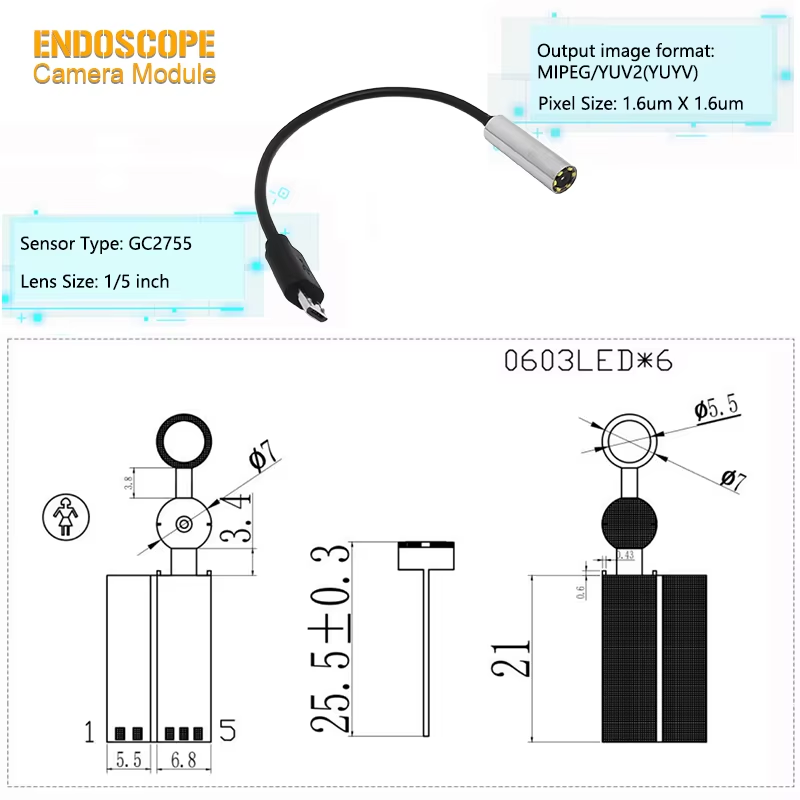 |
We use the GC2755 CMOS sensor to deliver stable 1920 × 1080 image output for close-range visual inspection and compact endoscopic imaging applications.
The 1/5-inch optical format and 1.6μm pixel size help improve imaging performance in dim environments, making the module suitable for enclosed or low-illumination observation tasks.
With a 25–40mm fixed focus range and 80° diagonal field of view, we optimize this module for macro inspection, close-range observation, and detail-oriented imaging.
The module supports USB2.0 high-speed transmission and UVC plug-and-play compatibility, helping simplify evaluation, development, and OEM system integration.
We support MJPEG and YUYV (YUY2) output formats for practical image transmission and system compatibility across different host platforms.
The steel shell structure and IP67 protection help improve durability in demanding working environments and enhance suitability for compact inspection tools.
| Parameter | Specification |
|---|---|
| Model | SF-N1070 |
| Sensor | GC2755 |
| Optical Format | 1/5 inch |
| Pixel Size | 1.6μm × 1.6μm |
| Resolution | 2MP, 1920 × 1080 |
| Module Diameter | 7mm |
| Shell Material | Steel Shell |
| Waterproof Rating | IP67 |
| Interface | USB2.0 High Speed, 6-pin Soldering |
| Protocol | UVC |
| Output Format | MJPEG / YUYV (YUY2) |
| Frame Rate | MJPEG 20–30fps at 1080P |
| Field of View (D) | 80° |
| Focus Type | Fixed Focus |
| Focus Range | 25–40mm |
| Distortion | < 2% |
| Compliance | RoHS |
We recommend this module for medical visualization OEM projects that require a compact camera module for auxiliary observation, device development, and compatible imaging systems.
It is also suitable for precision industrial inspection, including narrow-space observation, close-range defect inspection, component surface checks, and internal structure viewing.
For customers building portable visual tools or integrated observation devices, this module provides a practical balance of compact size, HD resolution, low-light capability, and USB connectivity.
1.Macro Visual Inspection: Ideal for jewelry appraisal,Observation of precision parts, and other macro imaging tasks where fine detail capture and color accuracy are critical.
2.Consumer Smart Devices: Integrates seamlessly into smart home products, portable cameras, and consumer electronics, leveraging plug-and-play USB and OTG compatibility for enhanced functionality.
3.Open-Source Hardware Development: Serves as a customizable camera solution for makers and open-source projects, supporting parameter adjustments to meet diverse prototyping needs.
4.Commercial Vision Terminals: Deployed in self-service kiosks, video conferencing equipment, and commercial displays, providing stable 20–30fps real-time preview for smooth visual interaction.
We understand that different projects require different optical and structural solutions. Based on your application, we can support evaluation for customized diameter, steel sleeve, LED configuration, view angle, and other integration-related parameters. If your project requires a modified focus range, different housing protection, or customized interface arrangement, our engineering team can communicate with you during development.
We are a professional and high-end oriented manufacturer of endoscope camera modules with long-term experience in miniature imaging solutions. We can supply ready-made endoscope camera modules from 0.9mm to 10.0mm, covering medical, industrial, LED, side-view, separated, and integrated designs. Our manufacturing capability is supported by precision production processes, R&D resources, and ISO13485-based quality management, together with image quality and reliability testing for demanding OEM projects.
FAQs
Q1: What is a endoscope camera module?
A1: The endoscope camera module is a highly compact imaging device tailored for inspecting internal structures across medical, industrial, and research fields. It typically includes a camera lens, a light source, and a flexible or rigid tube, allowing easy access to confined spaces. In medical settings, it facilitates the examination of organs like the stomach, intestines, respiratory tract, and vagina, playing a crucial role in diagnostics and minimally invasive surgeries. This device can capture high-definition images and videos, which are then relayed in real time to an external monitor. Some variants offer additional functionalities such as video recording, photography, and even micro-scissors for enhanced procedural interventions. In industrial contexts, endoscopic camera modules are utilized to inspect machinery, pipes, and other hard-to-reach locations, aiding in the detection of issues like leaks, wear, and corrosion.
Q2: Are you factory or trade company?
A2: We are an original equipment manufacturer (OEM) ,we specializing in intelligent camera modules, equipped with our own production facility featuring ten levels of dust-free and sterile workshops. we conduct our production operations with high efficiency. Our team adheres to standardized procedures, ensuring stability and reliability throughout the manufacturing process. Each employee undergoes systematic professional training and follows stringent protocols while wearing specially designed cleanroom attire to maintain a hygienic and sterile production environment,prioritize product quality and guarantee that every camera module undergoes multiple stages of rigorous inspection and testing to meet high control standards. Additionally, we have a dedicated R&D team that continuously invests in the development of our proprietary products, fostering technological innovation.
Q3: How to control an endoscope camera module?
A3:The operation of the endoscope camera module consists of several complex steps, including data transfer, software parameter setting and image processing display. Successful operation relies on seamless coordination between hardware and software, and endoscopic cameras typically operate within a specific voltage range. To avoid fluctuating voltage instability, the control module usually uses USB, micro-usb, HDMI or wireless Wi-Fi interfaces to connect to devices such as computers, tablets or smartphones. Users can install specialized software or applications compatible with the camera to easily adjust zoom, focus and resolution, contrast, image parameters, recording and other options. In addition, users can monitor live video feeds and make real-time adjustments as needed.
Q4: What does an endoscope camera module see?
A4: The design of the endoscope camera module aims to capture clear images and video feedback of various biological structures and narrow passages, making it essential for visual examinations of hard-to-reach areas. In the medical field, these modules are crucial during procedures like gastroscopy and colonoscopy, allowing physicians to thoroughly assess the esophagus, stomach, and intestinal walls, which aids in the early detection of cancers, ulcers, and polyps. In bronchoscopy, the device effectively displays and records abnormalities in the airways and lungs, assisting in diagnosing infections or tumors. Urological evaluations employ cystoscopes to assess bladder and urethral health, while otoscopes examine the ear canal and eardrum, and nasopharyngoscopes inspect the nasal cavity and throat. Additionally, colposcopes monitor the vaginal walls for infections and lesions. The use of endoscopes extends to surgical applications, such as laparoscopy, where high-definition images of internal organs are provided through small incisions, enabling real-time monitoring and targeted surgical interventions. Many endoscopes also incorporate built-in lighting to ensure optimal visibility in darker environments, facilitating patient recovery.
Q5: What can be customized for endoscope camera modules?
A5: The endoscope camera module can be selected as integrated or separated, and the diameter size, and whether it comes with a steel sleeve and LED light can also be customized.
Q6:Can the focusing range and field of view angle of the module be adjusted?
The module is equipped with a standard DFOV80° field of view angle lens, and the focusing range is fixed at 25mm-40mm. According to actual usage requirements, the lens can be replaced to adjust the relevant parameters.


