Views: 0 Author: Site Editor Publish Time: 2026-10-28 Origin: Site


In precision environments—whether navigating the human body or inspecting a high-pressure turbine—visual distortion is a critical failure point. Motion skew caused by rolling shutter artifacts can quickly turn a highly capable imaging sensor into a severe liability. Operators cannot afford to miss crucial details when navigating tight spaces.
While rolling shutter sensors remain the industry standard due to their compact size and lower cost, they carry a hidden flaw. Their line-by-line exposure method causes the "jello effect" or image tearing whenever operators execute rapid probe movement. This geometric warping obscures structural boundaries. It often leads to costly misdiagnoses or overlooked structural fractures in critical components.
For device manufacturers and product engineers, eliminating this skew requires careful evaluation. You must review sensor hardware, Image Signal Processor (ISP) tuning, and application-specific trade-offs before finalizing a component shortlist. We will explore the exact mechanics behind this distortion. You will also learn proven hardware and software mitigation strategies to build better, more reliable optical systems.
Optical distortion directly threatens the operational success of any endoscopic procedure. When an endoscope camera module fails to deliver a mathematically accurate representation of the environment, the entire system loses its value. This risk manifests across three distinct operational areas.
The "jello effect" severely compromises edge detection. A rolling shutter captures different parts of the frame at slightly different moments. Rapid camera movement turns straight lines into diagonal curves.
In medical settings, this distortion risks misidentified tissue boundaries. Surgeons rely on precise visual feedback during biopsies. If the camera skews the image, they might misjudge the margin of a lesion. In industrial settings, the stakes are equally high. Fast pipe traversals often blur micro-fractures. Inspectors might miss a critical weld defect because motion tearing obscured the fine crack line.
Ergonomics extend beyond physical grip. Visual ergonomics play a massive role in operator stamina. Motion skew forces operators to continually slow their probe movement. They must pause frequently to allow the camera to stabilize.
This forced pacing artificially inflates procedure times. When surgeons or inspectors must fight the equipment to get a clear image, cognitive fatigue sets in quickly. They spend mental energy deciphering distorted images instead of focusing on the actual diagnosis or inspection protocol.
Unreliable video feeds frequently fail modern quality assurance audits. Verifiable, distortion-free documentation is now a non-negotiable success criterion.
Common Mistake: Many engineering teams treat motion skew as a minor nuisance rather than a critical compliance risk. Always document acceptable geometric distortion thresholds in your early product requirements.
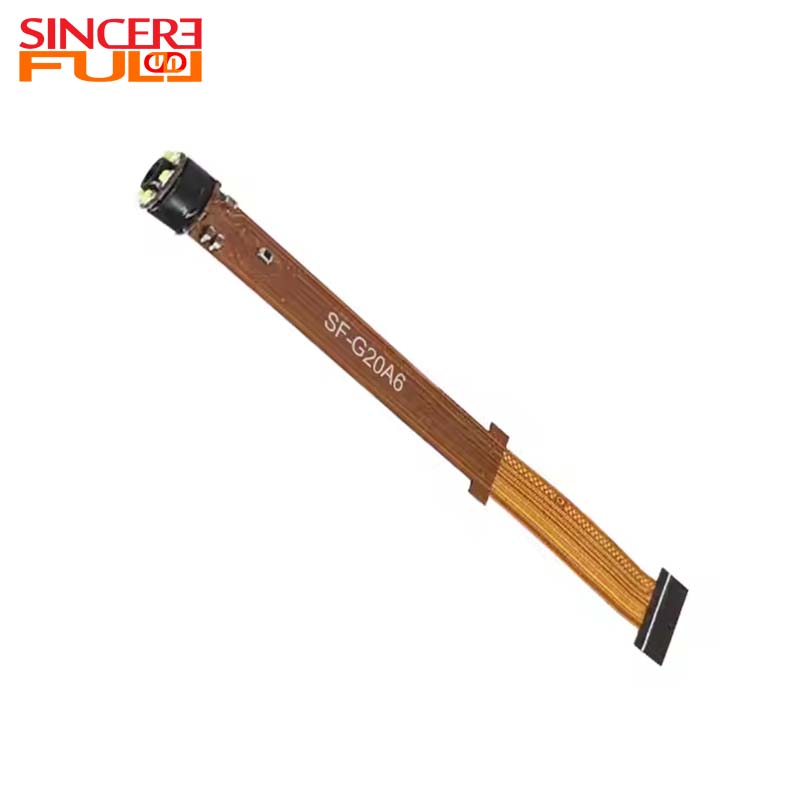
To fix motion skew, we must first understand the fundamental physics of the image sensor. The architecture of a miniature endoscope camera module dictates how it gathers light and converts it into data.
Most modern endoscopes use CMOS (Complementary Metal-Oxide-Semiconductor) sensors. These sensors do not capture the entire image at once. Instead, they expose and read pixel data row by row, usually from top to bottom.
Because of this sequential process, a time delay exists between reading the first and last rows.
Motion skew happens because the integration time per row interacts poorly with the velocity of the endoscope tip. If the camera pans rapidly across a scene, the bottom of the frame captures the environment a fraction of a second later than the top.
If the tip moves faster than the total readout speed of the sensor, geometric distortion becomes mathematically inevitable. Vertical objects appear leaning. Fast-moving fluids appear to stretch. The severity depends entirely on the camera's panning velocity versus the sensor's row-readout clock.
Global shutter sensors capture every pixel simultaneously. They completely eliminate motion skew. However, engineering reality demands strict trade-offs. You cannot simply drop a global shutter sensor into every medical device.
Global shutter pixels require much more complex circuitry. Each pixel needs an extra analog memory node to hold the charge while the system reads the data. This extra circuitry leads to larger sensor footprints. It reduces the area available for light gathering (lower fill factor), which degrades low-light sensitivity. It also generates higher thermal output. In environments where the outer diameter must remain under 3mm, rolling shutter remains the only physically viable option.
When physical space prohibits global shutters, hardware engineering provides several alternative paths. You can leverage specific sensor upgrades to mitigate rolling shutter artifacts effectively.
Increasing the frame rate is the most direct hardware solution. Evaluate sensors that natively support 60fps to 120fps. Faster frame rates demand faster row readouts.
When the sensor reads rows more rapidly, it drastically reduces the time delta between the first and last row. This compresses the skew effect. While technically still present, the distortion becomes imperceptible to the human eye. Operators experience smooth, fluid video even during rapid probe navigation.
You should assess the viability of moving to a global shutter for rigid endoscopes. Rigid scopes, commonly used in laparoscopy or specific automotive inspections, offer slightly more forgiving spatial constraints.
If your outer diameter allows for a 5mm or larger sensor package, newer micro-global shutter sensors might fit. However, you must pair them with powerful external light sources to compensate for their reduced low-light sensitivity.
Clever lighting design can mask sensor limitations. You can pair rolling shutter sensors with pulsed LED lighting, also known as strobe lighting.
The system syncs the LED flashes to the sensor's specific exposure window. By delivering intense, micro-second bursts of light exactly when all rows are exposing, you effectively "freeze" motion. This technique minimizes tearing significantly. It is highly effective but requires sophisticated synchronization timing between the camera control unit and the LED driver.
Hardware upgrades carry implementation risks. Moving to a more robust, high-speed sensor generates more heat. In medical endoscopy, patient safety standards (like IEC 60601-1) strictly limit the maximum temperature of applied parts.
You must redesign heat dissipation paths. Faster data rates also require higher bandwidth interfaces (like MIPI-CSI2). This potentially demands thicker, heavily shielded cabling. Thicker cables compromise probe flexibility, reducing operator maneuverability.
Best Practice: Always prototype thermal output early in the design cycle. High-FPS sensors run hot. Rely on thermal potting compounds and metallic outer sheaths to draw heat away from the sensor die.
If hardware upgrades exceed your footprint budget, software provides the next line of defense. Modern Image Signal Processors (ISPs) carry powerful computational photography features to correct physical sensor flaws.
Advanced digital de-warping happens in real time within the ISP. These processors use optical flow analysis to track pixel movement across consecutive frames.
By mapping the velocity vectors of moving textures, the algorithm predicts how much the geometry has stretched. It then digitally warps the image back into its correct shape. More advanced systems integrate gyroscopic metadata. A micro-IMU (Inertial Measurement Unit) inside the camera tip feeds movement data to the ISP, telling it exactly how fast the camera panned. The ISP uses this precise math to reverse the rolling shutter slant instantly.
Heavy software de-warping introduces glass-to-glass latency. The ISP must buffer several frames to analyze optical flow. You must carefully manage this delay.
In surgical environments, high latency is dangerous. Sub-50ms latency is the standard threshold for real-time surgical or inspection navigation. If the delay exceeds 100ms, operators experience severe hand-eye coordination degradation. They might overshoot their target or damage delicate structures. Software mitigation is a balancing act between perfect geometry and instantaneous visual feedback.
Bringing discrete ISP boards into a product complicates manufacturing. To solve this, many teams use USB endoscope camera modules.
These specialized modules often handle complex ISP corrections right onboard the camera assembly. They output a pre-corrected, UVC-compliant (USB Video Class) video stream directly to the host device. This offloads the processing requirement from your host computer or tablet. It vastly simplifies the engineering burden for your internal software teams, allowing plug-and-play integration.
Your mitigation strategy changes entirely based on your target market. Medical and industrial fields prioritize different performance metrics. You must align your procurement criteria with these realities.
Table 1: Procurement Focus Areas
| Requirement Category | Industrial Endoscope Modules | Medical Endoscope Modules |
|---|---|---|
| Environmental Protection | IP67/68 ratings, oil & chemical resistance. | Autoclave, EtO Sterilization, Bio-compatibility. |
| Acceptable Latency | Moderate (100ms - 150ms). Automation compensates for delays. | Ultra-low (Sub-50ms). Crucial for hand-eye coordination. |
| Interface & Cabling | Long cable runs via Ethernet or FPD-Link. | Thin, highly flexible cables. MIPI-CSI2 standard. |
| Distortion Tolerance | Slight warping accepted if resolution resolves fine cracks. | Zero tolerance. True geometry required for biopsies. |
When sourcing industrial endoscope camera modules, engineers focus heavily on durability and transmission distance.
Evaluation lenses must carry deep waterproofing ratings (IP67/68) and resist harsh aviation fuels or caustic chemicals. Maintaining high framerates over massive cable runs requires sophisticated bridging technologies. You will often convert MIPI-CSI2 signals to Ethernet or FPD-Link to reach distances up to 30 meters.
In industrial settings, slight latency is often more acceptable than missed spatial details. Inspectors usually perform steady, slow passes inside pipelines. They care deeply about clarity and dynamic range to see dark corners, making rolling shutter flaws less prominent unless automated high-speed robotics drive the probe.
Medical procurement is an entirely different beast. Everything revolves around ISO 13485 compliance and stringent sterilization compatibility.
Sensors must survive repeated autoclave cycles or Ethylene Oxide (EtO) treatments. Evaluation lenses prioritize ultra-low latency for seamless hand-eye coordination. Medical fields possess zero tolerance for spatial distortion during biopsies. This demands the highest-tier sensor readouts. If your module cannot deliver perfect geometry at low latency, surgeons will reject the system immediately.
You cannot judge motion skew purely from a spec sheet. Vendor datasheets often highlight maximum framerates under optimal, hyper-bright scenarios. To ensure success, follow a strict evaluation process.
Mitigating rolling shutter is not simply about buying a "better" camera; it is a system-level engineering challenge balancing sensor speed, lighting, and processing. Every form factor constraints your sensor choices, and every software fix impacts your latency budget.
To move forward, engineering teams should take immediate action to audit their current system. Calculate your maximum motion velocity and identify your strict latency tolerance. Reach out to vendors to request evaluation kits (EVKs) for side-by-side ISP testing under your specific lighting conditions. Partner with experienced module integrators who understand the deep commercial compliance constraints of your industry. By treating image distortion as a holistic system challenge, you guarantee a clearer, safer product for your end-users.
A: No. Software can significantly reduce the perceptual distortion (de-warping), but it cannot recreate physical data lost during sequential row exposure. Only global shutter eliminates it entirely at the hardware level.
A: While heavily dependent on the velocity of the camera tip, 60fps is generally the baseline requirement for smooth navigation, with 90fps+ preferred for high-speed automated inspections.
A: Many high-end USB modules feature an integrated ISP that handles automatic white balance, exposure, and basic anti-skew algorithms before outputting the video over UVC, though performance varies by manufacturer.
A: Global shutter sensors require an analog memory node at every pixel to store the charge simultaneously, complicating the semiconductor manufacturing process and increasing the physical die size.


