Product Overview
As a premier manufacturer and supplier of precision imaging components, we present the 3.9mm Ultra Miniature Endoscope Camera Module with PCB Board. Engineered for seamless hardware integration, this micro-visual solution empowers developers and equipment manufacturers to conquer severe space constraints while delivering high-definition diagnostics.
- Ultra-compact 3.9mm diameter stainless steel probe designed for inaccessible micro-spaces.
- Standardized PCB layout with a direct USB 2.0 interface for streamlined assembly.
- Driver-free UVC protocol compatibility for rapid system deployment across multiple platforms.
- Optimized for demanding applications in industrial inspection, automotive diagnostics, and precision equipment manufacturing.
Product Description
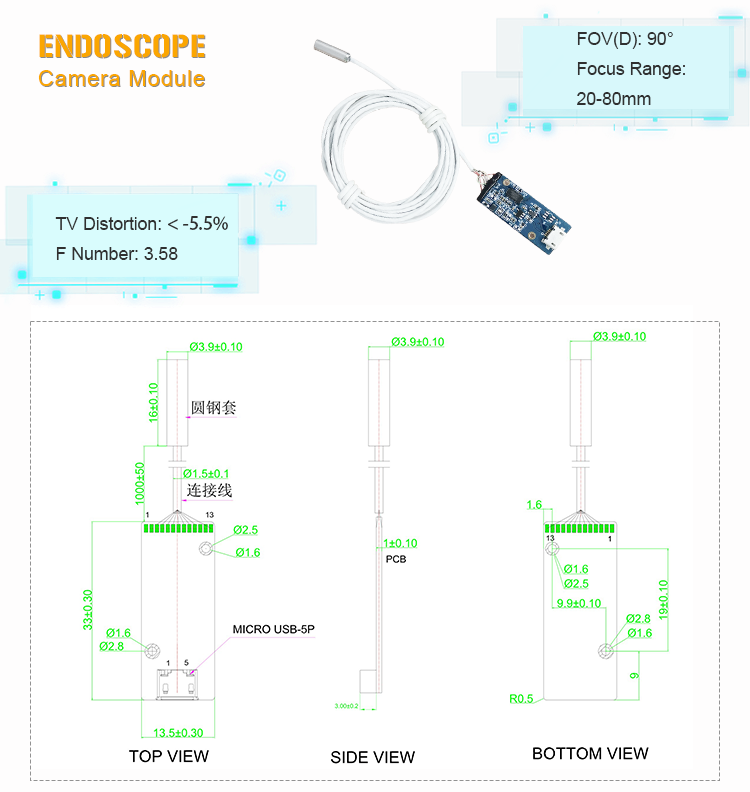
The 3.9mm ultra-miniature USB 2.0 endoscope camera module represents a paradigm shift in micro-visual engineering, meticulously crafted to illuminate and capture the most restrictive environments. Housed in a robust, cool-to-the-touch stainless steel shell, the ultra-slim 3.9mm diameter probe effortlessly glides through narrow pipelines, micro-pores, and intricate mechanical cavities that render conventional imaging devices completely obsolete. The tactile quality of the standardized PCB board reflects exceptional industrial craftsmanship, featuring a highly precise layout that hardware engineers can seamlessly integrate into host motherboards without the burden of complex adapter configurations.
Beyond its physical elegance, this imaging module fundamentally transforms operational efficiency for equipment developers. By leveraging a standard USB interface, it draws stable power and transmits high-fidelity data directly through existing ports, dramatically reducing internal hardware clutter and accelerating development cycles. The visual output is crisp and uncompromising, capable of capturing the finest surface textures, minute scratches, and microscopic anomalies with absolute clarity. Whether deployed in demanding industrial inspections, precision automotive diagnostics, or delicate laboratory observations, this miniature visual component empowers equipment manufacturers to elevate their diagnostic capabilities, ensuring reliable performance and expediting the time-to-market for advanced inspection systems.
Product Specifications
| Parameter | Specification Details |
| Product Name | 3.9mm VGA Sensor Endoscope Camera Module |
| Image Sensor | VGA Sensor (1/18 inch CMOS) |
| Module Size | 3.9mm diameter (±0.10mm) |
| F No. | 3.58 |
| FOV(D) | 90° (Integrated 120° ultra-wide-angle lens) |
| TV Distortion | < -5.5% |
| Output Interface | USB 2.0 (Micro USB-5P, supports hot-swapping) |
| Theory | CMOS Imaging |
| Focus Range | 20–80mm (Depth of field: 5–50mm, minimum working distance: 5mm) |
| Output Format | YUV & MJPG (Dual-format output, software switchable) |
| Illumination | 4 high-brightness white LEDs (Clear imaging at 0 lux) |
| Waterproof Rating | IP67 (Dust and water resistance) |
| Operating Temperature | -20°C to 70°C (Stable image quality between 0°C and 50°C) |
| Protocol | USB Video Class (UVC), Plug-and-Play |
| Supported OS | Windows, macOS, Linux, Android |
| Shell Material | Steel shell |
| PCB Substrate | Industry-standard dimensions and layout |
Key Features & Highlights
Engineered to deliver uncompromising performance in the most demanding integration scenarios, this camera module combines optical precision with robust digital versatility. It is specifically designed to alleviate common engineering bottlenecks, providing a reliable, ready-to-deploy visual solution that enhances the core value of your final equipment.
- Dual-Format Output Flexibility: Supporting both YUV and MJPEG formats, the module allows software engineers to dynamically switch between uncompressed data for meticulous analysis or compressed streams for smoother frame rates, achieving dual functionality from a single hardware component.
- Superior Distortion Control: With a TV distortion rate meticulously calibrated to < -5.5%, the imaging output maintains structural fidelity. This ensures that when inspecting precision instruments or micro-mechanical parts, the visual data remains geometrically accurate, preventing misdiagnosis of internal faults.
- Optimized Thermal Management: The carefully selected CMOS sensor and efficient PCB layout ensure minimal heat generation during prolonged operation. This thermal stability is critical when the probe is inserted into sensitive environments, protecting both the camera module and the inspected cavity.
Ultra-Miniature Design for Restricted Spaces
The defining characteristic of this imaging component is its extreme miniaturization. Achieving a precise 3.9mm diameter requires advanced manufacturing techniques and meticulous component selection, resulting in a probe that redefines accessibility in visual diagnostics.
- Micro-Pore Penetration: The 3.9mm profile allows the camera to effortlessly navigate through ultra-small-diameter pipes, thin water lines, and complex engine passages that are entirely inaccessible to standard inspection cameras.
- Surgical-Grade Housing: Encased in a durable steel shell, the lens and sensor are protected from physical abrasions during insertion, making it highly suitable for integration into medical catheters, micro-robots, and internal earphone housing environments.
- Non-Destructive Testing (NDT): By utilizing such a compact probe, technicians and automated systems can perform comprehensive internal cavity examinations without the need for costly and time-consuming component disassembly.
Macro Optical Performance for Precision Diagnostics
Visual clarity at microscopic distances is paramount for accurate defect recognition. This module is optically tuned specifically for close-proximity environments, ensuring that every pixel translates into actionable diagnostic data for the end-user.
- Ultra-Close Focus Capability: Boasting a depth of field ranging from 5mm to 50mm, and a minimum working distance of just 5mm, the lens captures intricate surface textures with striking sharpness.
- Expansive Field of View: The integrated 120° ultra-wide-angle lens (yielding a 90° diagonal FOV) ensures that a single image can cover a circular area approximately 10mm in diameter even at the closest working distance, maximizing inspection efficiency.
- Defect Highlighting: The 1/18 inch VGA CMOS sensor is optimized for macro scenarios, providing sufficient resolution and pixel density to clearly identify minute details such as micro-scratches, metallic burrs, and foreign particulate matter.
Environmental Adaptability & Advanced Illumination
Industrial and field applications rarely offer ideal operating conditions. This camera module is fortified to withstand harsh elements, ensuring continuous, reliable operation regardless of external environmental stressors.
- Zero-Lux Imaging: Confined cavities are inherently devoid of ambient light. The module is equipped with 4 high-brightness white LEDs precisely calibrated to illuminate the immediate inspection area, guaranteeing clear, noise-free image capture even in total darkness (0 lux).
- IP67 Ingress Protection: The steel-encased probe head boasts an IP67 rating, offering complete protection against dust ingress and allowing for submersion in water and non-corrosive liquids, essential for plumbing, pipeline, and fluid-heavy industrial inspections.
- Wide Temperature Tolerance: Designed for thermal resilience, the module operates reliably across a harsh ambient temperature range of -20°C to 70°C, maintaining perfectly stable image quality between 0°C and 50°C, making it ideal for outdoor deployments and active machinery inspection.
Cross-Platform Compatibility & Plug-and-Play Operation
Software integration is often the most resource-intensive phase of product development. This module eliminates software friction by adhering to universal video standards, drastically reducing the time required for system debugging and deployment.
- Universal UVC Protocol: Compliant with the USB Video Class (UVC) standard, the module is automatically identified as a native camera device by the host system, completely bypassing the need for manual driver installation or proprietary software development.
- Broad OS Support: It offers seamless, out-of-the-box compatibility with all mainstream operating systems, including Windows, macOS, Linux, and Android, ensuring your final product can interface with virtually any terminal device.
- Embedded System Friendly: For developers building autonomous inspection robots or smart medical devices, the module connects directly to embedded platforms like Raspberry Pi and Jetson Nano, facilitating rapid prototyping and edge-computing integration.
Hardware Integration & Development Ease

As illustrated in the engineering schematics above, the module is designed with the hardware integrator in mind. Every dimension and interface choice is optimized to reduce host motherboard space requirements and simplify the physical connection process.
- Standardized PCB Substrate: The PCB utilizes industry-standard dimensions (33mm x 13.5mm) and layout practices. This predictability allows hardware engineers to confidently reserve space during the initial stages of host device design, mitigating the risk of late-stage structural modifications.
- Industrial Micro USB-5P Interface: The inclusion of a standard Micro USB-5P connector supports integrated 5V power supply and data transmission through standardized pin definitions (VBUS, D+, D-, GND).
- Hot-Swapping Capability: Built to endure rigorous use, the interface supports hot-swapping operations. The insertion and removal cycle endurance complies strictly with USB industrial standards, easily handling the demands of frequent component changes in modular equipment designs.
Versatile Industry Applications
The combination of a micro-sized probe, robust environmental protection, and high-fidelity imaging makes this module an incredibly versatile component. It serves as the visual core for a wide array of specialized diagnostic and inspection equipment across multiple sectors.
- Industrial Micro-Pipe Inspection: Highly effective for assessing the internal integrity of ultra-small-diameter infrastructure, including thin water pipes, pneumatic air lines, and hydraulic oil tubes, highlighting wear, corrosion, or blockages.
- Precision Instrument & Electronics: Enables quality control teams to perform non-destructive internal cavity examinations of micro-mechanical parts, densely packed electronic chips, and precision instruments to identify manufacturing defects.
- Automotive Diagnostics: Facilitates the internal viewing of complex, confined vehicle cavities such as small engine passages, precision fuel fittings, and structural voids, streamlining maintenance procedures.
- Laboratory & Medical Research: Applicable for the non-invasive observation of miniature laboratory components, biological specimens, and basic medical micro-cavity exploration where high-definition visual feedback is critical.
Industrial Quality & Customization Capabilities
We understand that off-the-shelf solutions do not always meet the exact specifications of specialized equipment. Our manufacturing process is built on a foundation of industrial-grade quality control, paired with the flexibility to adapt to your unique engineering requirements.
- Rigorous Quality Assurance: Every module undergoes strict testing protocols to ensure consistent optical performance, thermal stability, and interface durability, meeting the high-reliability standards expected by industrial and medical equipment manufacturers.
- Flexible OEM/ODM Customization: To perfectly align with your product architecture, we offer deep customization options. Engineering teams can specify custom cable lengths, alter lens angles, or request specific interface modifications to ensure the module integrates flawlessly into your proprietary systems.
- Stable Supply Chain: By partnering directly with a primary manufacturer, procurement teams benefit from consistent component availability, transparent lead times, and scalable production capacities that grow alongside your market demand.
Why Choose Us
Selecting the right visual component supplier is a critical decision that impacts your product's performance and your bottom line. We provide more than just hardware; we deliver a comprehensive partnership designed to support your engineering and procurement objectives.
- Direct Manufacturer Advantage: By eliminating intermediaries, we provide highly competitive pricing structures without compromising on the premium materials or meticulous craftsmanship required for micro-optics.
- Dedicated Engineering Support: Our technical team works collaboratively with your developers, offering expert guidance on integration, thermal management, and software interfacing to significantly shorten your product development lifecycle.
- Proven Industry Expertise: With years of specialized experience in endoscopic imaging technology, we possess a deep understanding of the unique challenges faced in micro-cavity diagnostics, ensuring our products are engineered to solve real-world operational bottlenecks.
Frequently Asked Questions (FAQ)
To assist your engineering and procurement teams in their evaluation process, we have compiled detailed technical responses to the most common inquiries regarding this endoscope camera module.
- 1. Does the module's Micro USB-5P interface support hot-swapping, and what is its durability?
Yes, the module's Micro USB-5P interface is engineered to meet rigorous industrial standards and fully supports hot-swapping operations. The connector's insertion and removal cycle rating complies with official USB industrial specifications, ensuring long-term reliability and maintaining a secure data connection even in application scenarios that demand frequent plugging and unplugging. - 2. What factors contribute to the price variance among different endoscope modules in the market?
Price differences are primarily driven by the quality of core components and regulatory compliances. Key factors include the brand and tier of the image sensor (e.g., premium SONY IMX series versus standard domestic sensors), the complexity of the optical lens groups (aspherical glass lenses command a higher premium than standard plastic), and the presence of specialized medical certifications (such as FDA approvals, which require a rigorous 2-3 year validation process). - 3. What level of detail can this endoscope camera module actually capture?
This module is designed to capture high-definition, real-time imagery of extremely narrow internal structures. In industrial settings, it clearly highlights micro-wear, hairline fractures, corrosion, or blockages in machinery and plumbing that are invisible to the naked eye. For laboratory or research applications, the integrated LED light source and macro lens provide a bright, magnified view of miniature specimens or internal cavities, allowing for precise real-time monitoring and analysis of structural anomalies. - 4. Regarding imaging clarity: Can it focus at an ultra-close distance of 5mm, and will it show minute scratches?
Absolutely. The module is specifically calibrated with a depth of field ranging from 5mm to 50mm, with its peak clarity starting at a minimum working distance of just 5mm. At this ultra-close range, combined with the 120° ultra-wide field of view, a single frame captures a 10mm diameter area. The 1/18 inch sensor's pixel density is optimized for this exact scenario, making it highly effective for clearly identifying minute surface defects, microscopic scratches, burrs, and foreign particles. - 5. How seamless is the interface compatibility with embedded platforms or mobile devices?
Integration is highly streamlined. The module utilizes a standard USB 2.0 interface and supports the universal UVC protocol. For embedded platforms (such as Raspberry Pi or Jetson Nano) and mainstream operating systems (Windows, Linux, Android), it offers true plug-and-play functionality, requiring zero additional driver development. Connecting to a mobile device simply requires an OTG adapter cable, provided the host device supports external UVC cameras. The standardized pin definitions (VBUS, D+, D-, GND) make custom wiring straightforward for hardware engineers.


