


| Quantity: | |
|---|---|


SF-C50USB-D2.0
SINCEREFIRST
| This OCHFA10 CMOS Sensor 2.0mm Diameter USB2.0 UVC Driver Free Endoscope Camera Module, is an ultra-micro endoscope camera module equipped with the OCHFA10 sensor, specially designed for close-range visual inspection inside ultra-thin pipes, microchannels and tiny cavities. Its 2.0±0.05mm probe with a steel shell achieves IP67 waterproof performance, ensuring stable operation in harsh environments while maximizing accessibility to tiny spaces that conventional devices cannot reach. The 86°×86° symmetric field of view provides a square imaging frame, reducing detection blind spots and adapting to both square and circular target observation. With a 0.418mm focal length, distortion <-11% and 5–50mm dedicated close-range focus, it maximizes imaging clarity within commonly used endoscopic distances, perfectly matching close-range inspection needs. Equipped with 4 integrated LED fill lights for low-light adaptation, a Micro USB 5P interface (USB 5V power supply) and built-in standard UVC protocol, it supports plug-and-play with mainstream devices, eliminating driver installation and improving deployment efficiency. Its separate design with a 1.5-meter connecting line enhances deployment flexibility in complex narrow spaces, complies with RoHS standards, and balances ultra-compact size, waterproof durability and convenience, perfectly fitting various tiny-space close-range detection scenarios. | 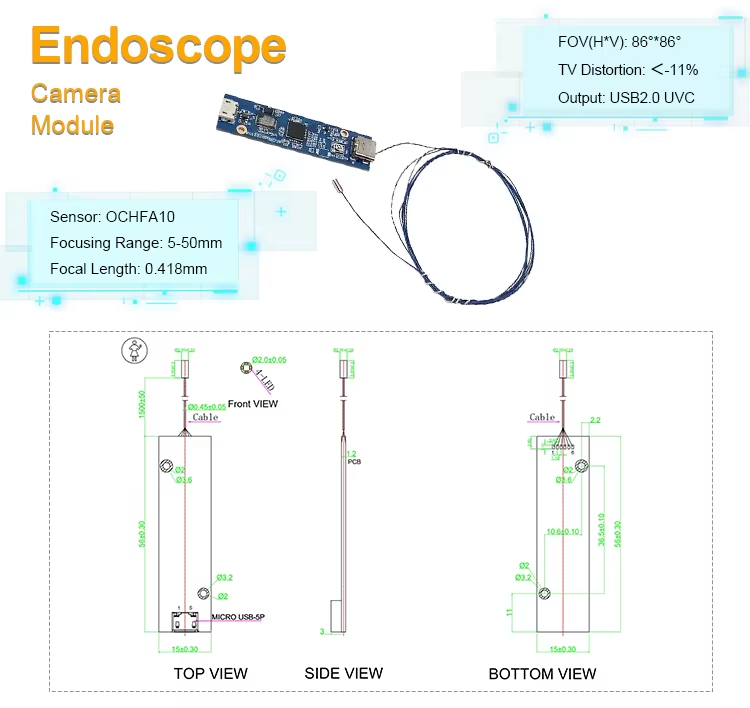 |
IP67 Waterproof with Steel Shell: Equipped with a steel shell, achieves IP67 waterproof, ensuring stable operation in harsh environments.
86°×86° Symmetric FOV: Square imaging frame, reduces blind spots, suitable for square and circular target observation.
5–50mm Close-Range Focus: Dedicated interval, maximizes imaging clarity in common endoscopic working distances.
USB2.0 UVC Driver-Free: Built-in standard protocol, plug-and-play with mainstream devices, boosting deployment efficiency.
Product Name | Medical ENDOSCOPE Camera Module |
Image Sensor | OCHFA10 |
Pixel | 1MP |
Focusing Range | 10-100mm |
Focal Length | 0.418mm |
F. NO | 5.0 |
Product Type | Endoscope Camera Module |
Led | 0402 Led |
TV Distortion | <-11% |
Feature | CMOS sensor Endoscope Camera Module |
Micro-Pipeline Endoscopic Detection: Can be used for microchannels and thin pipes with inner diameter ≥2.0mm, using its ultra-micro waterproof probe to observe internal defects, blockages and corrosion.
Precision Micro-Component Inspection: Can be used for non-destructive close-range defect inspection of micro parts, chip solder joints and micro structures.
Minimally Invasive Medical Exploration: Can serve as a close-range imaging unit for ultra-thin minimally invasive instruments, used for visual observation of human cavities and tissues.
Portable Micro-Detection Equipment: Can be used as the core module of handheld micro-detection tools, realizing on-site rapid imaging and fault location.
FAQ◢
1. What is the difference between medical and industrial endoscope modules?
The medical module emphasizes biocompatibility, sterilization and high image quality, and needs to comply with FDA/CE certification; Industrial modules focus on durability (such as corrosion protection), wide temperature operation (-20°C to 70°C), and special light sources (such as UV).
2. What can I do if the module fails to start?
Check the power adapter (for example, 12V output), the port is loose, and the fuse is blown. If the wireless module is used, check the battery level and pairing status.
3. What are the typical requirements for custom modules?
Common requirements include special dimensions (e.g., 1mm diameter), multispectral imaging (e.g., fluorescence navigation), and interface protocol adaptation (e.g., interfacing with DICOM systems).
4.How does the 86°×86° symmetric FOV reduce detection blind spots?
The square imaging frame provides uniform coverage and minimizes the edge distortion common with circular lenses. This makes it highly effective for inspecting both square and circular targets, such as micro-component solder joints and complex structures.


