Views: 0 Author: Site Editor Publish Time: 2026-06-08 Origin: Site


An endoscope camera module USB interface design is built for developers who need a compact imaging component that can connect to a host system with less driver complexity. The 10mm diameter gives the module more room than ultra-micro camera heads, allowing a larger optical structure, stronger lighting options, and easier mechanical integration. At the same time, it remains small enough for many compact visualization products.
This article explains how to evaluate a 10mm USB endoscope camera module from a component-level perspective. The key point is simple: this product is an endoscope camera module. It is not a finished inspection tool and should not be described as a complete device. Its value depends on how well it integrates with the final host product, including the enclosure, cable route, display unit, software platform, and power design.
USB is widely used because it simplifies system development. A USB camera module can often connect to common host platforms with standard video protocols, reducing the need for complicated custom interface work. For many product teams, this means faster sample testing, easier software debugging, and more predictable production planning.
The USB interface is especially useful when a project needs image capture on a computer, embedded board, tablet-like host, or custom display system. It can transmit image data and power through a compact cable structure, depending on the design. However, USB is not automatically the best choice for every project. Developers should still check bandwidth, frame rate, cable length, electromagnetic interference, connector strength, and software compatibility.
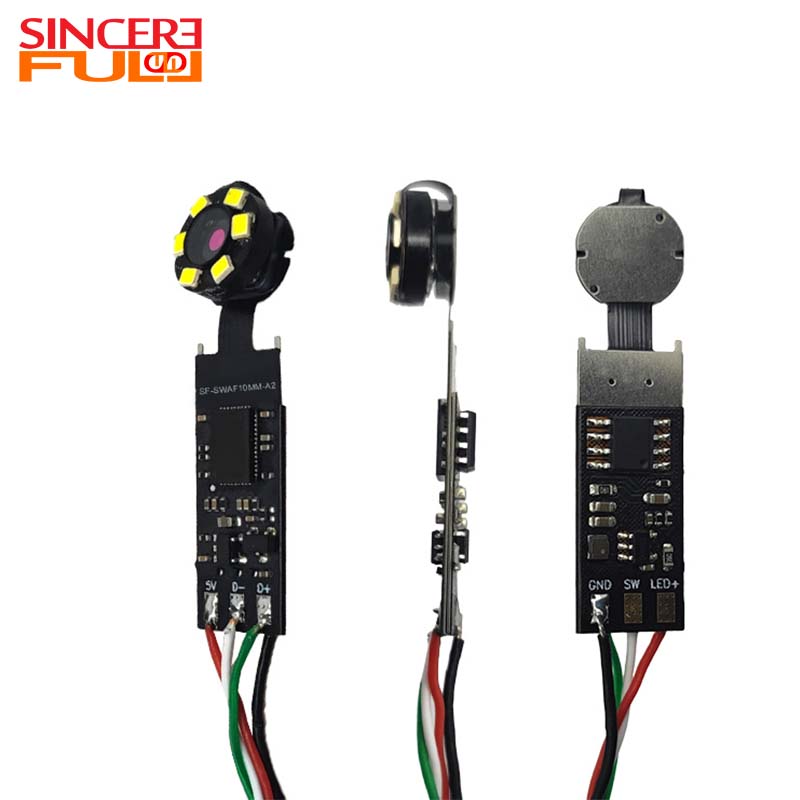
Compared with smaller modules, a 10mm camera head gives engineers more design space. It may allow a larger CMOS sensor, a more complex lens group, additional LED lighting, or a stronger shell structure. This can improve image brightness, focus behavior, and assembly reliability. For projects that do not require an ultra-small diameter, a 10mm option often provides a more balanced solution.
The larger diameter can also make production more stable. Very small modules require tighter assembly control and may have less room for heat spreading. A 10mm module still needs careful design, but the added space helps with lens alignment, LED placement, cable strain relief, and sealing structure. This is why many developers evaluate 10mm modules when image quality and integration stability matter more than the smallest possible camera head.
Checklist Item | Why It Matters | Buyer Question |
|---|---|---|
USB version | Affects data transfer, frame rate, and host compatibility. | Does the host support the required USB protocol? |
Resolution and frame rate | Controls image detail and smoothness. | Is the output stable under the expected lighting condition? |
Lens design | Determines view angle, focus range, and distortion. | Does the lens match the target distance and viewing direction? |
Lighting | Supports visibility in narrow or dark spaces. | Are LED brightness and heat behavior acceptable? |
Cable and connector | Influence installation, bending, and signal stability. | Can the cable route fit the final product structure? |
A 10mm module may support higher image resolution than many ultra-small camera heads, but pixel count alone does not define performance. The sensor, lens, image signal processor, lighting, and host display all affect the final image. If the lens cannot resolve enough detail, a high-pixel sensor will not show its full value. If the lighting is uneven, bright spots and shadows may hide key features.
For the 10mm diameter 5MP side-view USB endoscope camera module, buyers should review not only the headline resolution but also the viewing direction, autofocus behavior, LED structure, cable requirements, and mechanical fit. A side-view structure can be useful when the target surface is not directly in front of the camera head. It changes how the module should be mounted and how the host product should guide the user.
A second useful reference is the OV2740 CMOS 1080P 60fps side-view USB2.0 endoscope camera module. A higher frame rate can support smoother live viewing when the camera or target moves. Still, the complete system must be checked. Host processing speed, cable quality, power stability, and software settings may all influence the actual output.
A USB endoscope camera module should be described as a module-level imaging component. It can provide image capture, signal output, lighting support, and optical viewing capability, but it is not the whole end product. The final system may include a handle, display, processor, power supply, software interface, housing, control buttons, and accessories. Those items are outside the module unless specifically included in a supplied assembly.
Clear wording protects both the supplier and the buyer. It prevents unrealistic expectations and keeps technical evaluation focused on the real scope of supply. Instead of asking whether the module alone completes the application, buyers should ask how it will connect to the host system and what additional parts are needed for final use.
A practical workflow starts with sample verification. Connect the module to the planned host system and confirm that the video stream is recognized. Check the output format, resolution options, frame rate, brightness control, and image stability. Next, test the mechanical design. Confirm that the camera head, cable, and connector can fit the enclosure without excessive bending or compression.
After the first mechanical review, test the module under realistic viewing conditions. Do not judge the image only in an open room with strong light. Place the module at the intended working distance and observe whether the target stays sharp. Check whether LED brightness creates glare. Review whether the side-view angle matches the product’s viewing path.
Choosing by resolution only and ignoring lens focus distance.
Assuming every USB module will work with every host system.
Ignoring cable flexibility and connector space during mechanical design.
Testing image quality under easy conditions instead of the real product environment.
Describing a module as a complete tool, which can mislead readers and buyers.
For 10mm side-view integration, developers can review the 10mm diameter 5MP USB endoscope camera module with LEDs. For projects that prioritize smoother video output through a USB2.0 structure, the OV2740 1080P 60fps USB2.0 endoscope camera module can also be evaluated as a component-level option.
No. It is an imaging module. It needs a host system, enclosure, power design, display or processing unit, and software support before it becomes part of a finished product.
USB can simplify host connection and sample testing. It is useful when the project needs a widely supported video interface, but bandwidth and cable length still need verification.
Not always. It gives more space for optics and lighting, but final image quality depends on the sensor, lens, lighting, processing, cable, and host system.
A 10mm USB endoscope camera module is a practical choice for developers who need a compact imaging component with easier host integration. The correct evaluation method is to treat it as part of a larger system, not as a finished tool. By checking USB compatibility, optical design, cable routing, lighting behavior, and mechanical fit, buyers can select a module that supports stable integration and avoids unclear product positioning.


