IntroductionAn endoscopic imaging system lets doctors see inside the human body or inspectors look inside machinery without large incisions or disassembly. But how does it actually work? Behind the small camera head at the tip is a carefully designed system of optics, electronics, and illumination t
1. Introduction: When Probe Diameter Becomes the Critical FactorIn industrial pipeline inspections, automotive maintenance, and equipment servicing, one often overlooked but crucial parameter is probe diameter. When inspection channels narrow from above 5mm to below 5mm, most standard endoscope modu
Learn why endoscope cameras are used in industrial inspection. Discover the benefits of industrial borescope camera systems, industrial endoscope camera module design, and industrial inspection camera solutions for hard-to-reach internal inspection tasks.
In medical procedures and industrial inspections, seeing into tight, confined spaces is essential—whether it's examining a patient's internal organs or inspecting the interior of a complex machine. This is where rigid endoscope camera modules come in. But what exactly are they, and how do they diffe
IntroductionSize matters in camera technology. The smaller the camera, the more places it can go. Miniature camera modules have revolutionized industries from medicine to manufacturing, enabling applications that were impossible just a decade ago. Whether it’s a mini camera endoscope navigating thro
IntroductionWhen a doctor needs to see inside a patient’s body without a large incision, they use an endoscope. At the heart of that endoscope is a camera system. A medical endoscope camera system is a complete imaging solution for diagnostic and surgical procedures. It combines a miniature camera,
Oral self-examination has always been difficult. Deep within the teeth, between gaps, and on the chewing surfaces of molars—these areas are hard to see with the naked eye, and ordinary mirrors lack sufficient magnification. Smart dental mirrors have changed this: by connecting to a mobile app, users
Endoscope camera modules have evolved from niche medical tools into widely adopted imaging components across multiple industries. With continuous improvements in CMOS sensor technology, miniaturization, and optical design, these modules now enable visual inspection in environments that are otherwise
I. Introduction: When Inspection Space and Imaging Precision Evolve TogetherIn the fields of industrial pipeline inspection, heavy equipment maintenance, and municipal engineering exploration, an increasingly prominent technical challenge is emerging: the physical scale of inspection targets is grow
IntroductionMost endoscope cameras look straight ahead. Point the tip at what you want to see, and there it is. But what if what you need to inspect is off to the side—like the inside wall of a pipe, a cylinder bore, or a weld seam? That’s where a side-view endoscope camera module comes in. Instead
In modern medicine, the phrase "seeing is believing" has been replaced by "seeing is curing." The integration of high-definition imaging into surgical and diagnostic tools has fundamentally changed patient outcomes. At the center of this revolution is the medical endoscope camera module.For decades,
In the specialized field of optical imaging, few components are as transformative as the endoscope camera module. These tiny "intelligent eyes" allow us to visualize environments that are otherwise physically inaccessible—whether it is the interior of a human artery or the combustion chamber of a je
IntroductionNeed to look inside a jet engine, a buried pipe, or a car engine—without taking anything apart? That’s what a borescope does. And at its heart is a camera module. A borescope camera module is the tiny imaging system that lets you see into places you can’t otherwise reach. At Sincere, we’
IntroductionHow do you see inside a patient’s artery, inspect a jet engine blade, or check a pipe for blockage? You can’t just look. You need a camera small enough to fit through a tiny opening. That’s what a miniature endoscope camera module does. It’s a complete imaging system packed into a packag
The Ultimate Guide to Micro Endoscope Camera Modules: Technology, Sizes, and ApplicationsIn the world of high-tech imaging, there is a constant battle against space. Whether it is a surgeon navigating the delicate pathways of the human heart or an aerospace engineer inspecting a turbine blade for mi
What is the Difference Between Medical and Industrial Endoscope Cameras?At a glance, a medical endoscope camera and an industrial endoscope camera look remarkably similar: they both consist of a tiny imaging sensor mounted on the end of a long, flexible tube designed to see where the human eye canno
1. Introduction: When Observation Direction Becomes a BottleneckIn industrial inspection, medical aesthetics instruments, and educational labs, a common technical challenge arises: the target of interest is often located on pipe sidewalls, narrow gaps, or hard-to-reach areas where a direct frontal a
In the world of medical diagnostics and precision industrial inspection, "space" is a luxury that engineers rarely have. When you are designing a tool to navigate a human artery or a jet engine turbine, every tenth of a millimeter matters.As a Camera Module manufacturer with over 30 years of experti
IntroductionIf you're designing something that needs to see into tight spaces—a medical scope, an industrial inspection tool, or even a DIY gadget—size is everything. The camera module has to fit through whatever opening you have. Too big, and it won't go where it needs to. Too small, and you might
What is an Endoscope Camera Module? A Complete Technical OverviewIn the fields of modern medicine and industrial maintenance, the ability to see into inaccessible spaces is not just a convenience—it is a necessity. At the heart of this capability lies a remarkably sophisticated piece of technology:
| Availability: | |
|---|---|
| Quantity: | |
SF-C1019USB-D6.0-SV-L200-95D V1.0
SINCEREFIRST
| This Wide Angle 6.0mm Diameter OV9734 CMOS Sensor USB Interface Endoscope Camera Module, is an industrial visual detection component specially designed for side observation scenarios such as equipment sidewalls, pipe walls and gaps, featuring a professional side-view optical structure that enables vertical layout between the imaging direction and the probe axis, eliminating the need to bend the probe and directly realizing visual observation of vertical surfaces. Its 6.0mm diameter probe is precisely controlled to meet the deployment requirements of narrow spaces, allowing it to easily enter gaps, small holes and thin pipes that conventional equipment cannot reach, breaking through the space limitations of side-view detection. Equipped with an OV9734 720P HD image sensor, the module is optimized for 200mm short-distance imaging, ensuring stable and clear image output within the typical endoscopic operation distance, while the 95° large field of view significantly expands the single-frame coverage range, reducing the number of probe movements and greatly improving the efficiency and completeness of sidewall detection. Adopting a USB driver-free architecture, it supports plug-and-play, enabling quick start of the imaging process after device connection without additional driver support, which simplifies deployment and operation. The combination of side-view structure, miniaturized size, large field of view and short-distance optimized imaging makes it a standardized imaging solution for sidewall and vertical surface observation in pipeline detection, equipment maintenance, automobile maintenance and precision instrument maintenance. | ![]() |
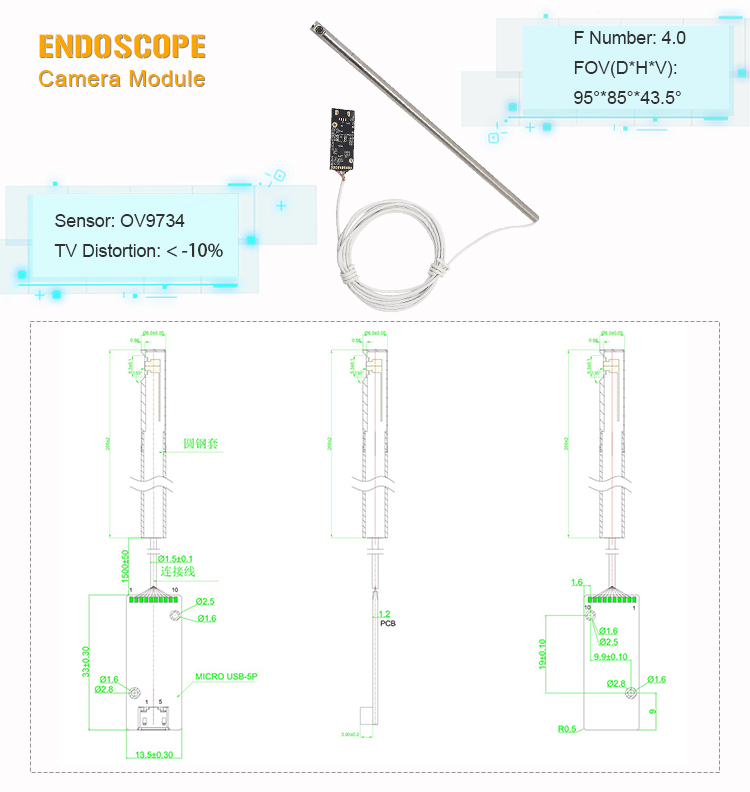
Product Name | ENDOSCOPE Camera Module |
Image Sensor | OV9734 |
Pixel | 1MP |
Focusing Range | 10-100mm |
Focal Length | 1.08mm |
F NO | 5.0 |
Product Type | Endoscope Camera Module |
Led | 0402 Led |
TV Distortion | <-10% |
Feature | Side-View Endoscope Camera Module |
FAQ
1. Possible causes of noise in the image?
If the sensor is overheating, signal transmission interferes, or the ISO is too high in low light, check the heat dissipation design, cable shielding, or enable the noise reduction mode.
2. Why does the image appear color bias?
The filter may need to be corrected or replaced by software due to uncalibrated white balance, mismatch of light source color temperature (such as LED mixed with daylight), or aging of the sensor.
3. What should I do if the module fails after high temperature sterilization?
Check whether the tolerance temperature is exceeded (for example, some are only 120°C), turn off the power and remove the battery before sterilization, damage may involve sealant failure or circuit board deformation.
