


| Quantity: | |
|---|---|


SF-SJYL7-FT+SF-SJN73310 Button
SINCEREFIRST
This OV9734 CMOS Sensor 720P HD Image Separate Endoscope Camera Module with LEDs that need built-in lighting and flexible front-end / control-board placement. The confirmed configuration uses six 0201 LEDs and a 102°±5° diagonal FOV, giving the device a relatively wide illuminated view in a small diameter. The optical section is separated from the control board through the Type-C / 5-pin architecture. An optional button-capture direction can be evaluated for handheld tools that need a physical image-recording control, creating a different device role from the 3.3mm OH01A10 60fps model. Difference: This model combines a 3.3mm OV9734 separate structure, 102° viewing angle and six LEDs, with an optional button-capture direction for handheld inspection devices. | 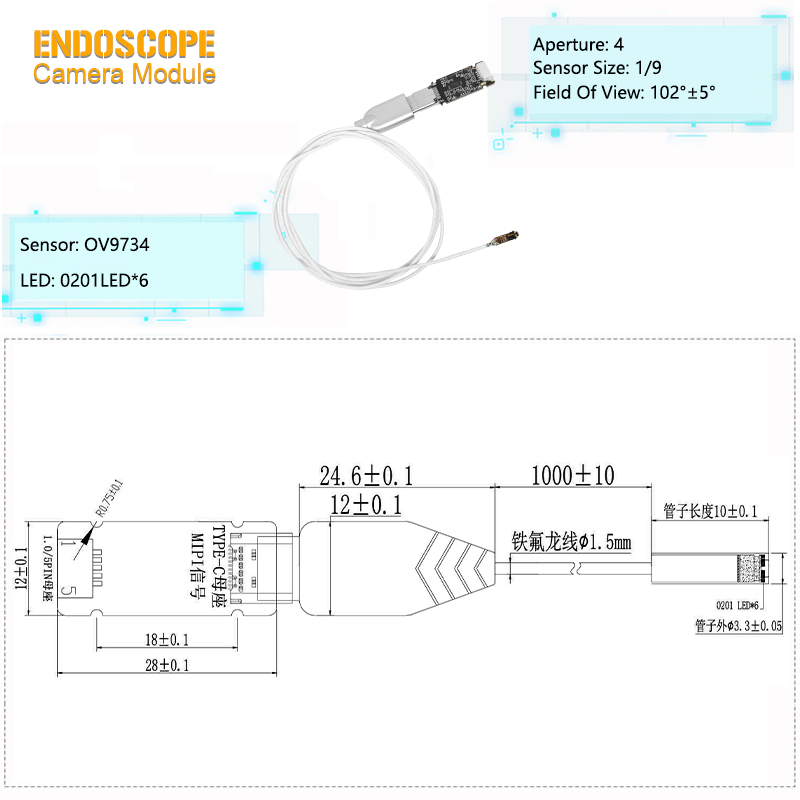 |
Selection Requirement | Standard Configuration | Selection Note |
Entry Space | 3.3mm module direction | Confirm the complete front-end / tube clearance in the final assembly. |
Viewing Coverage | 102°±5° diagonal FOV | Use this direction when wide nearby coverage is important. |
Lighting | 6×0201 LEDs | Confirm fixed front illumination is appropriate for the target surface and distance. |
Device Layout | Separated optical section + control board | Confirm Type-C / 5-pin routing and board placement fit the device. |
Operator Control | Optional capture-button direction | Use this option only when the final tool benefits from a physical capture control. |
Protection | No IP67 in the confirmed configuration | Select a protected / steel-shell direction if the operating environment requires sealing. |
1. Handheld Inspection Scope with Capture Control: The separated layout and optional button-capture direction support a handheld tool that needs a compact front end plus local image recording. Confirm button behavior with the final host software.
2. Compact Industrial Borescope: The 3.3mm diameter, six LEDs and 102° FOV support illuminated forward observation in narrow equipment spaces. Confirm the working distance and protection requirement.
3. Portable Maintenance Inspection Camera: The board can be positioned away from the imaging section while the LEDs provide local lighting. Confirm cable routing and available board space.
4. OEM Image-Recording Inspection Terminal: The physical capture direction can be evaluated when the device needs an operator control for recording inspection findings. Final capture logic should be verified with the host application.
Product Name | Bare LED Endoscope Camera Module |
Image Sensor | OV974 CMOS Sensor |
Pixel | 1MP |
Diameter | 3.3mm |
View Angle | 102° |
| Resolution | 720P |
| Type | Separate |
F NO | 4.0 |
Product Type | Butoon Photo Endoscope Camera Module |
Led | 6pcs 0201 Led |
Interface | USB 5Pin |
Feature | CMOS sensor Endoscope Camera Module |
1.Embedded Vision Integration: Can be used in small intelligent devices as an internal image acquisition unit. With its separate design and easy integration, it provides a simple path for equipment to realize visual functions.
2.Industrial Simple Inspection: Can be configured in low-precision visual inspection stations on production lines. With its low cost and high stability, it implements a cost-effective and stable inspection solution.
3.Intelligent Interactive Terminals: Can be adapted to real-time image acquisition of human-computer interaction equipment. With its plug-and-play and stable imaging, it meets the needs of user interaction and image transmission.
4.Modular Equipment Docking: Can connect to finished equipment that needs an external camera unit. With its standardized interface, it provides a fast and standardized integration solution.
1. Front-End and Board Layout: If the standard 3.3mm front structure, tube length or board position does not fit the device, the front-end / tube / board layout can be reviewed. Please provide the available diameter, insertion length, board location and assembly drawing.
2. Viewing Coverage: If the 102° FOV does not match the inspection task, the lens / FOV direction can be evaluated. Please provide the target size, target distance and required coverage.
3. Six-LED Configuration: If the fixed six-LED arrangement is too strong, too weak or creates reflections, the lighting direction and control method can be reviewed where supported. Please provide the target reflectivity, working distance and brightness requirement.
4. Button and Connector Logic: If the capture-button or connector arrangement differs from the device concept, the control, Type-C and 5-pin layout can be reviewed. Please provide the host control logic, connector preference, board placement and expected software behavior.
Type-C transmits MIPI signals to the DSP board (high-speed, low-latency for 30FPS raw images); USB 5Pin outputs via USB 2.0 (supports UVC). This avoids signal interference & enables plug-and-play with computers/inspection tools.
Yes. It has passed international certifications including CE, FCC, RoHS, and REACH, meeting regulatory standards of most countries/regions—no extra compliance adjustments are needed for overseas use.
Fits diverse depths (0.1mm chip close-ups, 102° wide shots). Adjust the lens focus ring slightly — no complex calibration.
It supports the UVC Protocol, enabling plug-and-play functionality with mainstream systems (Windows, Linux, Android, MacOS) without extra drivers. The Separated design also allows flexible arrangement of the lens and control board to fit installation spaces.
CTA◢
For sample evaluation, please provide the available diameter, target distance, required viewing angle, lighting condition, board position, connector direction and whether a physical capture button is required. We can then review the optical, mechanical and control layout for the final inspection device.


