Product Overview
As a premier manufacturer and reliable supplier of optical imaging solutions, we present the 12MP UHD Endoscope Camera Module. Designed for seamless integration into professional diagnostic and inspection equipment, this highly compact unit delivers unparalleled visual clarity and robust performance for demanding environments.
- Ultra-High Definition: Powered by a 12 million pixel sensor capturing pristine 4K UHD imagery.
- Adaptive Sizing: Available in both 12.5mm bare module and 14.5mm IP67-rated steel shell configurations.
- Advanced Illumination & Precision Focus: Features 8 dimmable white light SMD LEDs coupled with an intelligent auto-focus mechanism ranging from 3.5cm to infinity.
Product Description
Step into a new era of visual inspection with our state-of-the-art 12.5mm Diameter Mini CMOS Sensor Endoscope Camera Module. When handling this delicately engineered component, the robust craftsmanship of its optional IP67-rated steel shell immediately conveys industrial-grade durability. It feels solid yet remarkably compact at just 36.6mm in length, designed specifically to glide effortlessly through the most constricted pipelines, intricate valve networks, and complex mechanical cavities without snagging or resistance. The true magic, however, lies in the visual experience it delivers. The moment the system powers on, the 1/3.06-inch CMOS sensor floods your display with breathtaking 4K UHD imagery, revealing the subtle textures of micro-cracks, the exact coloration of chemical corrosion, and the finest structural anomalies that lower-resolution cameras simply blur into obscurity.
For system integrators and diagnostic equipment designers, this module eliminates the frustrating guesswork of dark-environment imaging. The crisp, instantaneous auto-focus mechanism operates with a silent, fluid precision, locking onto targets from a mere 3.5cm away all the way to infinity. This means operators no longer need to manually push and pull the probe to find the optical sweet spot—the image remains consistently sharp and responsive. Coupled with intelligent image processing algorithms that automatically balance exposure and color temperature, the resulting video feed is smooth, true to life, and devoid of distracting digital noise. By integrating this module, you are not just upgrading a component; you are drastically enhancing the diagnostic accuracy, operational efficiency, and overall value of your entire inspection ecosystem.
Product Specifications
| Product Name | 12.5mm Endoscope Camera Module |
| Trademark | SINCERE FIRST |
| Sensor | 1/3.06-inch CMOS |
| Pixel | 12MP |
| Resolution | 3840×3104 (4K UHD) |
| Pixel Size | 1.12μm × 1.12μm |
| Probe Diameter | Φ12.5mm / Φ14.5mm |
| Module Length | 36.6mm |
| F.NO (Aperture) | F/2.2 |
| FOV (D) | 80.9° |
| Focus Type | Auto Focus |
| Focusing Range | 3.5cm ~ Infinity |
| LED | 8pcs White Light SMD LEDs (Dimmable / Optional hardware dimming) |
| Color Temperature | 4500–5000K |
| Interface / Mounting Type | USB 2.0 (UVC compatible) |
| Power Supply | 5V |
| ADC Accuracy | 10-bit |
| Operating Temperature | 0℃–50℃ |
| Supported OS | Windows XP, Windows 7 |
| Image Control | Automatic Exposure (AEC), Automatic Gain (AGC), Automatic White Balance (AWB) |
| Structure Options | Bare Module (Φ12.5mm) / Steel Shell with IP67 Waterproof & Dustproof (Φ14.5mm) |
Key Features & Highlights
Engineered to overcome the most demanding inspection challenges, this endoscope camera module combines cutting-edge optical technology with rugged adaptability. It empowers your diagnostic equipment to perform flawlessly in unpredictable environments.
- Exceptional Clarity: The 12MP sensor captures minute details, significantly reducing the risk of missed defects during critical inspections and ensuring accurate assessments.
- Dynamic Illumination Control: Hardware-adjustable dimming allows operators to instantly adapt light levels, preventing glare on highly reflective metal surfaces or illuminating pitch-black voids.
- Seamless Auto-Focus: Transitions smoothly from extreme close-ups to expansive cavity views without requiring tedious manual repositioning of the probe.
- Plug-and-Play Architecture: UVC compatibility ensures immediate recognition by host systems, drastically reducing software development time and integration hurdles.
- Thermal Stability: Consistently delivers high-fidelity imaging with 10-bit ADC accuracy even when operating continuously in temperatures up to 50℃.
Advanced Imaging & Auto-Focus Performance
In complex diagnostic environments, the resolution of your imaging component dictates the success of the entire operation. This module is built around a formidable 12 million pixel CMOS sensor, delivering an astounding 3840×3104 resolution. This level of detail transforms how operators perceive internal structures, turning vague shadows into actionable data.
- Micro-Defect Recognition: The ultra-fine 1.12μm pixel size captures the most subtle textures, allowing for the early detection of hairline fractures, localized corrosion, and material fatigue.
- Intelligent Auto-Focus Mechanism: Covering a vast focal range from 3.5cm to infinity, the lens automatically and rapidly adjusts to keep the subject razor-sharp as the probe navigates through winding spaces.
- Operational Efficiency: By eliminating the need to manually maneuver the probe back and forth for focus, operators can complete thorough inspections faster and with greater confidence in their findings.
- Distortion-Free Viewing: The precisely engineered F/2.2 aperture and 80.9° field of view work in harmony to provide a wide, well-lit perspective without compromising edge-to-edge sharpness.
Structural Design & Environmental Protection
Physical constraints and harsh environments are the primary hurdles in internal inspections. We engineered this module to provide maximum integration flexibility without sacrificing durability, ensuring it fits perfectly into your specialized equipment while surviving the rigors of the field.
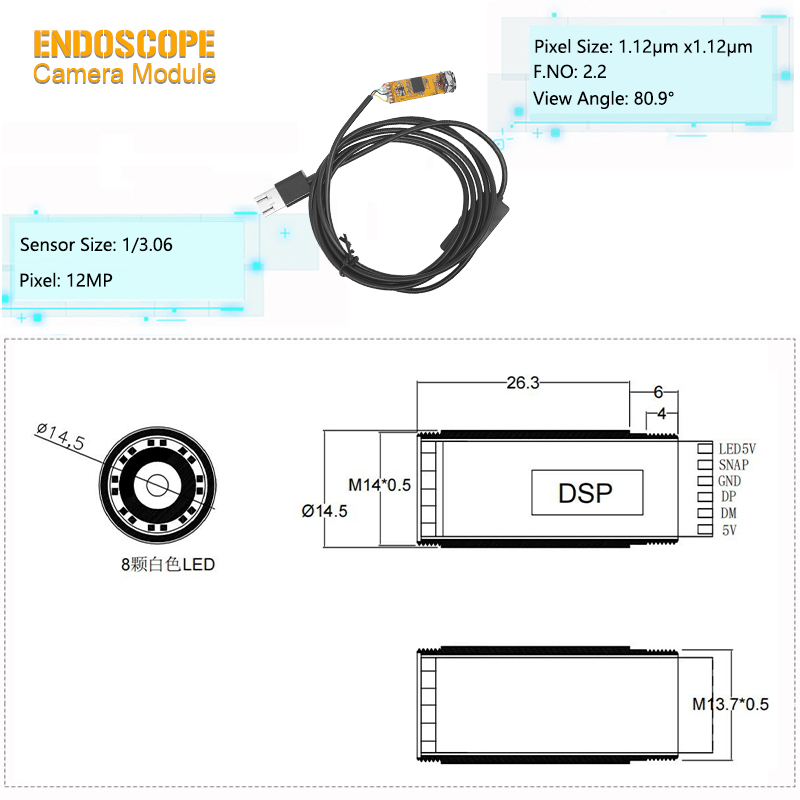
- Dual-Size Adaptability: Choose the ultra-compact Φ12.5mm bare module for tightly constrained device housings, or opt for the Φ14.5mm version for direct deployment in demanding physical environments.
- IP67-Rated Steel Shell: The Φ14.5mm variant features a meticulously machined steel enclosure, providing absolute protection against dust ingress and liquid submersion, vital for plumbing and chemical applications.
- Resilient Construction & Optimized Length: At merely 36.6mm long, the rigid section of the camera easily navigates through sharply curved pipes and angled joints, specifically designed to withstand the physical stress of daily industrial use.
Intelligent Illumination & Low-Light Capability
Internal cavities are inherently devoid of ambient light. To combat this, the module features a highly sophisticated illumination and image processing suite that guarantees vibrant, accurate visual feedback regardless of how dark or reflective the environment might be.
- Surround LED Array: Eight strategically positioned white light SMD LEDs cast a uniform, shadow-free glow across the inspection area, revealing depth and texture.
- Customizable Dimming: The optional hardware dimming function allows precise control over light output, preventing blinding reflections when inspecting polished stainless steel or wet surfaces.
- Natural Color Reproduction: Operating at a color temperature of 4500–5000K, the light mimics natural daylight, ensuring that rust, fluids, and wire color-coding appear in their true, recognizable colors.
- Algorithmic Enhancement: Built-in Automatic Exposure (AEC), Automatic Gain (AGC), and Automatic White Balance (AWB) continuously analyze and adjust the video feed to maintain optimal brightness and contrast dynamically.
- Thermal Heat Dissipation: The LED board and surrounding architecture are engineered to dissipate heat efficiently, preventing thermal sensor noise caused by prolonged illumination in highly confined spaces.
System Compatibility & Ease of Integration
Time to market is critical for equipment developers and system integrators. This module is engineered with standard protocols to ensure a frictionless integration process, allowing your engineering team to focus on higher-level system design rather than troubleshooting basic connectivity.
- Universal USB 2.0 Interface: Utilizes a widely adopted, highly stable connection standard, ensuring reliable data transmission across a vast array of host devices and motherboards.
- UVC Protocol Support: True plug-and-play functionality eliminates the need for proprietary driver development, instantly streaming video upon connection to compatible systems.
- Broad OS Support: Fully compatible with established operating systems like Windows XP and Windows 7, making it an ideal choice for upgrading legacy industrial terminals as well as outfitting modern diagnostic stations.
- Low Power Consumption: Operating efficiently on a standard 5V power supply, it minimizes the thermal load and energy draw, which is crucial for extending the battery life of portable, handheld inspection tools.
Versatile Application Scenarios
The unique combination of ultra-high definition, compact sizing, and robust environmental protection makes this camera module the ideal optical engine for a diverse range of demanding professional applications across multiple industries.
- Heavy Machinery Diagnostics: Inspect the internal components of massive engines, gearboxes, and hydraulic systems to locate wear and tear without the immense cost and downtime of complete disassembly.
- Industrial Pipeline Inspection: Navigate through sprawling chemical pipelines, refinery tubes, and ventilation ducts to accurately identify blockages, structural fatigue, and corrosive degradation.
- Aviation and Aerospace: Provide the critical visual clarity needed to safely examine turbine blades, airframe voids, and complex wiring harnesses for micro-fractures or chafing.
- Archaeological & Security Probing: Safely explore hidden compartments, ancient artifacts, and structural cavities with minimal invasive disruption, capturing high-resolution archival footage.
- Municipal Infrastructure: Evaluate the structural integrity of HVAC systems and underground drainage networks with a module that reliably withstands damp, dark, and demanding conditions.
OEM Customization & Engineering Support
We understand that standard off-the-shelf components rarely meet the exact specifications of highly specialized diagnostic equipment. Our dedicated engineering team offers deep, comprehensive customization services to align the module perfectly with your project requirements.
- Optical Tailoring: Adjust the Field of View (FOV) or modify the focal range to perfectly suit the specific viewing distances and spatial constraints of your target application.
- Form Factor Modifications: Customize the wiring harness length, connector types, and structural housing dimensions to seamlessly fit your proprietary device architecture.
- Illumination Adjustments: Reconfigure the LED layout, intensity, or even the light spectrum (such as integrating UV or IR LEDs) for specialized material inspections like non-destructive testing.
- Advanced Image Tuning: Our technicians can fine-tune the ISP algorithms to optimize contrast, edge detection, and color saturation for the specific materials your equipment will encounter.
- Sensor Upgrades: Options to integrate specialized CMOS sensors for heightened sensitivity in specific wavelengths or higher frame rates for dynamic inspections.
- Custom Firmware Development: Tailored software protocols to ensure the camera module communicates flawlessly with proprietary diagnostic dashboards and automated analysis software.
Why Choose Us
Partnering with the right component manufacturer is crucial for the long-term success and reliability of your product lines. We bring decades of optical engineering expertise and stringent quality control to every single module we produce.
- Uncompromising Quality Assurance: Every module undergoes rigorous testing for thermal stability, focus accuracy, and environmental resilience before leaving our state-of-the-art facility.
- Scalable Production Capacity: Whether you require a small batch for initial prototyping or massive volumes for a global product rollout, our agile manufacturing lines ensure timely, consistent delivery.
- Direct Technical Collaboration: Gain direct access to our core engineering team, ensuring swift resolution of integration challenges and rapid iteration of custom designs.
- Cost-Effective Excellence: By controlling the entire manufacturing process from sensor integration to final assembly, we deliver premium, high-resolution imaging solutions that maintain your competitive pricing edge.
Frequently Asked Questions (FAQ)
Find detailed answers to common technical inquiries regarding the integration, capabilities, and performance of our 12.5mm camera modules to assist your procurement and engineering decisions.
1. How does the 12MP resolution impact the data bandwidth requirements during operation?
Transmitting 4K UHD (3840×3104) video requires a stable and capable connection. While the USB 2.0 interface is highly compatible and universally adopted, we utilize efficient image compression within the module's DSP to ensure smooth frame rates without overwhelming the host system's processing capabilities. For applications requiring uncompressed raw data, specific frame rate adjustments or interface upgrades can be discussed with our engineering team.
2. Can the auto-focus mechanism be disabled or locked for specific inspection applications?
Yes, depending on your system integration needs, the auto-focus behavior can be modified. Through our OEM customization services, we can configure the firmware to lock the focus at a predetermined distance or allow manual software overrides. This is particularly useful in environments with heavy particulate matter, steam, or floating debris that might otherwise confuse the auto-focus sensor.
3. What is the difference in thermal management between the bare module and the steel shell version?
The Φ12.5mm bare module is designed to rely on the thermal dissipation properties of your device's internal housing and surrounding airflow. In contrast, the Φ14.5mm version utilizes its IP67-rated steel shell as a highly effective heat sink. This shell draws thermal energy away from the CMOS sensor and LED array, ensuring stable 10-bit ADC accuracy and preventing thermal noise even during prolonged operation at the maximum rated 50℃.
4. How does the optional hardware dimming function interface with our main control systems?
The optional dimming function is typically controlled via an inline hardware switch integrated into the wiring harness for manual operation. However, for deep system integration, we can customize the control board to accept digital PWM signals directly from your main processing unit. This allows your software application to dynamically adjust the LED brightness based on real-time feedback from the Automatic Exposure Control (AEC).
5. Is the IP67 steel shell resistant to industrial chemicals and harsh solvents?
The IP67 rating guarantees complete protection against dust ingress and temporary submersion in water. The high-grade steel shell also offers excellent resistance to common industrial lubricants, mild solvents, and hydraulic fluids. However, for applications involving prolonged exposure to highly acidic, highly alkaline, or extremely corrosive chemical environments, we strongly recommend discussing specialized anti-corrosive coatings or alternative housing materials with our engineering team.
6. What is the typical lead time for developing a customized module prototype?
For standard modifications such as cable length adjustments, connector swaps, or basic firmware tweaks, prototypes can typically be dispatched within 2 to 3 weeks. More complex customizations involving lens redesigns, custom PCB layouts, specialized LED spectrums, or specific image tuning algorithms generally require 4 to 6 weeks to produce fully functional initial engineering samples.


