


| Quantity: | |
|---|---|


SF-C1019USB-D6.0-SV-L200-95D V1.0
SINCEREFIRST
We developed this 6mm side-view endoscope camera module for OEM customers who need stable HD imaging in narrow spaces, side-wall inspection scenarios, and compact visualization systems. Built with the OmniVision OV9734 sensor, this module supports 720P image output and is designed to provide reliable side-view observation where conventional front-view modules are less effective. Our 6mm side-view structure is suitable for applications that require access to confined spaces, corners, inner walls, and curved passages. With a 10–100mm focusing range, 1.08mm focal length, F.NO 4.0, and a 95° × 85° × 43.5° field of view, this module helps capture more lateral detail within limited operating space. The F4.0 aperture provides a balanced optical design for compact side-view imaging, supporting practical brightness and image consistency in close-range observation tasks. To improve visibility in low-light environments, we integrate 0402 micro LED illumination into the module design. This helps provide more uniform lighting in small cavities, pipelines, and enclosed inspection areas. Combined with the side-view optical structure, the LED-assisted design makes the module suitable for observation tasks where direct front-view lighting may not be sufficient. We position this module as a practical and customizable imaging component rather than a generic off-the-shelf product. For customers developing compact endoscope systems, side-wall inspection tools, or specialized visualization equipment, we can also support project-based communication for structural and optical customization. | 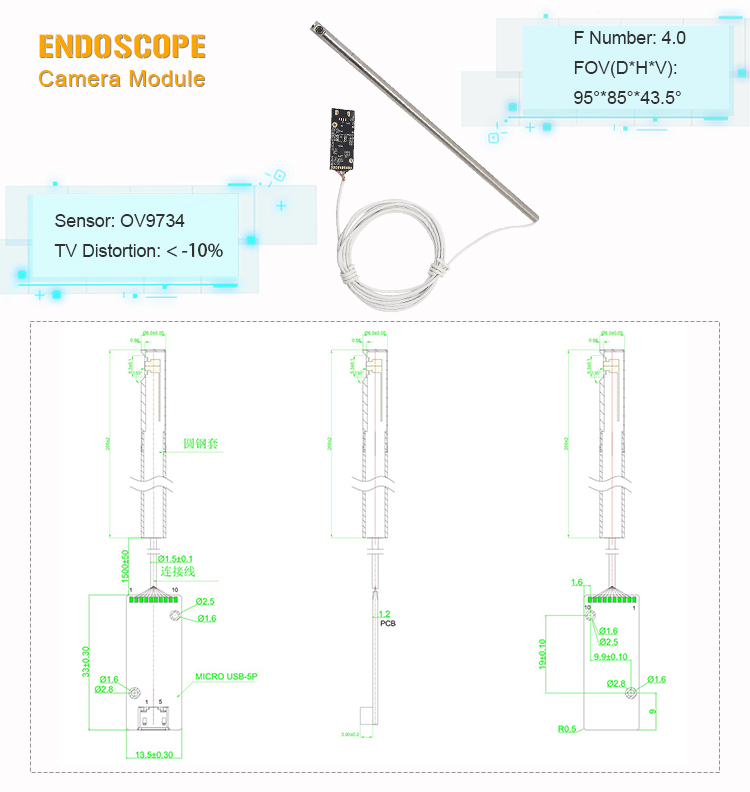 |
We use a side-view observation structure to improve visibility in corners, inner walls, side surfaces, and narrow passages that are difficult to inspect with direct-view modules.
Built around the OV9734 sensor platform, this module supports HD image output for close-range inspection and compact endoscopic imaging applications.
With a 1.08mm focal length and F.NO 4.0, we optimize this module for compact side-view imaging applications that require a practical balance of brightness, field coverage, and structural miniaturization.
With a field of view of 95° × 85° × 43.5°, the module is designed to improve side-wall coverage and increase visual access in confined spaces.
We optimize this module for short-to-medium working distances, helping customers inspect features located at different depths inside compact structures.
The integrated 0402 LED lighting design improves visibility in dark or enclosed environments and supports clearer imaging during narrow-space observation.
We can support project discussion for interface adaptation, optical tuning, structure adjustment, and other customization requirements based on your application.
We recommend this module for side-wall inspection in pipelines, narrow cavities, and internal channels where lateral observation is more valuable than direct front-view imaging.
It is also suitable for precision equipment inspection, including weld observation, corner-area inspection, internal structural checks, and other compact-space imaging tasks in industrial environments.
For medical device development and OEM visualization systems, this module can be considered for side-view imaging integration in compatible devices, subject to the customer’s own product design, validation, and regulatory planning.
1. Aerospace: turbine disc mortise test, fuel pipeline side wall corrosion analysis.
2. Precision manufacturing: mold cooling water channel side wall detection, 3D printing parts inter-layer defect detection.
3. Medical field: lateral perspective assistance in arthroscopic surgery.
| Parameter | Specification |
|---|---|
| Image Sensor | OV9734 |
| Resolution | 1MP, 1280 × 720 HD |
| Module Diameter | 6mm |
| Viewing Type | Side View |
| Focusing Range | 10–100mm |
| Focal Length | 1.08mm |
| F.NO | 4.0 |
| Field of View (D/H/V) | 95° × 85° × 43.5° |
| TV Distortion | < -10% |
| LED Type | 0402 LED |
| Interface | USB |
| Application Type | Endoscope Camera Module with LED |
Compared with conventional direct-view modules, side-view endoscope camera modules are better suited for observing inner walls, lateral surfaces, corners, and areas that are difficult to inspect head-on. This makes them particularly useful in pipelines, curved passages, corner structures, and other complex inspection environments.
The 6mm compact structure balances accessibility and optical performance, while the F.NO 4.0 optical design helps maintain practical image brightness and stable imaging performance in a miniature side-view configuration.
We understand that many applications require more than a standard specification. Based on your project requirements, we can support evaluation for customized diameter platforms, cable structures, interface forms, optical parameters, and structural arrangements. If your application requires a different field of view, working distance, or integration method, our engineering team can communicate with you during development.
We are a professional and high-end oriented manufacturer of endoscope camera modules with long-term experience in miniature imaging solutions. We can supply ready-made endoscope camera modules from 0.9mm to 10.0mm, including medical, industrial, side-view, LED, and USB-based designs. Our manufacturing capability is supported by precision production equipment, R&D resources, and ISO13485-based quality management, together with image quality and reliability testing processes for demanding applications.
1. Advantages of AI-assisted endoscope modules?
It integrates real-time lesion marking (such as polyp recognition), surgical navigation (blood vessel positioning), automatic exposure and other functions, and relies on edge computing chips to achieve low latency processing.
2. How to achieve stereoscopic vision with 3D endoscope?
Images of the left and right eyes are captured through a dual lens module or a splitter prism, and synchronously output to a 3D display at ≥1080p/60fps to ensure smooth operation, suitable for minimally invasive surgery.
3. What is the difference between medical and industrial endoscope modules?
The medical module emphasizes biocompatibility, sterilization and high image quality, and needs to comply with FDA/CE certification; Industrial modules focus on durability (such as corrosion protection), wide temperature operation (-20°C to 70°C), and special light sources.


