


| Quantity: | |
|---|---|


SF-C016USB-D0.9
SINCEREFIRST
|
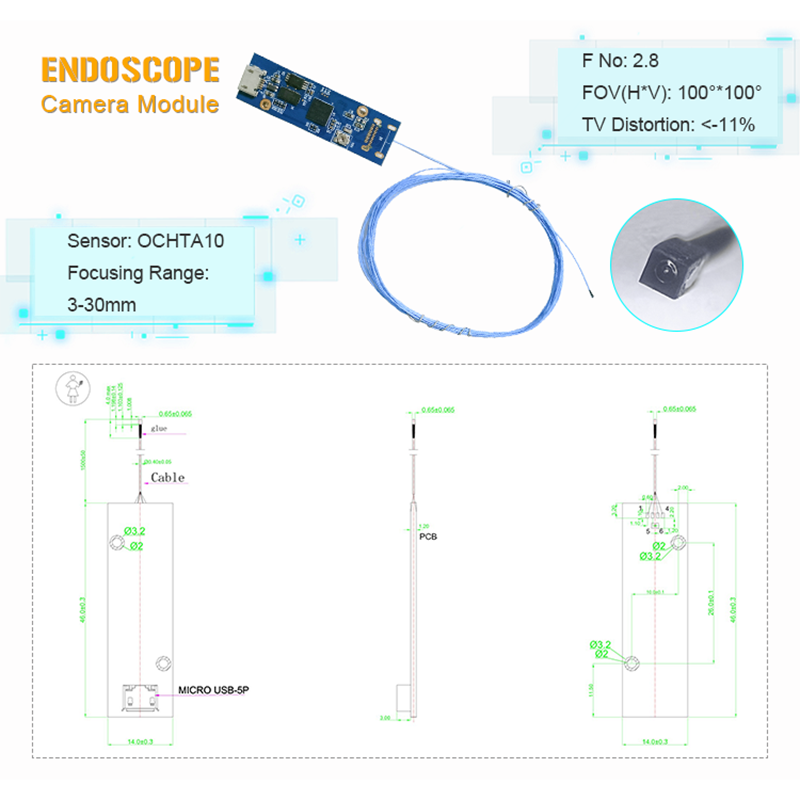
This OCHTA10 CMOS Sensor Ultra Wide Angle HD Image Endoscope Camera Module, is based on the OCHTA10 image sensor, adopting a Micro-USB 5Pin interface to realize both power supply and data transmission simultaneously. Its built-in UVC protocol enables plug-and-play functionality, eliminating the need for additional main controls and complex debugging, which significantly reduces integration and deployment costs. The 100°×100° ultra-wide-angle optical system combined with 400×400 high resolution achieves clear imaging in an ultra-mini lens size, covering a wide single-frame range. The fixed focus design eliminates manual debugging steps to improve efficiency; it supports YUV/MJPEG dual-format output to adapt to different image processing needs, complies with RoHS environmental standards, and can stably adapt to various scenarios such as industrial and embedded applications.
|
 |
Product Advantage ◢
UVC Plug-and-Play: Built-in UVC protocol, no additional drivers or main controls required, just connect to the device for use, simplifying the operation process.
100°×100° Ultra-Wide Angle: Expands the single-frame imaging coverage, reduces the number of lens movements during detection or collection, and improves efficiency.
Ultra-Mini Lens with High-Definition Imaging: Stably outputs 400×400 resolution in an ultra-mini lens size, balancing compactness and clarity.
Fixed Focus & Dual-Format Output: Eliminates manual debugging steps, supports YUV/MJPEG dual formats, and adapts to various usage scenarios.
Technical Parameters ◢
Product Name |
Mini Endoscope Module |
Image Sensor |
OCHTA10 |
Diameter |
0.9mm |
Focusing Range |
3-30mm |
Focal Length |
0.175mm |
F No. |
2.8 |
| Resolution | 400*400 |
| Connector | Micor-USB-5P |
FOV(H*V) |
100°*100° |
TV Distortion |
<-11% |
Output |
USB2.0 UVC |
Format |
YUV&MJPEG |
Embedded Visual Perception: Can be used in small intelligent devices as an image acquisition unit. With its compact size and plug-and-play feature, it can obtain real-time environmental visual information and adapt to the miniaturization needs of devices.
Industrial Close-Range Inspection: Can be used in industrial close-range inspection scenarios to collect product appearance defects and size parameters. With its clear imaging and easy operation, it can support automated inspection processes.
Built-in Equipment Monitoring: Can be used for built-in monitoring of instruments and equipment. With its compact size and stable performance, it can visually record the internal working status of equipment and meet status monitoring needs.
Teaching Experiment Verification: Can be used for teaching experiment verification. With its simple operation and intuitive imaging, it can demonstrate the principle of visual acquisition and provide accurate image data for scientific research and teaching experiments.
FAQ ◢
Q1: What is a endoscope camera module?
The endoscope camera module is a sophisticated device designed to capture high-definition images and videos of narrow internal structures. It is widely utilized in various fields, including medical, industrial, and scientific research. In the medical field, its high-speed transmission interface enables real-time data transmission via network connections, facilitating remote consultations and analysis. This technology helps doctors observe internal organs and tissues, allowing them to identify potential lesions and health issues. In practice, tools like gastroscopy and colonoscopy enable doctors to directly examine the digestive tract, perform biopsies, and provide immediate feedback, enhancing diagnostic accuracy and treatment timeliness. In the industrial sector, endoscopic inspections of mechanical equipment and pipelines allow engineers to detect wear, corrosion, and blockages.
Q2: Are you factory or trade company?
A2: We are a leading camera module manufacturing company focused on providing high quality smart camera products. Our production facilities are equipped with ten dust-free and aseptic automated workshops to ensure efficient and clean every step. After strict training, employees abide by the operating procedures and wear special dustproof clothing to ensure the safety and cleanliness of the production environment. Each endoscope module is subjected to multiple rigorous tests to ensure that the product always maintains a high qualification rate. Our R&D team continues to innovate, keep up with market demand, promote technological progress, provide customers with excellent solutions, and win market trust and support.
Q3: How to control an endoscope camera module?
A3: When performing endoscopic operations, it is especially important to understand the device characteristics and operation steps to ensure the best image quality and data recording. Familiarity with software and equipment will help improve productivity. The operation of the endoscopic camera includes data transfer, software setup, image processing and display, and the seamless collaboration of hardware and software is essential. The camera usually operates within a specific voltage range, and it is necessary to avoid voltage fluctuations affecting performance. Connected to the device via USB, micro-USB, HDMI, and Wi-Fi interfaces, users can install related software based on camera compatibility, adjust image parameters, and monitor and dynamically optimize image effects in real time
Q4: What does an endoscope camera module see?
A4: The endoscope camera module can capture high-definition images or videos of a wide range of surrounding environments in real time. These stored photos or videos are then transmitted to the display screen, so that doctors or technical staff can see and analyze problems inside the body, pipes, engines or other areas, and make targeted interventions. In terms of medical use, endoscopes can penetrate the organs of the human body that are difficult to directly observe, such as the digestive tract, lungs, ears, esophagus, nose, etc., and can also be used for inspection of pipes or pipes, such as pipes or industrial systems, engine rooms or mechanical areas, air conditioning compressor bin areas, flexible or rigid endoscopes can be used, cameras are usually equipped with LED lights and other functions. To illuminate dark areas, and there may be additional tools, such as suction or grasping, clipping tools, to aid in surgery.
Q5: What can be customized for endoscope camera modules?
A5: The endoscope camera module offers versatile options to meet specific needs, available in both integrated and separated configurations. You can choose the diameter size that suits your application, ensuring optimal fit and performance. Additionally, customization options include the choice of whether the module comes with a durable steel sleeve for extra protection and whether it is equipped with built-in LED lighting for better visibility in dark or confined spaces.


