


| Quantity: | |
|---|---|


SF-C1019USB-D6.0-SV-L200
SINCEREFIRST
| This OV9734 CMOS Sensor Side View USB2.0 Interface Endoscope Camera Module carried on the OV9734 sensor adopts a 6.0mm diameter side-view structure and lateral optical imaging design, paired with a USB2.0 UVC plug-and-play interface, specially built for scenarios such as cavity side walls and narrow gap sides that conventional front-view probes cannot reach. Its 6.0mm compact diameter can easily extend into narrow spaces, and the side-view structure can accurately capture side imaging; equipped with integrated LED lighting, IIC control and brightness adjustment functions, it can flexibly adapt to close-range side wall detection needs. The USB2.0 interface integrates 5V power supply, data transmission and grounding functions, plug-and-play and easy to operate, providing a clear and stable visual imaging solution for various side-view scenarios. | 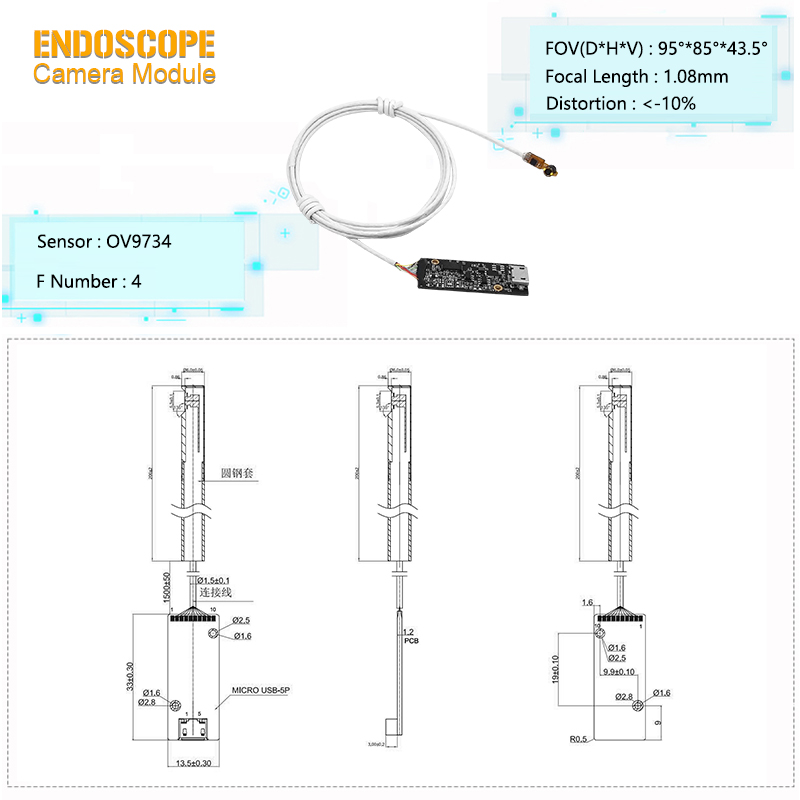 |
Side-View Dedicated Imaging: Adopts lateral optical design, can accurately capture side walls and narrow gap sides, solving the blind area problem of front-view probes.
6.0mm Compact Diameter: Slim size, can easily extend into narrow gaps and thin pipes, adapting to various hidden side-view detection scenarios.
OV9734 Sensor: Clear and stable imaging, accurately adapting to close-range side-view observation and ensuring detail presentation.
USB2.0 Plug-and-Play: UVC plug-and-play, integrating power supply, data transmission and grounding, simple and efficient to operate.
Pipe Inner Wall Side-View Detection: Can be used in pipelines above 6mm. With its 6.0mm diameter and side-view imaging, it can observe the inner wall status, defects and wear from the side without disassembling the pipeline.
Precision Equipment Side Maintenance: Can be used in narrow gaps inside electronic equipment. With its compact size and side-view function, it can inspect the side status of components, solder joints and cables without disassembly.
Automotive Hidden Part Side Detection: Can be used in engine gaps, air conditioning ducts and other parts. With its accurate side-view and flexible adaptation, it can locate side wall faults and evaluate status.
Vertical Surface Close-Range Imaging: Can be used for vertically installed components and side wall samples. With its close-range side-view and clear imaging, it can complete high-definition image acquisition and recording.
Product Name | Endoscope Camera Module |
Image Sensor | OV9734 |
Diameter | 6mm |
Pixel | 1MP |
FOV(D*H*V) | 95°*85°*43.5° |
TV Distortion | <-10% |
Connector | Mini USB-5P |
LED | 0402 LED |
DSP | USB2.0 UVC |
Format | YUV&MJPG |
FAQ
1. How to choose the module suitable for car maintenance?
It is necessary to have an oil-proof lens, adjustable focal length (such as 10-100mm), LED strong light, some with magnetic probes or 360° rotating head to check the engine dead Angle.
2. Why do pipeline inspection modules need long cables?
The cable length is usually 10-30 meters, including Kevlar tensile layer and waterproof connector, which supports real-time transmission while resisting internal friction and chemical corrosion of the pipeline.
3. What should I do if the module fails after high temperature sterilization?
Check whether the tolerance temperature is exceeded (for example, some are only 120°C), turn off the power and remove the battery before sterilization, damage may involve sealant failure or circuit board deformation.


