




| Quantity: | |
|---|---|


SF-C1019USB-D3.6-PRO-D120-Glass
SINCEREFIRST
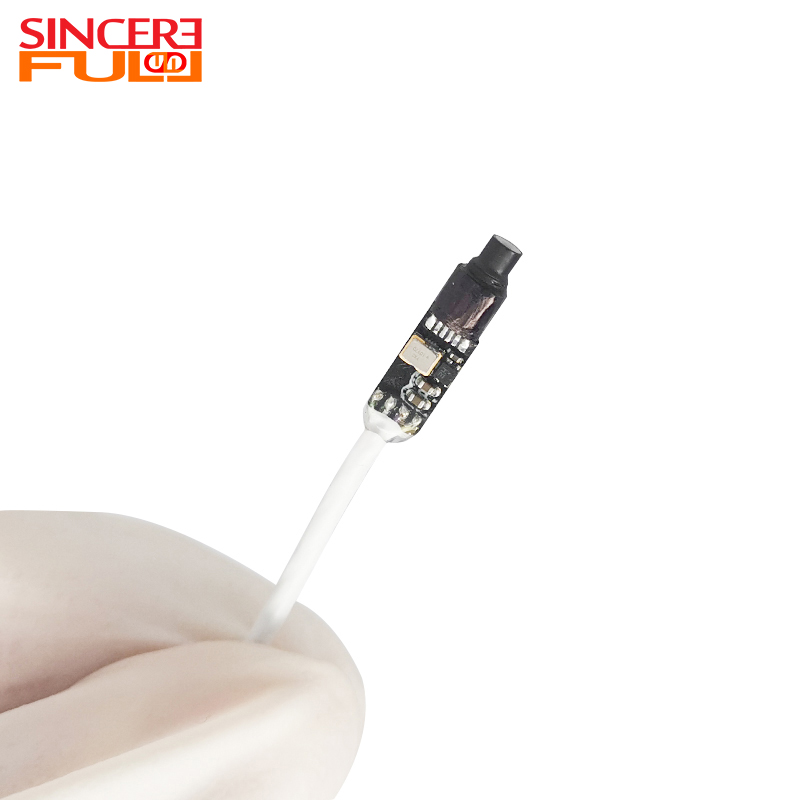
This 3.6mm Diameter USB2.0 Interface HD Mini OV9734 CMOS Sensor Separate Endoscope Camera Module,is a professional visual detection component specially designed for ultra-narrow space visualization, integrating the mature OV9734 CMOS sensor to deliver stable HD imaging performance. Its probe diameter is precisely controlled at 3.6mm, achieving an extreme miniaturization design that breaks through the space limitations of conventional endoscopic equipment, allowing easy access to micro-holes, thin pipes and narrow gaps that ordinary probes cannot reach, significantly improving detection accessibility. The optical system is optimized for close-range imaging with a 10–100mm focusing range, perfectly adapting to the typical working distance of endoscopic scenarios, ensuring stable clarity during close-range observation; paired with a 1.08mm focal length, F4.0 aperture and 95°×85°×43.5° field of view, it can cover a wide detection range while maintaining clear imaging, even in confined spaces. Equipped with 4 high-brightness LED lights, it can provide effective supplementary light for dark narrow spaces, further ensuring clear imaging in low-illumination environments, and the optional LED fill light design allows flexible configuration according to actual detection needs. Adopting a standard USB2.0 UVC driver-free architecture, it supports YUV/MJPEG output formats and 720P@30fps stable imaging, enabling quick start of imaging by directly connecting to terminal devices without installing additional drivers, greatly simplifying deployment and operation. The module is equipped with 5PIN USB and JST SM04B-GHS-TB dual interfaces, enhancing compatibility and flexibility in system integration, and complies with RoHS environmental requirements, meeting industrial environmental protection standards. The combination of extreme miniaturization, close-range wide-range imaging, driver-free convenience, and optional LED fill light makes this module widely applicable to ultra-thin pipelines, precision electronics, automobile maintenance, medical experiments and other ultra-narrow space detection scenarios, becoming a reliable imaging solution for confined space detection. | 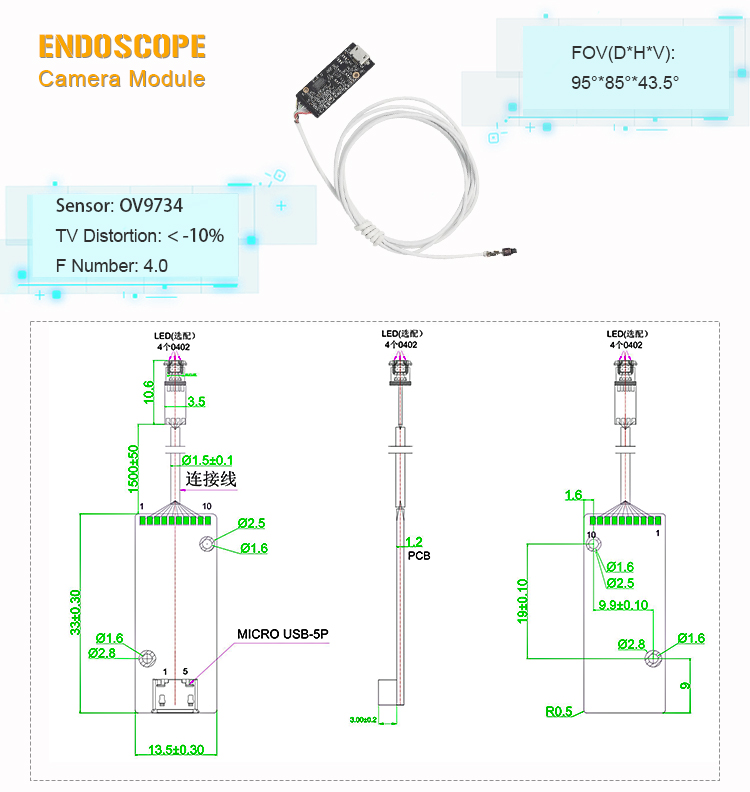 |
3.6mm Ultra-Miniature Probe:Extremely compact design allows access to micro-holes, thin pipes, and narrow gaps that conventional equipment cannot reach, improving detection in ultra-tight spaces.
UVC Plug-and-Play:Compliant with USB 2.0 UVC standard. No driver installation required—simply connect to the terminal device for instant imaging.
Close-Range to Wide-Range Imaging:Focusing range from 10–100mm ensures clear, stable imaging across typical endoscopic working distances.
High-Brightness LED Lighting:Four optional LEDs provide effective illumination in low-light, confined spaces, with flexible configuration to suit different detection needs.
Pipeline Inspection:Ideal for micro-channels, thin pipelines, and hydraulic systems (≥3.6mm). Ultra-miniature probe and 10–100mm imaging ensure clear observation of internal states and defects.
Precision Electronics Maintenance:Accesses tight gaps in phones, laptops, and precision instruments to identify hidden component faults or soldering issues.
Automotive Narrow-Space Inspection:Suitable for engines, air conditioning lines, wiring channels, and fuel injectors. The small probe and wide FOV (95°×85°×43.5°) improve efficiency in fault detection without disassembly.
Medical and Experimental Micro-Probing:Fits small cavities and experimental setups for biological or medical observation. Close-range imaging supports high-precision inspection in research or clinical scenarios.
Sensor | OV9734 |
LED | 0402 White LED |
Connector | Mini USB-5P |
Diameter | 3.6mm |
Pixel | 1MP |
DSP | USB2.0 UVC |
Focusing Range | 10-100mm |
Focal Length | 1.08mm |
F Number | 4.0 |
| Output Format | YUV&MJPEG |
| Resolution | 720P@30fps |
| Key Words | Septate Endoscope Camera Module |
FOV(D*H*V) | 95°*85°*43.5° |
TV Distortion | <-10% |
FAQ
1. What are the typical requirements for custom modules?
Common requirements include special dimensions (e.g., 1mm diameter), multispectral imaging (e.g., fluorescence navigation), and interface protocol adaptation (e.g., interfacing with DICOM systems).
2. What can I do if the module fails to start?
Check the power adapter (for example, 12V output), the port is loose, and the fuse is blown. If the wireless module is used, check the battery level and pairing status.
3. What is the difference between medical and industrial endoscope modules?
The medical module emphasizes biocompatibility, sterilization and high image quality, and needs to comply with FDA/CE certification; Industrial modules focus on durability (such as corrosion protection), wide temperature operation (-20°C to 70°C), and special light sources (such as UV).
4.Is the LED fill light unit standard or optional? Is self-installation supported?
The four 0402-size LED fill lights are optional, not standard. They can be configured based on your lighting requirements. To enable this function, simply ensure compatibility with the corresponding pin definitions on the 10PIN sensor interface.
5.What is the maximum imaging specification? Is higher resolution output supported?
The maximum imaging resolution is 720P at 30fps, with YUV & MJPEG output formats. As the hardware and protocol are finalized, higher resolutions are not supported.
6. What are the pin definitions for the Micro USB-5P interface?
The Micro USB-5P interface pins are defined as follows: Pin 1 (USB_5V/Power), Pin 2 (USB_DM/Data-), Pin 3 (USB_DP/Data+), Pin 4 (GND), and Pin 5 (Shield Ground). This design integrates power supply, data transmission, and shielding.
7.What does a TV distortion value of < -10% indicate?
A TV distortion value of < -10% indicates barrel distortion. This is a specialized design for endoscopic lenses, enhancing field-of-view coverage in confined spaces under wide angles, which meets the specific requirements of endoscopic imaging.


