Research on Lightweight Integration of Low-Power Imaging Modules in Children’s Educational MicroscopesAbstractScientific enlightenment tools designed for young children must ensure both operational safety and engagement while providing intuitive and clear observational experiences. Traditional optic
Deconstructing the Design Philosophy and Application Boundaries of a Compact Endoscope Camera ModuleAgainst the backdrop of the increasing miniaturization and integration of professional-grade image acquisition equipment, a compact endoscope camera module tailored for close-range, confined-space ins
Technical Evolution and Clinical Empowerment of Hysteroscopic Imaging Systems Abstract With the deepening application of minimally invasive diagnostic and therapeutic techniques in gynecology, hysteroscopy has become a core tool for diagnosing and treating intrauterine lesions. Its clinical efficacy
January 27, 2026 — Mindray has been granted a patent for a novel "endoscopic camera and endoscopic camera system," introducing a dedicated anti-collision terminal structure. This innovation directly addresses a critical and often overlooked challenge in the precise assembly process of high-end endos
How to Select the Right Ultra-Short-Throw HD Camera Module for Confined Spaces? When integrating vision systems into industrial endoscopes, pipeline inspection tools, minimally invasive surgical instruments, or compact devices, choosing the right camera module is critical to success. Faced with chal
{"text":"The medical imaging landscape is rapidly shifting from Full HD (1080p) to Ultra HD (4K) as the new gold standard for high-end visualization. While marketing departments often demand 4K specifications to compete in premium segments, engineering teams face a complex reality. Integrating a hig
{"text":"In minimally invasive surgery (MIS), the monitor acts as the surgeon’s eyes, introducing a unique physiological challenge known as \"Hand-Eye Decoupling.\" Even millisecond delays between a physical hand movement and the visual confirmation on the screen can disrupt surgical flow. This late
{"text":"The landscape of medical and industrial inspection is rapidly shifting. We are moving away from bulky, cart-based units toward handheld, battery-operated IoT devices. This transition empowers professionals to perform diagnostics in remote or constrained environments with unprecedented ease.
{"text":"The medical device industry is currently navigating a fundamental restructuring. For decades, endoscopy relied on the \"asset\" model, where hospitals purchased expensive capital equipment designed to last for years. Today, the sector is rapidly shifting toward a \"consumable\" model, drive
{"text":"Accessing sub-2mm cavities presents a significant engineering hurdle across both medical and industrial sectors. Surgeons navigating bronchial peripheries and maintenance crews inspecting turbine blade cooling channels often face a physical wall: traditional 3mm borescopes simply cannot fit
January 19, 2026 — Ofilm has announced the completion of its 1×1mm ultra-miniature endoscopic camera module, marking a pivotal step in advancing minimally invasive medical diagnostics. This breakthrough addresses a core challenge in the industry by dramatically reducing the size constraints of tradi
Building Competitive Advantage in Compact Industrial Vision: Strategic Considerations for Micro HD Camera ModulesWith rapid advancements in industrial automation, endoscopic inspection, and consumer electronics, market demand for ultra-compact, highly integrated, reliable, and durable HD camera modu
In the optical technology iteration of camera modules, liquid lenses, as a new type of component breaking the limitations of traditional solid-state lenses, are gradually changing the design logic and application scenarios of modules with their dynamically adjustable optical characteristics. Unlike
From "Seeing" to "Seeing Clearly, Understanding and Penetrating"In the field of medical devices, the development of endoscope technology has profoundly changed the way of diagnosis and minimally invasive surgery. As the "eyes" of the endoscope system, camera modules are undergoing a profound transfo
The Profound Transformation of Medical Imaging Through the Lens of 10MP Endoscope ModulesIn an era where precision medicine and minimally invasive surgery are increasingly prevalent, endoscopes serve as the doctor's “extended eyes.” Their technological evolution directly impacts diagnostic accuracy
When Full HD resolution becomes a standard specification for miniature image sensors, Rayshun Micro's ES101 and OmniVision's OH01A10 have developed distinctly different technical characteristics within the same resolution framework.
5MP HD autofocus module empowers the Rhino XT duct cleaning system: Clear vision drives professional cleaning and transparent service.In professional HVAC duct cleaning, service value lies not only in cleaning results but also in the visualization, verifiability, and trustworthiness of the cleaning
Industry Analysis of Miniature HD Camera Modules: Core Perception Components in the Era of Intelligent VisionIntroductionAmidst the wave of universal connectivity and intelligent upgrades, machine vision has emerged as a pivotal technology empowering countless industries. As the “eyes” of visual sys
The development of high-resolution industrial endoscopes with an extremely small diameter is not merely a matter of component miniaturization, but a system-level engineering challenge that necessitates a sophisticated trade-off among optics, sensor performance, mechanical structure, and signal integ
High-Definition Micro Modules Empower Flexible Veterinary EndoscopesIn modern veterinary diagnostics, achieving precise internal examination, foreign body removal, and diagnostic sampling with minimal trauma is crucial for enhancing animal welfare and clinical standards—especially when dealing with
| Availability: | |
|---|---|
| Quantity: | |
SF-C1019USB-D3.9-ALL-D95
SINCEREFIRST
Narrow-space inspection in industrial and medical fields often faces trade-offs between image clarity and durability—until the OV9734 USB Endoscope Camera Module (Model: SF-C1019USB-D3.9-ALL-D95) from SincereFirst. As a 3.9mm ultra-slim imaging solution, it bridges medical-grade precision (for minimally invasive procedures) and military-spec ruggedness (for harsh industrial environments), solving pain points like blurry imaging in oil/smoke or probe damage in high-vibration scenarios. Backed by SincereFirst’s 30+ years of optical engineering (est.1992), this module delivers consistent performance for both critical surgeries and heavy-duty equipment diagnostics.
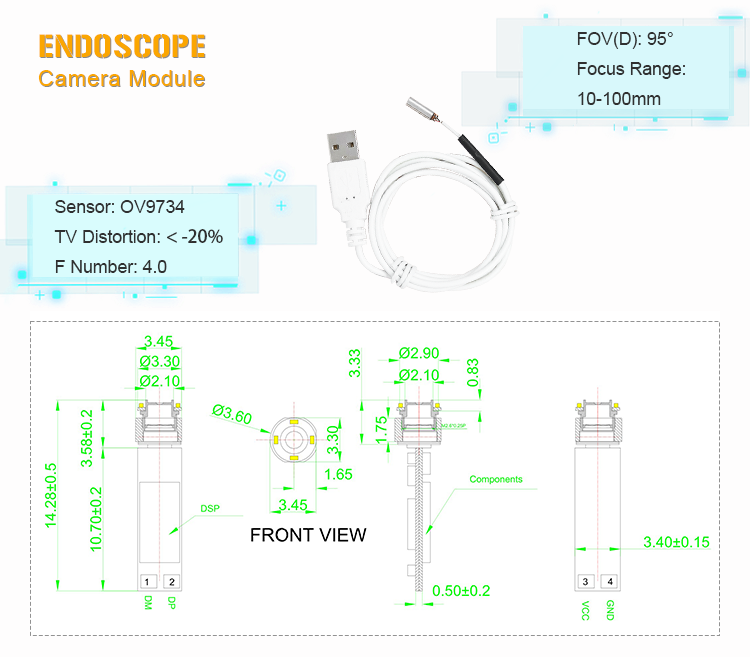
Keywords | USB Endoscope Inspection Camera Module |
Sensor | OV9734 |
LED | 0201 White LED |
Module Size | 3.9mm dia |
Focusing Range | 10mm-100mm |
Focal Length | 1.25mm |
FOV(D) | 95° |
TV Distortion | <-20% |
Output Format | Standard UVC |
F Number | 4 |
Imaging Quality | Colorfull |
Interface | USB2.0 |
1MP OmniVision OV9734 sensor streams 30FPS with latency; adaptive noise reduction eliminates blur in smoke-filled/oily industrial environments—ideal for gear wear or pipe crack detection.
3.9mm stainless steel probe survives 15G vibration and 85°C continuous operation; optional X-ray shielding for nuclear facilities—perfect for aerospace combustion chamber inspections or automotive transmission diagnostics.
Supports USB 2.0/Type-C/Micro-USB with automatic protocol negotiation; plug-and-play on Windows/Linux/macOS/Android—no driver development needed for explosion-proof tablets or medical workstations.
Quad 0201 white LED array with 6-100 lumen stepless dimming; auto color temperature adjustment ensures accurate material analysis (e.g., semiconductor wafer defects).
Inspect combustion chambers and turbine blades for cracks; withstands high temperatures (up to 85°C) and vibration. Analyze transmission gear wear or engine block leaks via 3.9mm ultra-slim probe; no disassembly needed.
Support minimally invasive surgeries (e.g., ENT, gastroenterology) with medical-grade imaging clarity. Detect semiconductor wafer defects or plastic part mold errors; 98.7% defect accuracy (third-party validated). Monitor wind turbine blade erosion or pipeline corrosion; IP67 rating resists outdoor moisture.
Pair it with a dual-lens splitter prism to capture left/right-eye images; output ≥1080p/60fps to 3D displays—ideal for complex minimally invasive surgeries.
Differences stem from sensor quality (e.g., OmniVision OV9734 vs. generic), optical lenses (aspherical vs. standard), and certifications (FDA/CE for medical use—takes 2-3 years).
Yes—common customizations include X-ray shielding (nuclear), longer cables (pipeline), or multispectral imaging (agricultural crop inspection). Contact our team for details.
Narrow-space inspection in industrial and medical fields often faces trade-offs between image clarity and durability—until the OV9734 USB Endoscope Camera Module (Model: SF-C1019USB-D3.9-ALL-D95) from SincereFirst. As a 3.9mm ultra-slim imaging solution, it bridges medical-grade precision (for minimally invasive procedures) and military-spec ruggedness (for harsh industrial environments), solving pain points like blurry imaging in oil/smoke or probe damage in high-vibration scenarios. Backed by SincereFirst’s 30+ years of optical engineering (est.1992), this module delivers consistent performance for both critical surgeries and heavy-duty equipment diagnostics.

Keywords | USB Endoscope Inspection Camera Module |
Sensor | OV9734 |
LED | 0201 White LED |
Module Size | 3.9mm dia |
Focusing Range | 10mm-100mm |
Focal Length | 1.25mm |
FOV(D) | 95° |
TV Distortion | <-20% |
Output Format | Standard UVC |
F Number | 4 |
Imaging Quality | Colorfull |
Interface | USB2.0 |
1MP OmniVision OV9734 sensor streams 30FPS with latency; adaptive noise reduction eliminates blur in smoke-filled/oily industrial environments—ideal for gear wear or pipe crack detection.
3.9mm stainless steel probe survives 15G vibration and 85°C continuous operation; optional X-ray shielding for nuclear facilities—perfect for aerospace combustion chamber inspections or automotive transmission diagnostics.
Supports USB 2.0/Type-C/Micro-USB with automatic protocol negotiation; plug-and-play on Windows/Linux/macOS/Android—no driver development needed for explosion-proof tablets or medical workstations.
Quad 0201 white LED array with 6-100 lumen stepless dimming; auto color temperature adjustment ensures accurate material analysis (e.g., semiconductor wafer defects).
Inspect combustion chambers and turbine blades for cracks; withstands high temperatures (up to 85°C) and vibration. Analyze transmission gear wear or engine block leaks via 3.9mm ultra-slim probe; no disassembly needed.
Support minimally invasive surgeries (e.g., ENT, gastroenterology) with medical-grade imaging clarity. Detect semiconductor wafer defects or plastic part mold errors; 98.7% defect accuracy (third-party validated). Monitor wind turbine blade erosion or pipeline corrosion; IP67 rating resists outdoor moisture.
Pair it with a dual-lens splitter prism to capture left/right-eye images; output ≥1080p/60fps to 3D displays—ideal for complex minimally invasive surgeries.
Differences stem from sensor quality (e.g., OmniVision OV9734 vs. generic), optical lenses (aspherical vs. standard), and certifications (FDA/CE for medical use—takes 2-3 years).
Yes—common customizations include X-ray shielding (nuclear), longer cables (pipeline), or multispectral imaging (agricultural crop inspection). Contact our team for details.
