This OV9734 3.5mm Diameter Steel Shell IP67 Waterproof 1MP HD Image USB Endoscope Camera Module for Close-Range Inspection, provides practical 720P imaging with an 88° field of view, 10–40mm focusing range and 6pcs 0402 LED illumination. It is designed for close-range observation inside equipment, small holes, mechanical cavities and low-light environments. The Steel Shell structure improves front-end protection and probe integrity, making it suitable for industrial inspection tools, maintenance endoscopes and portable USB endoscope devices.. | 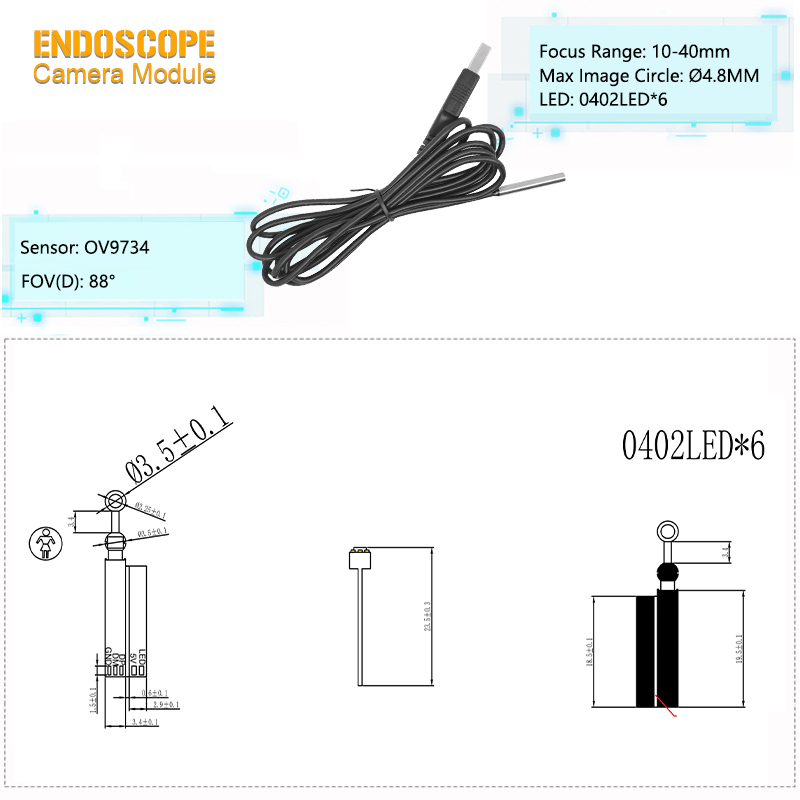 |
Product Highlight ◢
1. D3.5 Compact Steel Shell Structure: Suitable for narrow-space observation while improving probe protection and integration integrity.
2. OV9734 1MP Practical Imaging: Provides 720P-level observation for general inspection endoscope products.
3. 88° Medium Field of View: Better suited for focused target-area observation rather than ultra-wide inspection.
4. 10–40mm Close Focusing Range: Suitable for short-distance observation of small holes, cavities, mechanical structures and equipment interiors.
5. 6-LED Illumination: Supports low-light inspection inside dark cavities, holes and internal equipment spaces.
Technical Parameters ◢
Product Name | OV97342 Sensor Endoscope Camera Module |
Diameter | 3.5MM |
DSP | Type-C |
Sensor | OV9734 |
Lens Material | Plastic |
| Resolution | 720P |
| FOV | 88° |
Focusing Range | 10-40mm |
lens | Hd lens/prime focus |
Operating temperature | -20~70℃ |
Storage temperature | 0~50℃ |
Front Connector | Type C |
Application of Endoscope Camera Module
-
Industrial Equipment Internal Inspection: Enables non-destructive testing of heavy machinery and pipelines. Utilizes a slim probe with HD imaging and LED illumination to penetrate deep into equipment, accurately identifying cracks and corrosion within confined spaces.
-
Automotive Repair and Mechanical Maintenance Tools: Facilitates inspection of engine blocks and hidden chassis components. Navigates complex structures via a flexible tube to transmit real-time clear visuals, helping technicians pinpoint faults quickly without unnecessary disassembly.
-
Close-Range Small-Hole, Cavity, and Tube Observation: Supports internal quality checks for precision instruments and tubing. Leverages macro focus and high resolution to render minute details clearly at extremely close working distances, meeting fine observation needs in tight spaces.
-
Handheld USB Endoscope Devices: Optimizes on-site inspections and mobile operations. Features USB plug-and-play connectivity for direct HD streaming to smartphones or tablets, balancing portability with operational flexibility to boost field efficiency.
-
Household or Portable Inspection Tools: Aids in drain cleaning and appliance troubleshooting. Combines a lightweight design with a waterproof probe, allowing non-experts to intuitively inspect hidden areas and quickly diagnose blockages or damage.
-
Project Evaluation for Veterinary, Oral, or General Close-Range Observation Devices: Accelerates prototype validation for medical devices. Relies on standardized interfaces and stable image output to help developers test optical performance and structural design cost-effectively, speeding up the transition from concept to mass production.
FAQ
1.What is the working principle of the endoscope camera module?
The endoscope camera module collects internal images through the optical lens at the front end, converts them into electrical signals by CMOS or CCD sensors, and then optimizes them through noise reduction, enhancement, etc. by the image processing chip, and finally outputs high-definition video signals. Some modules support wireless transmission or optical fiber signal transmission, making them suitable for medical or industrial inspection scenarios.
2.Why is low-light performance important for endoscope modules?
When the ambient light inside the body or in the pipeline is insufficient, the module needs to be equipped with a high-sensitivity sensor and a large-aperture lens, and be combined with noise reduction algorithms to ensure the clarity of the dark field. Some products adopt infrared supplementary lighting or HDR technology to enhance low-light performance.
3. What is the significance of the depth of field range of the module?
The large depth of field can clearly present both near and far objects simultaneously, reducing the need for frequent focusing and is suitable for endoscopic surgery. Shallow depth of field is used to highlight specific planar details, such as epidermal examination.


