


| Quantity: | |
|---|---|


SF-SJN1050-USB
SINCEREFIRST
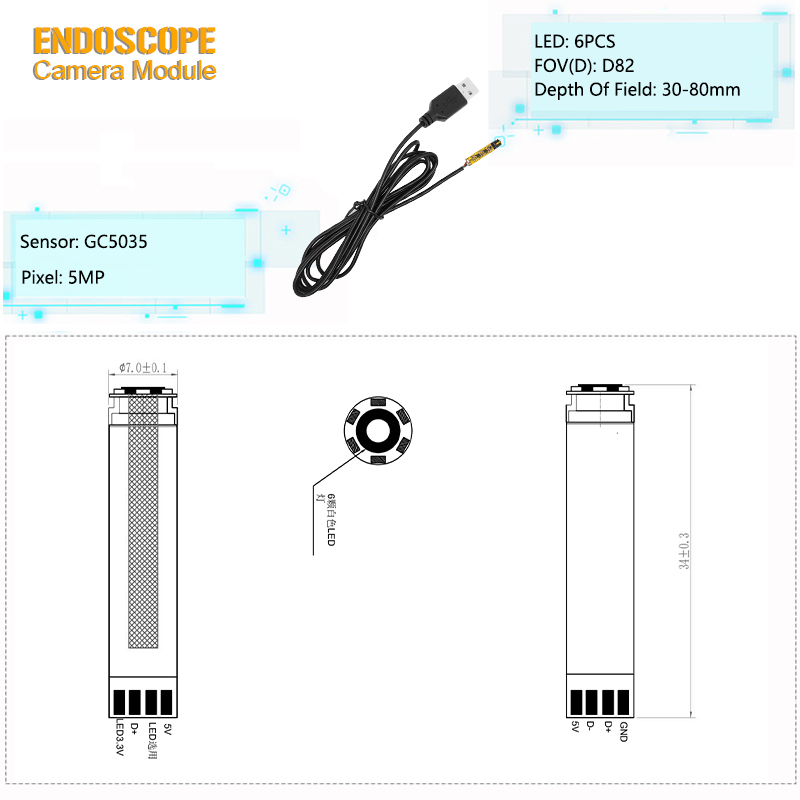
The SF-SJN1050-USB is an integrated USB endoscope camera module for equipment that needs a compact imaging head and built-in illumination. The camera, lens and six-LED array are arranged in a cylindrical module measuring 7.0±0.1mm in diameter and 34±0.3mm in length. This format helps engineers package the imaging unit inside a probe, handheld inspection tool or purpose-built enclosure without using a separate light source at the tip.
The GC5035 CMOS sensor provides 5MP imaging, while the 82° diagonal field of view balances scene coverage with the need to inspect confined areas. A 30–80mm depth of field is suited to targets viewed at a moderate working distance rather than direct-contact or ultra-close macro inspection. For other mechanical structures and diameters, review the integrated endoscope camera module range.
The GC5035 sensor gives the module the resolution needed to record surface condition, component position and other visible details during inspection. Actual image quality will also depend on the selected output mode, lens setting, illumination, cable configuration, host hardware and viewing software, so evaluation should be carried out in the final device environment.
Six white LEDs are positioned around the lens to illuminate dark cavities at the point of capture. The circular layout helps distribute light around the viewing area and reduces reliance on an external tip light. LED brightness is adjustable on supported configurations; the required control method and operating range should be confirmed before sampling.
The 82° diagonal field of view provides a useful view of the surrounding area without requiring excessive probe movement. Within the specified 30–80mm depth of field, the optical setup is intended to keep targets at different distances acceptably clear. Objects placed closer than the near limit or beyond the far limit may require a different lens or focus configuration.
The dimensional drawing specifies a maximum head diameter of 7.0±0.1mm and an overall module length of 34±0.3mm. These dimensions should be used when designing the mating tube, front window, retaining structure and cable exit. Allow room for assembly tolerances rather than designing the enclosure to the nominal 7.0mm value alone.
The front view shows six LEDs evenly arranged around the central lens. At the electrical end, the drawing identifies 5V, D−, D+ and GND connections for the USB signal and power path. Final pinout, cable length and connector type should be confirmed on the approved drawing before tooling or batch assembly begins.
Item | Specification |
|---|---|
Model | SF-SJN1050-USB |
Brand | SINCEREFIRST |
Module Type | Integrated USB endoscope camera module |
Image Sensor | GC5035 CMOS sensor |
Resolution | 5MP |
Aperture | F2.8 |
Diagonal Field of View | 82° |
Depth of Field | 30–80mm |
Head Diameter | 7.0±0.1mm |
Module Length | 34±0.3mm |
Illumination | 6 front-facing white LEDs |
LED Control | Adjustable on supported configurations |
Interface | USB 2.0, UVC |
USB Connections | 5V, D−, D+, GND |
Output Formats | MJPEG / YUY2; confirm the approved firmware configuration |
Host Systems | UVC-compatible Windows, macOS, Linux and Android hosts; target-device testing required |
Listed Working Temperature | −20°C to 70°C |
Environmental Compliance | RoHS |
The compact head, integrated LEDs and USB connection allow the module to be evaluated for endoscopic imaging equipment and other auxiliary visualization devices. It is an imaging component rather than a finished medical device. The device manufacturer is responsible for validating image performance, electrical and thermal safety, patient-contact materials, cleaning or sterilization methods, software, EMC and all market-specific regulatory requirements.
The module can be integrated into inspection equipment for viewing internal pipe surfaces, channels, housings and other areas that are difficult to access directly. Waterproofing, chemical resistance and impact protection depend on the final probe housing and sealing design; these properties should not be assumed from the camera module alone.
The 7mm head can support visual checks inside mechanical assemblies, equipment housings and maintenance access points where available space is limited. The 30–80mm depth of field is particularly relevant when the inspected surface sits several centimeters in front of the camera rather than directly against the lens.
Equipment developers can use the module as a compact image input for prototypes, test fixtures, teaching equipment and application-specific visualization systems. The target host, image format, cable route and illumination control should be fixed during sample evaluation.
The USB 2.0 UVC interface is intended to simplify connection to compatible host systems without a product-specific video driver. UVC support, however, does not remove the need for device-level testing. Host controller behavior, available USB bandwidth, cable length, power stability and software settings can all affect the final video stream.
Before integration, confirm:
The target operating system and hardware platform
Required image resolution, frame rate and output format
Available USB bandwidth and power supply stability
Cable length, cable routing and connector type
LED brightness and control requirements
Image orientation, color tuning and other firmware settings
If the host architecture or mechanical envelope differs from this standard model, compare other USB endoscope camera module options before final selection.
A camera module should be approved in the actual device rather than selected from sensor resolution alone. For an efficient technical review, provide the target application, available head diameter, working distance, host platform, cable requirement, environmental conditions and expected order volume.
Project Detail | Why It Matters |
|---|---|
Target device and enclosure drawing | Confirms the 7mm head, 34mm length and cable exit fit the mechanical design |
Typical target distance | Verifies whether the 30–80mm depth of field matches the inspection task |
Host hardware and operating system | Supports UVC, bandwidth and power compatibility checks |
Required resolution and frame rate | Determines the output mode and firmware configuration to evaluate |
Cable length and connector | Affects signal stability, routing and assembly |
LED control requirement | Defines brightness adjustment and operating behavior |
Temperature, sealing and cleaning conditions | Identifies housing, material and validation needs outside the bare module |
Sample quantity and forecast demand | Helps plan evaluation and production requirements |
Depending on the project, the engineering team can evaluate cable, connector, lens, firmware and mechanical adaptations. A typical project flow covers requirement review, drawing and specification confirmation, sample preparation, customer-side testing and production after the approved sample is signed off.
SincereFull is a core endoscope camera module brand under SincereFirst, which has worked in optical imaging since 1992. The product range covers integrated, separated, USB, wireless, medical-development and industrial camera module configurations. This allows equipment developers to compare a standard module with a project-specific solution rather than forcing one camera design into every application.
Support can include requirement review, module selection, drawing confirmation, sample coordination and transition to production. For a useful evaluation, the engineering discussion should begin with measurable constraints such as diameter, viewing distance, interface, cable, lighting and operating environment.
Yes. The supplied drawing specifies a head diameter of 7.0±0.1mm. The mating enclosure should include suitable assembly clearance and should be checked against the approved production drawing.
The module uses a 5MP GC5035 sensor, but the available USB stream depends on the approved firmware, output format, frame rate, host bandwidth and software. State the required resolution and frame rate when requesting a sample so the output mode can be confirmed.
The module is designed around the USB Video Class standard and can connect to compatible Windows, macOS, Linux and Android hosts. Compatibility should still be tested on the exact host board, USB port, operating-system version and application software used in the final product.
No IP rating or sterilization method should be assumed for the bare module. Waterproofing and resistance to cleaning or sterilization processes depend on the finished enclosure, lens window, adhesive, cable seal and validated device design. Share the intended environment before requesting a sample.
Adjustable LED lighting is available on supported configurations, but the control method depends on the electrical and firmware design. Confirm whether the final device needs fixed brightness, manual adjustment or software-linked control.
These items can be reviewed as part of an OEM project. Provide the required cable length, connector drawing, host platform, image orientation and preferred output settings so technical feasibility can be assessed before sampling.
No. It is an imaging component that may be evaluated for integration into medical or auxiliary visualization equipment. Product-level safety, clinical performance, EMC, software and regulatory compliance remain the responsibility of the finished-device manufacturer. RoHS environmental compliance is listed for the module.
Include the application, enclosure diameter, working distance, host system, output requirement, cable and connector, LED control preference, environmental conditions, sample quantity and estimated production demand. A drawing or photo of the intended device is also helpful.
OEM Camera Module Support
Share your application and integration requirements with our team. We will review whether the standard SF-SJN1050-USB fits your project or whether a tailored configuration should be evaluated.


