




| Quantity: | |
|---|---|


SF-C0310TV-D4.6
SINCEREFIRST
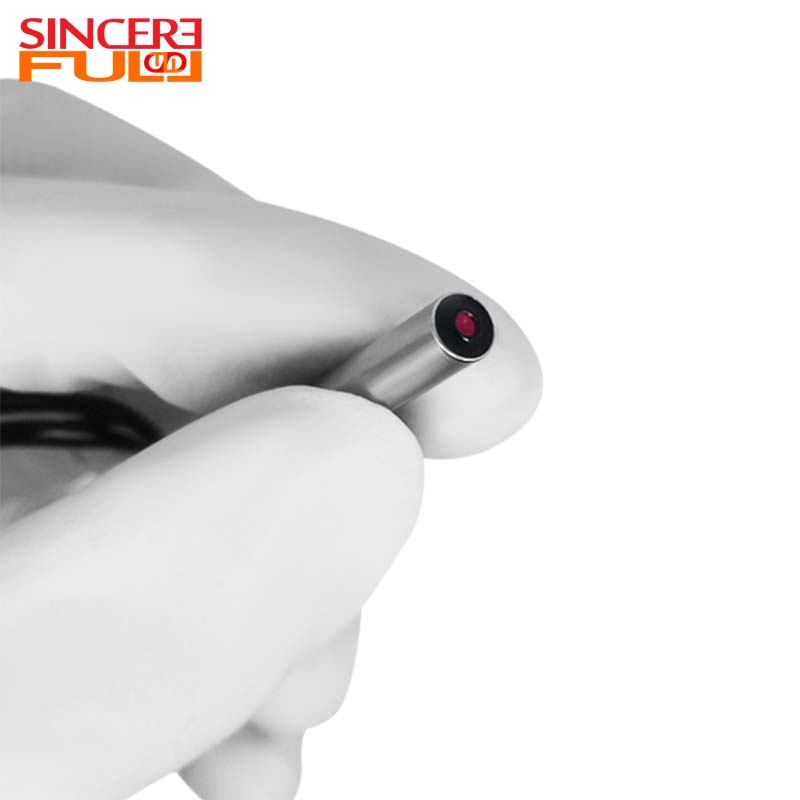
| This 4.6mm Diameter 720P IP67 Waterproof HD Image VGA NTSC Analog Endoscope Camera Module, is an endoscope camera module with VGA resolution (640×480) and NTSC analog video output (YUV format), specially designed for close-range detection in narrow spaces without digital devices, enabling direct connection to display terminals. Its 4.6mm compact probe balances structural strength and passability, fitting most thin pipes and cavities. With 1.08mm focal length, F2.8 aperture and 90° viewing angle, it achieves ultra-low distortion (<1%), restoring the real shape of images and improving detection reliability. The 10–60mm fixed focus optimizes clarity in commonly used endoscopic distances, ensuring clear imaging for close-range inspection. Equipped with 6 LEDs for fill light, it adapts to low-light environments; it supports 3.3–5V VCC power supply and 2.6–3.1V LED power supply, with power consumption of 90–170mA (including lights). Its NTSC analog output requires no decoding, enabling direct connection to monitors and perfect compatibility with old equipment. Compliant with RoHS standards, it balances compactness, compatibility and stability, ideal for close-range detection scenarios requiring direct display connection. |  |
1. 4.6mm Compact Size: Balances structural strength and passability, fitting most thin pipes and cavities.
2. Ultra-Low Distortion Imaging: Distortion <1%, restores real image shape and improves detection reliability.
3. NTSC Analog Direct Output: No decoding required, directly connects to monitors, compatible with old equipment.
4. 10–60mm Close-Range Focus: Fixed focus, ensures clear imaging in commonly used endoscopic distances.
Product Name | Medical Endoscope Camera Module |
Features | Micro Endoscope Camera Module |
Led | 0402 White Led |
Sensor | VGA |
Focusing Range | 10mm-60mm |
Waterproof | IP67 |
Focal Length | 1.08mm |
Trademark | SINCERE FIRST |
F Number | 2.8 |
Fov(D) | 90° |
| Distortion | <1.0% |
Thin Industrial Pipeline Endoscopy: Can be used for pipes above 4.6mm, utilizing its compact probe to observe internal defects and blockages.
Traditional Equipment Maintenance: Can be used for internal inspection of mechanical cavities, adapting to analog monitors for easy operation.
Portable Endoscopic Detection: Can directly connect to display terminals, realizing on-site rapid imaging without a host.
Precision Structure Observation: Can be used for detecting cavity and component shapes, thanks to its ultra-low distortion images.
FAQ◢
1.Why choose NTSC analog output?
NTSC ensures broad backward compatibility with standard-definition displays and older AV equipment. Practically, its ~30fps frame rate provides smoother motion capture and effectively prevents light flicker/banding when recording in 50Hz electrical regions.
2. How to evaluate the cost performance of the module?
For comprehensive resolution, durability, and after-sales support (such as medical modules that require calibration services from manufacturers), industrial scenarios can prioritize MTBF (mean time to failure) indicators.
3. Can I buy a used medical endoscope module?
Sterilization history, sensor wear (e.g. number of hours on) must be confirmed, and must be re-certified by the original manufacturer, otherwise there is a risk of cross-infection or performance.
4. What is the difference between medical and industrial endoscope modules?
The medical module emphasizes biocompatibility, sterilization and high image quality, and needs to comply with FDA/CE certification; Industrial modules focus on durability (such as corrosion protection), wide temperature operation (-20°C to 70°C), and special light sources (such as UV).
5. Can the endoscope camera module be equipped with both LED beads and optical fiber supplementary lighting simultaneously?
The endoscope camera module can be equipped with both LED beads and optical fiber supplementary lighting systems simultaneously. LED beads are usually integrated as the basic lighting source at the front end of the module, while fiber optic supplementary lighting is connected to a high-brightness cold light source (such as xenon lamp or laser light source) through a dedicated interface. The two can achieve coordinated supplementary lighting through time-sharing multiplexing or different spectral combinations. This hybrid lighting solution is mostly adopted for industrial-grade modules, while for medical modules, attention should be paid to the biocompatibility packaging of the optical fiber interface. The specific implementation needs to consider engineering issues such as power supply management, heat dissipation design and optical path coupling. Usually, this kind of solution requires deep customization and the price will be relatively high.


