




| Quantity: | |
|---|---|


SF-N735V3 D3.5
SINCEREFIRST
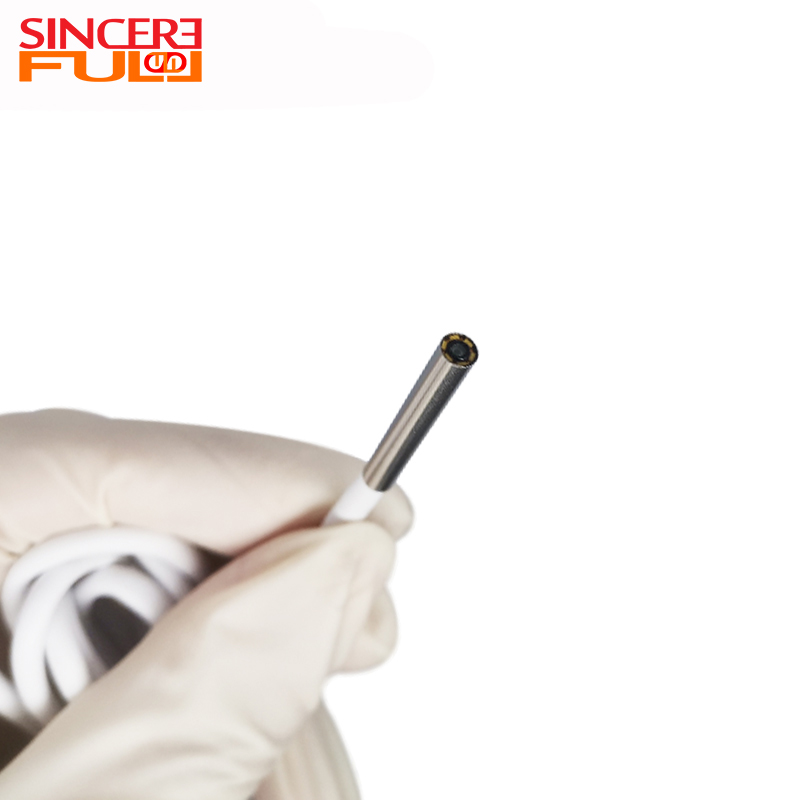
This 3.5mm Diameter 1MP HD Image OV9734 CMOS Sensor Wide Angle USB Integrated Endoscope Camera Module,
is a cost-effective miniature imaging solution engineered for close-range visual capture in confined spaces. Featuring a 3.5±0.1mm slim probe, the module strikes an ideal balance between structural rigidity and penetration capability to fit most medium and thin pipelines and enclosed cavities. Powered by the 1/9-inch OV9734 image sensor and optimized with a maximum Φ4.8mm imaging circle, it delivers coherent and natural visuals across the fixed 88° diagonal field of view with well-restrained distortion for distortion-free close-range observation. Pre-calibrated for 10–40mm focal range, it maintains steady sharpness throughout mainstream endoscopic working distances without manual tuning during deployment. Six built-in 0402 white LEDs supply uniform auxiliary lighting, enabling independent imaging in dark and lightless enclosed environments without extra lighting accessories. Designed with split structure and flexible cables, the module adapts to curved and complex installation paths. It supports driver-free use via Micro USB and Type-A dual USB interfaces to simplify device connection and lower integration barriers. Fully compliant with RoHS standards, this all-round module serves as a practical and easy-to-deploy imaging solution for daily inspection and embedded visual projects.
|
 |
3.5mm Compact Probe: Balances structural strength and penetration to match most common pipelines and confined cavities.
88° Optimized FOV: Moderate wide-angle design controls distortion efficiently and presents undistorted close-range images.
10–40mm Fixed Focus: Covers mainstream endoscopic working ranges and keeps stable definition without on-site debugging.
6 Built-in Fill LEDs: Offers stable auxiliary lighting to support direct imaging inside dark, lightless cavities.
Product Name |
30FPS Endoscope Camera Module |
Image Sensor |
OV9734 |
Lens Size |
1/9 inch |
Pixel Size |
1.4um X 1.4um |
Maximum effective pixel |
1280(H)X720(V) |
Interface type |
USB2.0 High Speed |
OTG protocol is supported |
USB2.0 OTG |
Supported resolution and frame rate |
30fps VGA YUV MJPEG / 30fps QVGA YUV |
Lens |
Hd lens/fixed focus |
Operating temperature |
-20~70℃ |
Pipeline Endoscopy: Can observe inner defects, blockages and corrosion of pipelines with inner diameter above 3.5mm relying on its slim and adaptable probe.
Mechanical Cavity Inspection: Can execute non-dismantling fault diagnosis for sealed structures such as engines, gearboxes and pump bodies.
Portable On-site Inspection: Can be assembled into handheld detection tools to realize fast on-site imaging and intuitive fault location.
Low-light Close-range Shooting: Can capture clear close-range footage inside dark narrow spaces with the assistance of dedicated LED fill lights.
FAQ◢
1. How does the endoscope camera module work?
The endoscope camera module collects the internal image through the front optical lens, converts it into electrical signal by CMOS or CCD sensor, and then optimizes it through image processing chip for noise reduction and enhancement, and finally outputs high-definition video signal. Some modules support wireless transmission or fiber optic signal transmission, suitable for medical or industrial inspection scenarios.
2. How does the Field of view (FOV) of the module affect the use effect?
The field of view Angle determines the imaging range. The wide Angle (above 120°) is suitable for observing a large area, but the edge may be distorted. Narrow angles (below 60°) provide a more focused picture. The selection should be based on the application scenario, such as laparoscopic surgery commonly used 70°-90° balanced field of view and detail.
3. What are the interface types of the module?
Common interfaces include USB3.0, HDMI, SDI, etc. Industrial scenarios may use PoE power supply interfaces, and medical devices integrate dedicated medical image interfaces (such as DVI-Med).


