An endoscope camera is one of those tools that people don’t fully appreciate—until they face a problem they can’t see. A strange noise inside a machine housing. A suspected blockage in a duct. A loose connector buried behind a panel. An engine issue that would normally require hours of disassembly just to confirm what’s wrong. In these moments, an endoscope camera module becomes more than a camera. It becomes a decision-making tool that turns “guessing” into evidence.
If you’ve ever tried to inspect something you can’t directly see—inside a pipe, behind a wall panel, inside a machine housing, or deep in an engine bay—you already understand why the industrial endoscope camera has become an essential tool across modern maintenance and quality inspection. An endoscope camera module turns impossible-to-see spaces into clear visual information, helping technicians find faults faster, reduce disassembly, and make better decisions with less downtime.
When an industrial endoscope camera fails during an inspection, it’s more than an inconvenience—it can delay maintenance decisions, stall production troubleshooting, or force you to disassemble equipment you wanted to inspect non-destructively.
Cleaning a medical endoscope camera module is not just about keeping the lens shiny—it’s about protecting image quality, protecting equipment lifespan, and supporting safe clinical workflows. In real use, camera modules face a mix of challenges: fogging, smears from handling, residue from disinfectant wipes, microscopic debris near connectors, and gradual performance loss from repeated cleaning with the wrong materials. Many teams also work under time pressure: the scope is needed again quickly, and “quick wipe” habits can quietly create long-term problems such as micro-scratches, seal damage, or corrosion at the connection points.
In endoscopy, the camera does more than “capture an image.” It influences diagnosis confidence, procedure efficiency, documentation quality, and even the learning curve for clinical teams. When clinicians talk about better visualization, they’re usually describing a combination of factors—sharpness at the edge of the field, accurate color reproduction, stable exposure in reflective environments, and reliable performance under the demanding realities of a procedure room.
IntroductionWhen you look through an endoscope camera, the first thing you notice is how much you can see. Some show a wide area; others zoom in on a small spot. That “how much” is called the field of view (FOV). For endoscope cameras used in medical diagnosis, industrial inspection, or plumbing, ch
In the development of embedded endoscope devices, portable inspection instruments, and wireless vision systems, camera module selection often requires trade-offs among transmission stability, connection reliability, optical suitability, and system expandability. When the inspection scenario involves
In industrial on-site maintenance, automotive diagnostics, and laboratory auxiliary detection, imaging system selection often faces a practical dilemma: operators need quick deployment and intuitive observation, but are unwilling to spend time installing drivers, debugging software, or configuring c
IntroductionEver used an endoscope where bright areas turned completely white and dark areas were pitch black? That’s a dynamic range problem. Dynamic range is the camera’s ability to capture detail in both the brightest and darkest parts of a scene at the same time. It’s a key image quality spec, y
In the fields of minimally invasive medical procedures, precision industrial inspection, and micro-instrument development, the probe diameter is often the first threshold determining inspection feasibility. When the inner diameter of the target channel falls below 2mm, traditional endoscope modules
IntroductionWhen you look through an endoscope—for a medical procedure, industrial inspection, or plumbing check—the smoothness of the video matters. A choppy, laggy image makes it hard to see what you’re doing. That’s where frames per second (FPS) comes in. FPS measures how many images the camera c
Learn how frame rate affects endoscope video quality in an Endoscope Camera Module, UVC endoscope camera module, USB endoscope camera, or TV Endoscope Camera Module. Explore how fps influences smoothness, motion handling, bandwidth, and live inspection performance.
Learn the latest technologies in endoscope cameras, including miniaturized Endoscope Camera Module design, HD and 4K imaging, AI-assisted visualization, and advanced optics from today’s Endoscope Camera Module Manufacturer and Endoscope Camera Module Brand landscape.
Learn what a 4K endoscope camera module is and how it differs from standard HD endoscope systems. Explore Endoscope Camera Module design, image detail, optics, lighting, and OEM selection for a 4k endoscope camera project.
| Availability: | |
|---|---|
| Quantity: | |
SF-C1011USB-D3.3-720P60
SINCEREFIRST
The 3.3mm OH01A10 Medical USB2.0 Endoscope Camera Module with LED Light (Model: SF-C1011USB-D3.3-720P60) from SINCEREFIRST is a high-performance imaging solution purpose-built for precision visualization in confined spaces, tailored for customers including medical device manufacturers, industrial inspection equipment integrators, and minimally invasive surgery solution providers. Core-equipped with the advanced OH01A10 color sensor, it adopts an innovative split-type structure, connects to the DSP processing board via high-stability wire bonding, and delivers efficient image output through the Micro USB interface, balancing excellent installation adaptability and stable signal transmission for mass production integration.
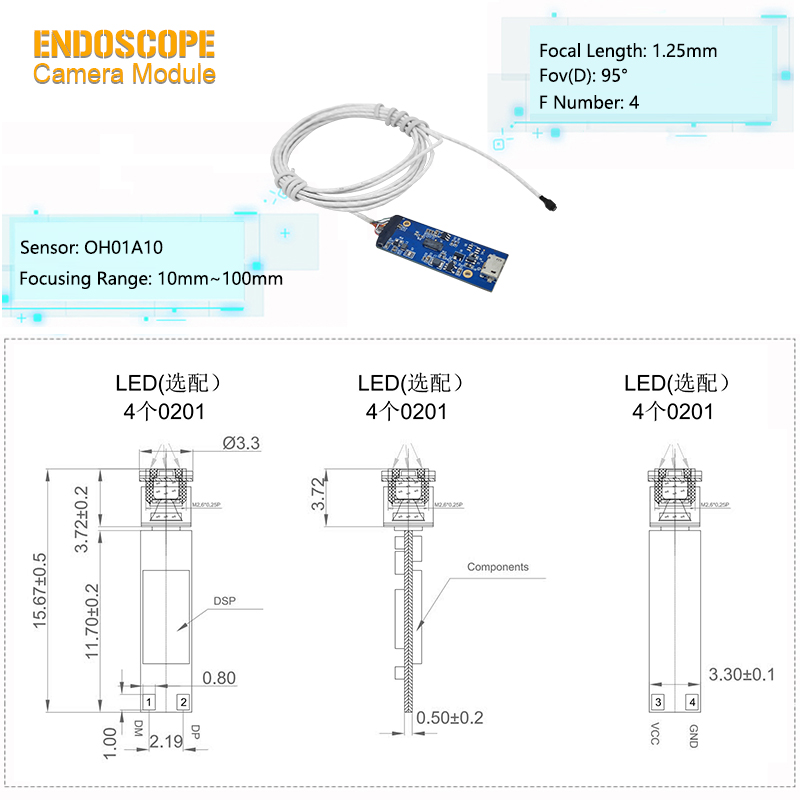
Powered by the premium OH01A10 sensor, this 720P 60fps endoscopic camera module delivers smooth high-definition video output, with TV distortion controlled within -2% to minimize edge deformation and maximize diagnostic accuracy. Its 95° wide diagonal field of view (DFOV) drastically reduces imaging blind spots, enabling one-time full coverage of the inspection area in narrow spaces without frequent position adjustments. The 10-100mm wide focusing range supports 10mm short-distance capture of tiny lesions and precision component defects, as well as 100mm long-distance full-area monitoring, adapting to diverse inspection needs.
With an overall diameter of only 3.3mm, paired with a 1.25mm short-focus lens and F3.58 optical configuration, this miniature endoscope camera module easily accesses ultra-narrow lumens and hard-to-reach interiors in medical and industrial scenarios. The split-type design offers exceptional flexibility for integration into various handheld and fixed endoscopic devices, reducing the development cycle for clients’ new products.
This module supports optional 4 high-brightness 0201 LED fill lights to ensure uniform illumination in low-light in-vivo or enclosed industrial environments. Manufactured with SMT and AA (Active Alignment) processes, it guarantees consistent imaging through micron-level calibration. It has passed CE, FCC, RoHS, and Reach international certifications, fully complying with global medical and industrial market access requirements, and reducing compliance costs for bulk procurement clients.
Parameter | Specification |
Product Name | 3.3mm Miniature Endoscope Camera Module with LED |
Sensor | OH01A10 |
DSP | USB |
Overall Diameter | 3.3mm (±0.1mm tolerance) |
Focal Length | 1.25mm |
F Number | 3.58 |
FOV (D) | 95° |
TV Distortion | <-2% |
Focusing Range | 10mm~100mm |
Optional LED | 4pcs 0201 High-Brightness LED |
Basic Tolerance | ±0.1mm |
Medical Diagnostics & Minimally Invasive Surgery: Ideal for ENT procedures including sinus examinations, vocal cord inspections, and pediatric bronchoscopy, as well as laparoscopic and arthroscopic minimally invasive surgeries, providing clear real-time visualization for precise operation.
Industrial Precision Inspection: Suitable for defect detection of precision mechanical components, internal inspection of small-diameter pipelines, and non-destructive testing of aerospace and automotive parts, accessing narrow spaces that traditional detection equipment cannot reach.
A1: Its ultra-compact 3.3mm diameter minimizes patient trauma during invasive procedures, while the 95° wide FOV, 10-100mm wide focusing range, and <-2% low distortion ensure accurate and efficient diagnosis. The certified compliant design, split-type structure for easy integration, and mass production consistency also reduce clients’ development and market access costs, making it perfect for batch integration into medical endoscopic devices.
A2: It is equipped with an optional 4pcs 0201 high-brightness LED fill light system for uniform illumination in dark in-vivo environments, paired with the high-sensitivity OH01A10 sensor and DSP built-in noise reduction algorithm, which effectively reduces image noise in low light and ensures clear, shadow-free imaging for reliable diagnosis.
Ready to integrate our high-performance OH01A10 medical endoscope camera module into your medical or industrial inspection devices? Contact our professional team today for a customized bulk quote, free sample consultation, and full OEM/ODM technical support. We offer strict batch quality control and competitive pricing to meet your mass production and project customization needs.
