


| Quantity: | |
|---|---|


SF-C1019USB-D3.9-ALL-D95
SINCEREFIRST
This OV9734 USB D3.9mm Endoscope Camera Module with D95 FOV and IP67 Waterproof for Narrow-Space Inspection designed for compact internal inspection and OEM handheld endoscope devices. Based on the D3.6 small-diameter structure, this version uses a Steel Shell front-end design, increasing the outer diameter to D3.9mm and supporting an IP67 waterproof structure for protected inspection use. With its D95 field of view, USB UVC output direction, and compact front-end structure, this module is suitable for pipe inspection cameras, waterproof handheld endoscopes, appliance repair tools, automotive inspection devices, HVAC checking tools, and narrow-space visual inspection systems. | 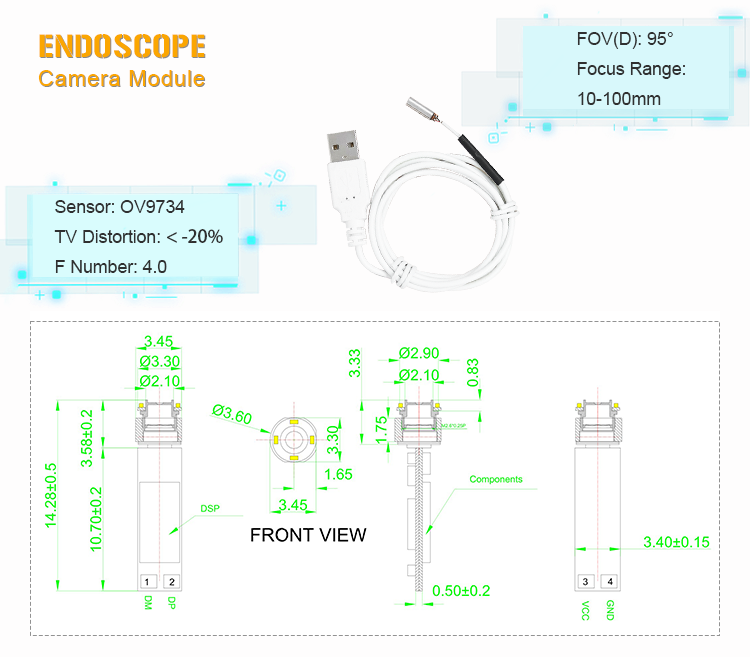 |
D3.9mm Small Diameter — suitable for small openings, narrow gaps, compact cavities, and small pipe inspection.
D95° Field of View — provides practical internal viewing coverage without moving into extreme ultra-wide imaging.
10–100mm Focus Range — suitable for close-range observation of pipe walls, internal parts, and hidden surfaces.
4pcs 0201 LEDs — supports close-range viewing inside darker cavities and equipment interiors.
Standard UVC Output Direction — suitable for USB-based inspection device development, with host compatibility to be confirmed.
4pin USB PAD Design — supports compact electrical connection with DM, DP, VCC 3.3V, and GND.
IP67 Waterproof Structure — suitable for wet pipe inspection and protected front-end visual checking.
Keywords | 3.6mm USB Endoscope Camera Module With LED Light |
Sensor | OV9734 |
LED | 0201 White LED |
Module Size | 3.9mm |
Focusing Range | 10mm-100mm |
Focal Length | 1.25mm |
FOV(D) | 95° |
TV Distortion | <-20% |
Output Format | Standard UVC |
F Number | 4 |
Imaging Quality | Colorfull |
Interface | USB2.0 |
Close-Range Surface Observation: Facilitates microscopic defect troubleshooting for precision components. Leverages exceptional macro resolution to clearly reproduce surface textures and minute flaws at extremely close working distances, fulfilling high-precision surface quality control requirements.
Appliance Internal Inspection: Enables fault diagnosis for air conditioners, washing machines, and other appliances. Navigates flexible tubing around complex structures to intuitively inspect internal part wear or foreign object jams, preventing blind disassembly.
Automotive Part Internal Viewing: Supports quality checks for core components like engine blocks or gearboxes. Employs a slim probe to easily reach confined spaces for intuitive inspection of machining defects or assembly status, avoiding costly full-assembly disassembly.
LED-Assisted Dark-Area Observation: Optimizes internal assessments in enclosed containers or unlit environments. Features built-in high-brightness LEDs that effectively penetrate the darkness to clearly illuminate inner walls, ensuring the accurate identification of details like welds or foreign debris.
Diameter review for D3.6mm, D3.9mm, or other small-diameter inspection structures.
Lens & FOV matching for D95 or other viewing angle requirements.
Focus range adjustment based on your inspection distance and target surface.
LED configuration review for close-range illumination in darker cavities.
Cable & connector customization, including cable length, USB PAD definition, and connector structure.
Protection structure evaluation if your device requires Steel Shell or IP-rated inspection use.
Host compatibility review based on your USB terminal, display device, or software environment.
FAQ◢
Q1: What type of camera module is SF-C1019USB-D3.9-ALL-D95?
A: It is a D3.9mm USB Endoscope Camera Module with Steel Shell front-end structure and IP67 waterproof design for compact internal inspection.
Q2: Why does the document show D3.6mm while the product is D3.9mm?
A: The D3.6mm version is the base small-diameter structure. The D3.9mm version adds a Steel Shell front-end structure, increasing the outer diameter while improving front-end protection.
Q3: Does the Steel Shell version support waterproof use?
A: The D3.9 Steel Shell version is analyzed as an IP67 waterproof configuration according to the confirmed product direction. Final waterproof performance should match the actual sealing process and sample version.
Q4: What is the benefit of D95 FOV?
A: D95 provides practical internal viewing coverage for pipe walls, equipment cavities, hidden spaces, and repair inspection tasks.
Q5: Is this model suitable for small openings?
A: Yes. The D3.9mm diameter helps the camera head enter small openings, compact cavities, narrow tubes, and equipment gaps.
Q6: Is it suitable for precision measurement?
A: It is mainly designed for visual inspection and internal observation, not precision measurement. If measurement accuracy is required, optical distortion and calibration should be reviewed separately.
Q7: Can LED, cable length, connector, or focus range be customized?
A: LED configuration, cable length, connector type, focus range, FOV, and front-end mechanical structure can be reviewed according to your inspection device design.
Q8: What information should I provide to confirm whether this module fits my project?
A: Please share your target device, required diameter, inspection environment, waterproof requirement, working distance, FOV requirement, cable length, connector type, lighting condition, and expected application.


