




| Quantity: | |
|---|---|


SF-C1019USB-D3.6-PRO-D120-Glass
SINCEREFIRST
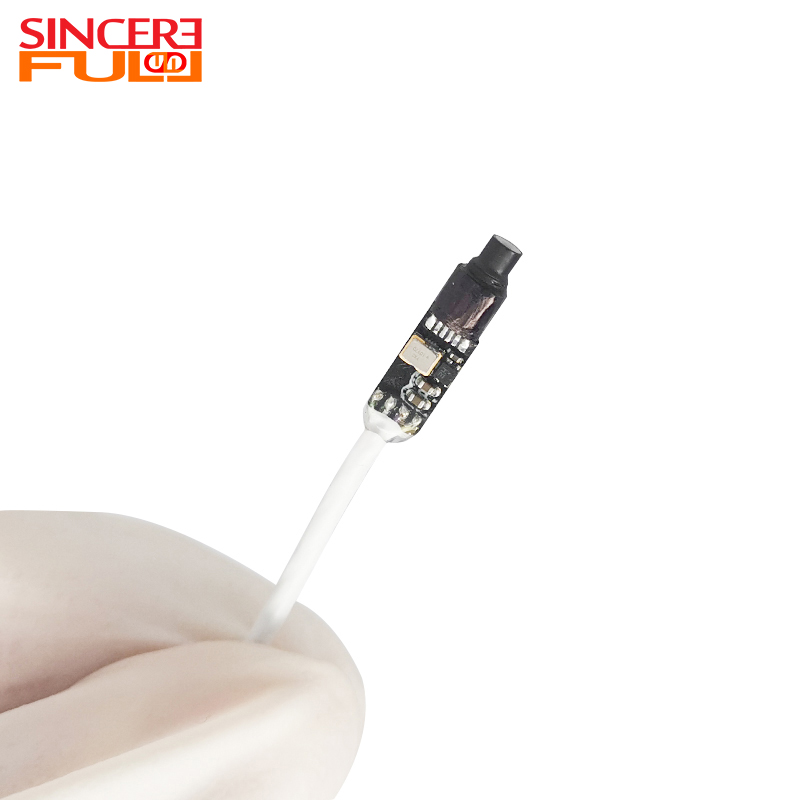
The OV9734 Sensor 3.6mm Micro HD Image USB2.0 UVC Driver-Free Protocol Endoscope Camera Module ,is an ultra-compact imaging solution designed for confined-space inspection. With a diameter of just 3.6mm, it can access narrow pipelines, equipment gaps, and cavities beyond the reach of conventional cameras.The module integrates the OV9734 CMOS image sensor with a 1.08mm focal length lens (F-number 4.0), delivering a field of view of 95°(D)×85°(H)×43.5°(V) and TV distortion controlled within -10%. The focus range covers 10–100mm, ensuring sharp imaging across a wide working distance. Four 0402-sized white LEDs are available as an optional add-on for illumination in dark environments.For connectivity, the module features a dual-interface design: a Micro USB-5P port for direct plug-and-play operation and a 10-pin sensor interface for development and integration. It supports USB 2.0 UVC protocol natively, enabling driver-free operation with integrated power and data transmission. Video output is available in both YUV and MJPEG formats, with maximum resolution of 720P at 30fps. Image orientation is preset for immediate use.Engineered with precision tolerances and a compact form factor, this module is suitable for industrial inspection, precision equipment maintenance, consumer endoscopy, and embedded vision applications. | 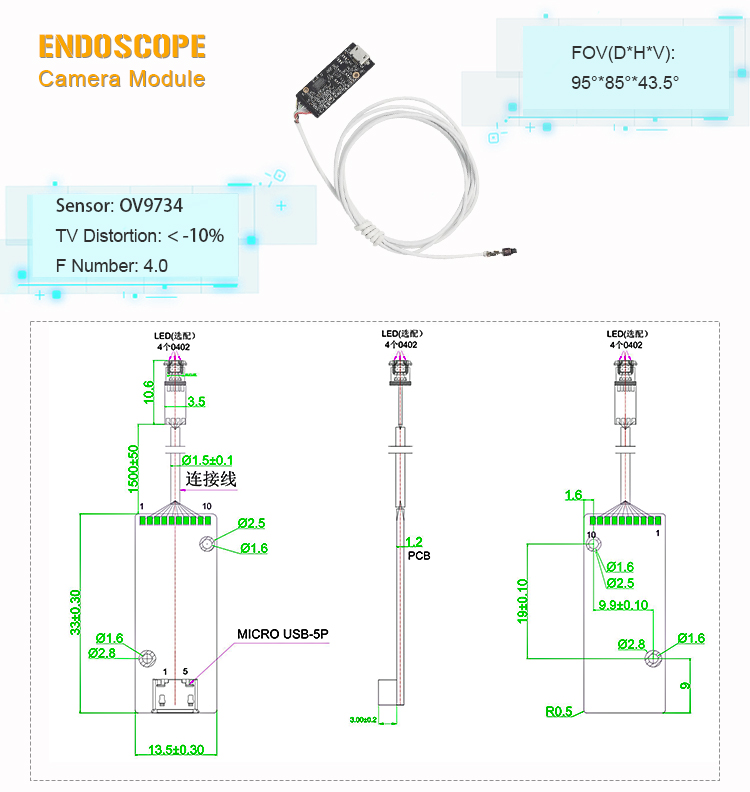 |
Ultra-Miniature Design:The 3.6mm diameter imaging head, manufactured with high-precision tolerances, enables access to extremely tight spaces such as narrow pipes, crevices, and internal cavities where standard cameras cannot fit.
Wide-Range Clear Imaging:The 10–100mm focus range combined with a 95° diagonal field of view delivers sharp images across varying working distances, from close-up detail inspection to mid-range overviews.
Plug-and-Play USB Connectivity:Native UVC protocol support and a Micro USB-5P interface allow direct connection to computers, smartphones, and embedded devices without driver installation, simplifying deployment.
Optional LED Illumination:Four 0402-sized white LEDs can be optionally integrated to provide illumination in dark environments, offering flexibility for different lighting conditions.
Industrial Inspection: Used for internal examination of pipes, engine components, and molds, enabling visual detection of defects, blockages, and surface conditions in confined industrial spaces.
Precision Equipment Maintenance: Ideal for diagnosing internal faults in electronic devices,precise instrument, and machinery, with the 3.6mm probe reaching tight gaps and optional LEDs illuminating dark areas.
Consumer Endoscopy: Applied in home appliance inspection,Pipeline detection, and DIY troubleshooting, with plug-and-play USB connectivity making it accessible for non-professional users.
Embedded Vision Integration: Serves as a compact vision module for Miniature intelligent detection equipment, robots, and custom hardware, leveraging standardized USB protocols and dual-interface design for seamless integration.
Sensor | OV9734 |
LED | 0402 White LED |
Connector | Mini USB-5P |
Diameter | 3.6mm |
Pixel | 1MP |
DSP | USB2.0 UVC |
Focusing Range | 10-100mm |
Focal Length | 1.08mm |
F Number | 4.0 |
FOV(D*H*V) | 95°*85°*43.5° |
TV Distortion | <-10% |
FAQ
1. What are the typical requirements for custom modules?
Common requirements include special dimensions (e.g., 1mm diameter), multispectral imaging (e.g., fluorescence navigation), and interface protocol adaptation (e.g., interfacing with DICOM systems).
2. What can I do if the module fails to start?
Check the power adapter (for example, 12V output), the port is loose, and the fuse is blown. If the wireless module is used, check the battery level and pairing status.
3. What is the difference between medical and industrial endoscope modules?
The medical module emphasizes biocompatibility, sterilization and high image quality, and needs to comply with FDA/CE certification; Industrial modules focus on durability (such as corrosion protection), wide temperature operation (-20°C to 70°C), and special light sources (such as UV).
4.Is the LED fill light unit standard or optional? Is self-installation supported?
The four 0402-size LED fill lights are optional, not standard. They can be configured based on your lighting requirements. To enable this function, simply ensure compatibility with the corresponding pin definitions on the 10PIN sensor interface.
5.What is the maximum imaging specification? Is higher resolution output supported?
The maximum imaging resolution is 720P at 30fps, with YUV & MJPEG output formats. As the hardware and protocol are finalized, higher resolutions are not supported.
6. What are the pin definitions for the Micro USB-5P interface?
The Micro USB-5P interface pins are defined as follows: Pin 1 (USB_5V/Power), Pin 2 (USB_DM/Data-), Pin 3 (USB_DP/Data+), Pin 4 (GND), and Pin 5 (Shield Ground). This design integrates power supply, data transmission, and shielding.
7.What does a TV distortion value of < -10% indicate?
A TV distortion value of < -10% indicates barrel distortion. This is a specialized design for endoscopic lenses, enhancing field-of-view coverage in confined spaces under wide angles, which meets the specific requirements of endoscopic imaging.
The OV9734 Sensor 3.6mm Micro HD Image USB2.0 UVC Driver-Free Protocol Endoscope Camera Module ,is an ultra-compact imaging solution designed for confined-space inspection. With a diameter of just 3.6mm, it can access narrow pipelines, equipment gaps, and cavities beyond the reach of conventional cameras.The module integrates the OV9734 CMOS image sensor with a 1.08mm focal length lens (F-number 4.0), delivering a field of view of 95°(D)×85°(H)×43.5°(V) and TV distortion controlled within -10%. The focus range covers 10–100mm, ensuring sharp imaging across a wide working distance. Four 0402-sized white LEDs are available as an optional add-on for illumination in dark environments.For connectivity, the module features a dual-interface design: a Micro USB-5P port for direct plug-and-play operation and a 10-pin sensor interface for development and integration. It supports USB 2.0 UVC protocol natively, enabling driver-free operation with integrated power and data transmission. Video output is available in both YUV and MJPEG formats, with maximum resolution of 720P at 30fps. Image orientation is preset for immediate use.Engineered with precision tolerances and a compact form factor, this module is suitable for industrial inspection, precision equipment maintenance, consumer endoscopy, and embedded vision applications. | |
Ultra-Miniature Design:The 3.6mm diameter imaging head, manufactured with high-precision tolerances, enables access to extremely tight spaces such as narrow pipes, crevices, and internal cavities where standard cameras cannot fit.
Wide-Range Clear Imaging:The 10–100mm focus range combined with a 95° diagonal field of view delivers sharp images across varying working distances, from close-up detail inspection to mid-range overviews.
Plug-and-Play USB Connectivity:Native UVC protocol support and a Micro USB-5P interface allow direct connection to computers, smartphones, and embedded devices without driver installation, simplifying deployment.
Optional LED Illumination:Four 0402-sized white LEDs can be optionally integrated to provide illumination in dark environments, offering flexibility for different lighting conditions.
Industrial Inspection: Used for internal examination of pipes, engine components, and molds, enabling visual detection of defects, blockages, and surface conditions in confined industrial spaces.
Precision Equipment Maintenance: Ideal for diagnosing internal faults in electronic devices,precise instrument, and machinery, with the 3.6mm probe reaching tight gaps and optional LEDs illuminating dark areas.
Consumer Endoscopy: Applied in home appliance inspection,Pipeline detection, and DIY troubleshooting, with plug-and-play USB connectivity making it accessible for non-professional users.
Embedded Vision Integration: Serves as a compact vision module for Miniature intelligent detection equipment, robots, and custom hardware, leveraging standardized USB protocols and dual-interface design for seamless integration.
Sensor | OV9734 |
LED | 0402 White LED |
Connector | Mini USB-5P |
Diameter | 3.6mm |
Pixel | 1MP |
DSP | USB2.0 UVC |
Focusing Range | 10-100mm |
Focal Length | 1.08mm |
F Number | 4.0 |
FOV(D*H*V) | 95°*85°*43.5° |
TV Distortion | <-10% |
FAQ
1. What are the typical requirements for custom modules?
Common requirements include special dimensions (e.g., 1mm diameter), multispectral imaging (e.g., fluorescence navigation), and interface protocol adaptation (e.g., interfacing with DICOM systems).
2. What can I do if the module fails to start?
Check the power adapter (for example, 12V output), the port is loose, and the fuse is blown. If the wireless module is used, check the battery level and pairing status.
3. What is the difference between medical and industrial endoscope modules?
The medical module emphasizes biocompatibility, sterilization and high image quality, and needs to comply with FDA/CE certification; Industrial modules focus on durability (such as corrosion protection), wide temperature operation (-20°C to 70°C), and special light sources (such as UV).
4.Is the LED fill light unit standard or optional? Is self-installation supported?
The four 0402-size LED fill lights are optional, not standard. They can be configured based on your lighting requirements. To enable this function, simply ensure compatibility with the corresponding pin definitions on the 10PIN sensor interface.
5.What is the maximum imaging specification? Is higher resolution output supported?
The maximum imaging resolution is 720P at 30fps, with YUV & MJPEG output formats. As the hardware and protocol are finalized, higher resolutions are not supported.
6. What are the pin definitions for the Micro USB-5P interface?
The Micro USB-5P interface pins are defined as follows: Pin 1 (USB_5V/Power), Pin 2 (USB_DM/Data-), Pin 3 (USB_DP/Data+), Pin 4 (GND), and Pin 5 (Shield Ground). This design integrates power supply, data transmission, and shielding.
7.What does a TV distortion value of < -10% indicate?
A TV distortion value of < -10% indicates barrel distortion. This is a specialized design for endoscopic lenses, enhancing field-of-view coverage in confined spaces under wide angles, which meets the specific requirements of endoscopic imaging.


