


| Quantity: | |
|---|---|


SF-C1011USB-D3.3-720P60
SINCEREFIRST
The SF-C1011USB-D3.3-720P60 is a 1MP USB D3.3 Endoscope Camera Module based on the OH01A10 sensor, designed for compact inspection devices and narrow-space visual observation. It supports YUV / MJPEG output at 1280×800@60fps, making it suitable for applications that require smoother real-time image feedback in a small-diameter camera structure. With its Separate type design, D3.3 diameter, Micro USB back connector, and 40×15mm main board, this module can be evaluated for handheld inspection tools, industrial borescopes, cavity inspection systems, and customized USB endoscope devices. | 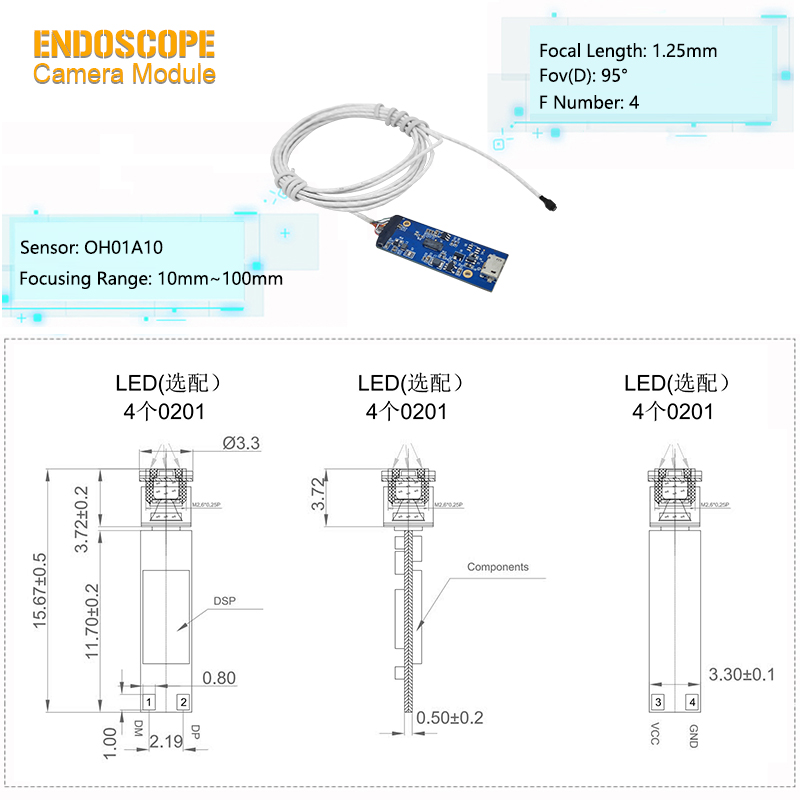 |
D3.3 Small-Diameter Endoscope Design: The D3.3 structure is suitable for narrow-space inspection and compact front-end integration where a standard camera module cannot fit.
1280×800@60fps Smooth Video Output: The module supports 1280×800 resolution at 60fps, helping provide smoother visual feedback during handheld movement or real-time inspection.
OH01A10 1MP Sensor for Compact Imaging: The OH01A10 sensor and 1MP resolution are suitable for close-range observation, cavity inspection, and small-diameter endoscope applications.
YUV / MJPEG Output for USB-Based Integration: YUV and MJPEG output options make the module suitable for USB visual inspection terminals and host-side video evaluation. Host compatibility should be confirmed based on the target platform.
95 / 130 FOV Options for Different Viewing Needs: The catalog lists 95 / 130 FOV options, allowing the lens direction to be reviewed according to whether the project needs wider scene coverage or more focused observation.
Separate Type Structure for Flexible Device Layout: The separated front-end and main board structure can help device developers arrange the imaging front end and control board according to the final mechanical design.
Product Name | Miniature endoscope camera module with led |
Basic tolerance | ±0.1mm |
DSP | USB |
Sensor | OH01A10 |
| Pixel | 1MP |
| Type | Separate type |
| Output Format | YUV / MJPEG |
| Resolution / Frame Rate | 1280×800@60fps |
Focusing Range | 10-100mm |
Focal Length | 1.25mm |
F Number | 3.58 |
FOV(D) | 95° |
TV Distortion | <-2% |
Diameter | 3.3mm |
Typical Applications◢
Lens and FOV matching can be evaluated according to the required viewing angle, including 95 / 130 FOV directions.
Working distance selection can be reviewed based on 4–10mm, 5–50mm, or 10–100mm focusing range requirements.
Cable length evaluation can be discussed according to the standard 1m length and maximum 5m line length listed in the catalog.
Connector and structure adaptation can be reviewed around the bonding wire front connector and Micro USB back connector.
Main board installation review can be performed based on the 40×15mm board size and final device structure.
An endoscopic camera module captures images inside the body through an optical lens at the front end, converts them into electrical signals via a CMOS or CCD sensor, and then optimizes them through an image processing chip for noise reduction and enhancement, etc. Finally, it outputs high-definition video signals. Some modules support wireless transmission or optical fiber signal transmission, and are suitable for medical or industrial inspection scenarios.
The mainstream resolutions include 720p, 1080p, and 4K. Medical-grade modules typically require a resolution of 1080p or higher to ensure diagnostic accuracy, while industrial modules may choose lower resolutions based on requirements to reduce costs. Ultra-high resolution modules (such as 4K) are mostly used in precise surgeries or scientific research fields.
The field of view determines the imaging range. A wide-angle (above 120°) is suitable for observing large areas but may have edge distortion; a narrow-angle (below 60°) provides a more focused image. The choice should be based on the application scenario. For example, in laparoscopic surgery, a 70°-90° FOV is commonly used to balance the field of view and details.
Yes, it is designed for dual use and has a standard version that meets basic needs of both fields. No need to purchase separate versions—you only need to confirm additional requirements (e.g., medical sterilization, industrial waterproofing) if your scenario has special demands.
The warranty period is 24 months for medical-use modules (covers sensor, LED, and structural defects caused by non-human factors) and 12 months for industrial-use modules. Extended warranties (up to 36 months) are available for an additional fee.


