


| Quantity: | |
|---|---|


SF-C16USB-D1.6
SINCEREFIRST
This is a 1.6mm diameter 2MP micro endoscope camera module with custom LED. It adopts 1.6mm ultra-thin diameter design, it can be customized with a high-brightness LED lighting system, ensuring clear image quality in confined spaces and low-light environments. It supports USB2.0 interface transmission and, in combination with a 1/18-inch image sensor and 2MP pixels, can achieve 30fps smooth dynamic capture at a 400×400 resolution, effectively reducing image blurring. With a F5.0 aperture and a 5-50mm wide focusing range combination, it can precisely present microscopic details while also covering mid-range observation needs. Its wide temperature operating range of -20°C to 70°C is suitable for complex scenarios such as industrial inspection, medical examination, and pipeline exploration. | 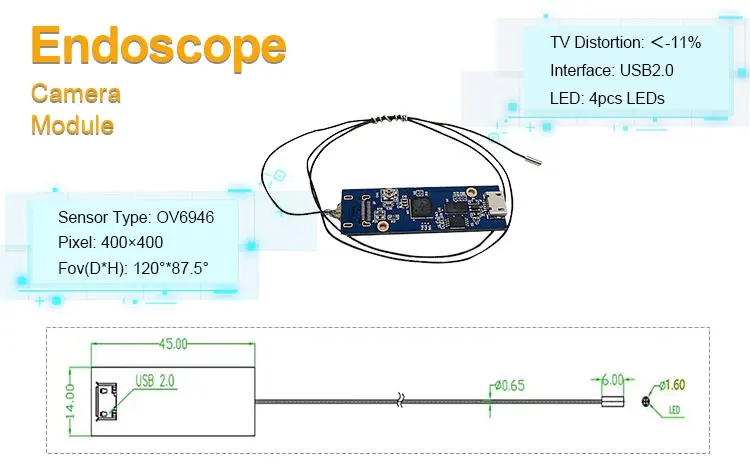 |
Miniaturized probing capability: A 1.6mm diameter probe can penetrate into narrow areas that are difficult for traditional equipment to reach, such as mechanical gaps and precision components.
Full-scenario adaptability: A -11% TV distortion rate ensures minimal geometric distortion of the image during mid-range and close-range observations, meeting medical-grade accuracy requirements.
Industrial-grade reliability: The metal packaging process enables the module to maintain stable imaging even in harsh environments such as vibration, high and low temperatures.
Product Name | 1.6mm Endoscope Camera Module |
lmage Device | 1/18” |
Output Interface | USB2.0 |
F No. | F5.0 |
TV Distortion | <-11% @ 0.95Field |
Focus Range | 5-50 |
Operating Temperature | -20°C~70°C |
Frame Rate | 400x400 @ 30fps |
Effective Picture Element | 400(H)X400(V) |
Dynamic Range | 65.8dB @ 4x gain |
The slender diameter of 3.9mm enables this borescope inspection camera module to easily access narrow spaces, such as small holes in mechanical equipment, the interior of pipelines, and the gaps of electronic devices. In places where traditional large-scale inspection equipment cannot reach, it can play a crucial role, greatly expanding the scope of inspection.
With its small overall size, it is convenient to carry. Whether in a workshop site, outdoor operation, or laboratory environment, it can be used conveniently without the need for the transportation and installation of large inspection equipment.
The USB interface is one of the most common interface types nowadays, and almost all devices like computers, laptops, and some tablets support USB connection. This means that this module can be easily connected to a variety of devices without the need for additional complex drivers or adapters, reducing the usage threshold and improving the compatibility of the equipment.
Through the USB interface, the data transmission is stable and fast, which can instantly transmit the images and videos captured by the camera to the connected device, making it convenient for users to view and analyze the inspection results in a timely manner.
It is designed to be sturdy and durable, able to withstand certain impacts, vibrations, and harsh working environments. The insertion tube is usually made of high-strength and wear-resistant materials, which are not easy to be damaged, ensuring the stability and reliability of the equipment during long-term use.
This durability makes the module suitable for various industrial and civil scenarios, reducing the maintenance cost and replacement frequency of the equipment.
1. Which devices can this module be connected to?
This module can be connected via the USB interface to most computers (including Windows, Mac OS, and Linux systems), laptops, and some tablets that support USB devices. As long as the device has a USB interface and can recognize external devices, this module can be used.
2. Can the brightness of the lighting system be adjusted?
Yes, the brightness of the lighting system can usually be adjusted. You can adjust the lighting brightness through the operation interface on the connected device or the control buttons on the module itself (if available) to adapt to different inspection environments.
3. Can the images and videos be saved?
Yes, the operation software on the connected device generally provides the function of saving images and videos. You can save the captured images and videos to the hard disk or other storage media of the device for subsequent viewing, analysis, and archiving.
This is a 1.6mm diameter 2MP micro endoscope camera module with custom LED. It adopts 1.6mm ultra-thin diameter design, it can be customized with a high-brightness LED lighting system, ensuring clear image quality in confined spaces and low-light environments. It supports USB2.0 interface transmission and, in combination with a 1/18-inch image sensor and 2MP pixels, can achieve 30fps smooth dynamic capture at a 400×400 resolution, effectively reducing image blurring. With a F5.0 aperture and a 5-50mm wide focusing range combination, it can precisely present microscopic details while also covering mid-range observation needs. Its wide temperature operating range of -20°C to 70°C is suitable for complex scenarios such as industrial inspection, medical examination, and pipeline exploration. | |
Miniaturized probing capability: A 1.6mm diameter probe can penetrate into narrow areas that are difficult for traditional equipment to reach, such as mechanical gaps and precision components.
Full-scenario adaptability: A -11% TV distortion rate ensures minimal geometric distortion of the image during mid-range and close-range observations, meeting medical-grade accuracy requirements.
Industrial-grade reliability: The metal packaging process enables the module to maintain stable imaging even in harsh environments such as vibration, high and low temperatures.
Product Name | 1.6mm Endoscope Camera Module |
lmage Device | 1/18” |
Output Interface | USB2.0 |
F No. | F5.0 |
TV Distortion | <-11% @ 0.95Field |
Focus Range | 5-50 |
Operating Temperature | -20°C~70°C |
Frame Rate | 400x400 @ 30fps |
Effective Picture Element | 400(H)X400(V) |
Dynamic Range | 65.8dB @ 4x gain |
The slender diameter of 3.9mm enables this borescope inspection camera module to easily access narrow spaces, such as small holes in mechanical equipment, the interior of pipelines, and the gaps of electronic devices. In places where traditional large-scale inspection equipment cannot reach, it can play a crucial role, greatly expanding the scope of inspection.
With its small overall size, it is convenient to carry. Whether in a workshop site, outdoor operation, or laboratory environment, it can be used conveniently without the need for the transportation and installation of large inspection equipment.
The USB interface is one of the most common interface types nowadays, and almost all devices like computers, laptops, and some tablets support USB connection. This means that this module can be easily connected to a variety of devices without the need for additional complex drivers or adapters, reducing the usage threshold and improving the compatibility of the equipment.
Through the USB interface, the data transmission is stable and fast, which can instantly transmit the images and videos captured by the camera to the connected device, making it convenient for users to view and analyze the inspection results in a timely manner.
It is designed to be sturdy and durable, able to withstand certain impacts, vibrations, and harsh working environments. The insertion tube is usually made of high-strength and wear-resistant materials, which are not easy to be damaged, ensuring the stability and reliability of the equipment during long-term use.
This durability makes the module suitable for various industrial and civil scenarios, reducing the maintenance cost and replacement frequency of the equipment.
1. Which devices can this module be connected to?
This module can be connected via the USB interface to most computers (including Windows, Mac OS, and Linux systems), laptops, and some tablets that support USB devices. As long as the device has a USB interface and can recognize external devices, this module can be used.
2. Can the brightness of the lighting system be adjusted?
Yes, the brightness of the lighting system can usually be adjusted. You can adjust the lighting brightness through the operation interface on the connected device or the control buttons on the module itself (if available) to adapt to different inspection environments.
3. Can the images and videos be saved?
Yes, the operation software on the connected device generally provides the function of saving images and videos. You can save the captured images and videos to the hard disk or other storage media of the device for subsequent viewing, analysis, and archiving.


