Views: 0 Author: Site Editor Publish Time: 2026-06-15 Origin: Site


Navigating tight spaces during critical inspections requires absolute precision. Professionals cannot afford blind spots or grainy visuals when analyzing delicate structures. Procurement managers, medical integrators, and NDT experts face a difficult balancing act. They must find equipment small enough to fit narrow cavities while maintaining exceptional diagnostic image quality. Sub-par consumer devices frequently flood the market, complicating the sourcing process. Selecting the correct module directly impacts operational safety and diagnostic accuracy. A misstep here risks misdiagnosis or sudden equipment failure during critical procedures. This guide provides a strict, evidence-based evaluation framework to help you choose the right hardware. You will learn how to distinguish reliable clinical-grade modules from basic gadgets. We explore crucial optical metrics, environmental compliances, and supply chain strategies to ensure your integration succeeds.
The 3.5mm diameter is the industry sweet spot, offering the minimal footprint necessary to house advanced CMOS sensors and adequate LED illumination without critical overheating.
Evaluation must be segmented by use case: medical/dental environments require specific sterilization (autoclavable) and compliance (FDA/CE) standards, whereas industrial NDT focuses on ruggedness and IP67+ ratings.
Sensor size, Image Signal Processing (ISP), and Depth of Field (DOF) are the core metrics that separate reliable diagnostic inspection devices from low-quality alternatives.
Sourcing requires vetting suppliers for authentic OEM/ODM capabilities and verified regulatory compliance, avoiding white-labeled consumer toys.
Engineers constantly battle physical limitations when designing micro-optical systems. If you shrink a camera below 3mm, you sacrifice too much light gathering capability. Sensor real estate becomes too small to capture high-quality images. Conversely, a 5mm diameter is often too bulky. It fails to navigate narrow intraoral canals, ENT passages, or complex micro-mechanical cavities. The 3.5mm diameter perfectly bridges this gap. It provides just enough surface area for a capable CMOS sensor while easily sliding into restrictive spaces.
Thermal management presents another engineering reality. High-resolution sensors and built-in LEDs generate significant heat. In confined environments, this heat concentrates at the camera tip. Professional units manage this thermal load effectively. They utilize specialized copper flex circuits and thermal potting materials. These components dissipate heat away from the tip. Proper heat management prevents tissue damage in medical scenarios. It also stops thermal noise from degrading the image sensor data.
You must define strict success criteria to validate any small diameter camera. A passing grade demands zero image artifacting under low-light stress. The module must deliver a sufficient frame rate. Usually, 30 frames per second is mandatory for smooth live video feeds. Finally, true-to-life color rendering is non-negotiable. Dentists and mechanics alike rely on accurate color reproduction to identify inflammation, rust, or fluid leaks.
Healthcare environments demand specialized optical configurations. Intraoral dental cameras require precise focal tuning to capture enamel details. Veterinary diagnostics rely on flexible insertion tubes to examine animal airways safely. Specialized laparoscopic modules also utilize this tiny form factor for minimally invasive procedures. Each use case dictates distinct hardware geometries and material selections.
Compliance and safety regulations form a non-negotiable baseline. Any diagnostic inspection device used in clinics must feature biocompatible external materials. True 0-degree precise viewing ensures surgeons see exactly what lies straight ahead without optical distortion. Furthermore, clinical equipment faces harsh sterilization routines. Modules must withstand high-temperature autoclave cycles. They endure pressurized steam at 134°C, which destroys unsealed consumer electronics.
Beware of the "medical grade" trap. Many budget suppliers use this term loosely. You must identify verifiable certifications. Look for FDA Class I or Class II registrations. Request CE MDR documentation rather than basic RoHS stickers. True medical-grade units feature sapphire glass lenses and medical-grade stainless steel housings. Marketing fluff cannot substitute for rigorous laboratory testing.
Industrial applications present entirely different environmental challenges. Technicians use these cameras for automotive cylinder inspections. They push them deep into micro-pipe networks. Aviation maintenance crews inspect turbine blades through tiny access ports. These scenarios prioritize mechanical ruggedness over biocompatibility. A broken lens inside a jet engine causes catastrophic downtime.
Durability ratings define a professional mini borescope. You need verified IP67 or IP68 water and oil resistance. The device must survive submersion in engine coolant or hydraulic fluid. Focal lengths must be optimized for mechanical cavities, typically focusing sharply at 10mm to 30mm. You also must choose between semi-rigid and flexible cable types. Semi-rigid cables hold their shape to navigate vertical voids. Flexible cables snake through complex curved pipe networks easily.
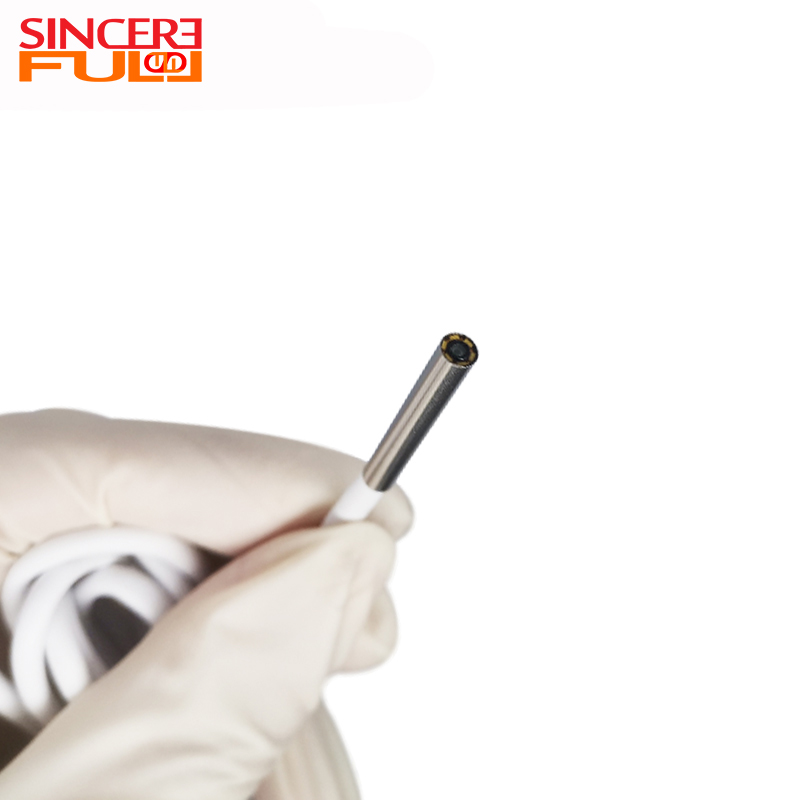
Micro-image chips dictate your baseline resolution and low-light performance. Historically, CCD sensors dominated medical imaging. Today, advanced CMOS sensors offer superior performance in ultra-small packages. A back-illuminated CMOS design captures more photons. This architecture dramatically improves low-light visibility inside dark cavities. When evaluating a mini endoscope camera 3.5mm, look closely at the pixel size and sensor format.
Raw sensor data alone isn't enough. The Image Signal Processor (ISP) acts as the brain behind the lens. It interprets electrical signals and converts them into a visible picture. Without a robust ISP, images appear grainy and washed out. You need hardware-level noise reduction to clean up dark scenes. The ISP also handles edge sharpening. This processing step ensures critical details, like hairline fractures or tissue boundaries, remain crisp for diagnostic clarity.
Matching the optical lens specifications to your specific inspection cavity is crucial. Field of View (FOV) determines how widely the camera sees. A wider FOV helps navigate large pipes. A narrow FOV concentrates pixels on a smaller area for magnified detail. Depth of Field (DOF) dictates the focus range. If your target sits 15mm away, a camera with a 30mm-80mm DOF will produce a blurry image.
Light delivery methods significantly impact image quality. Standard consumer models place tiny micro-LEDs directly around the lens tip. This setup is cheap but often causes severe glare on reflective surfaces like metal cylinders or wet tissue. Professional units sometimes employ fiber-optic light delivery. They transmit light from an external source down the cable. This approach keeps heat away from the tip and provides smoother, diffused illumination. It prevents image blowout and enhances surface contrast.
Chart: Optical Requirement Comparison | |||
Application Type | Ideal FOV | Optimal DOF | Illumination Preference |
|---|---|---|---|
Dental / Intraoral | 80° - 90° | 5mm - 25mm | Diffused Micro-LED |
Laparoscopic | 90° - 110° | 10mm - 50mm | Fiber-optic Transmission |
Automotive NDT | 60° - 80° | 15mm - 40mm | Adjustable Tip LEDs |
Aviation Maintenance | 90° - 120° | 10mm - 100mm | High-Output Fiber |
Seamless integration dictates how effectively teams deploy these devices. You must evaluate any portable endoscope based on its USB Video Class (UVC) compliance. UVC ensures true plug-and-play functionality. It eliminates the need to install proprietary, buggy drivers. A UVC-compliant module works instantly with Android tablets, Windows PCs, and macOS systems. It also integrates smoothly into complex proprietary medical display hubs.
Display integration forces a choice between standalone systems and modular units. Standalone devices feature built-in screens, typically around 5 inches. They offer rapid deployment and rugged, all-in-one housing. However, they restrict you to the built-in screen's resolution. Modular USB or wireless units rely on external hardware. They allow you to view feeds on high-resolution 4K monitors or large diagnostic tablets. This flexibility benefits stationary clinical environments greatly.
Standalone Systems: Quick boot times, immune to smartphone OS updates, ideal for dirty field work.
Modular USB Units: Highly upgradable display options, lightweight portability, easier to integrate into existing software ecosystems.
Latency and frame rate directly affect operator performance. Compressed video feeds over cheap Wi-Fi chips introduce lag. Even a 200-millisecond delay disrupts hand-eye coordination. This lag causes massive operator fatigue during intricate maneuvers. Uncompressed video feeds deliver real-time visual feedback. They ensure every hand movement translates instantly to the screen, preventing costly mechanical mistakes or surgical errors.
Assessing B2B suppliers requires diligence. You must differentiate between true OEM/ODM manufacturers and simple wholesale distributors. A wholesale distributor merely slaps a logo on a generic product. An OEM factory controls the PCB layout, lens alignment, and sensor calibration. They own cleanroom facilities. True manufacturers offer deep customization options, allowing you to tweak ISP settings or modify the lens barrel material.
Evaluating Minimum Order Quantities (MOQs) is a critical procurement step. Customizing a 3.5mm module involves engineering overhead. Suppliers offset prototyping costs by enforcing MOQs. You must factor these initial costs into your integration budget. Discuss tooling costs upfront. Clarify whether the supplier will refund prototyping fees once you place a mass production order.
Hidden Quality Assurance (QA) risks destroy product reliability. Budget options often suffer from inconsistent focal lengths across the same batch. They use poor cable shielding, which invites electromagnetic interference from nearby hospital equipment or factory motors. High failure rates quickly negate any initial cost savings. Reliable suppliers perform extreme QA tests, including 10,000-cycle cable flex tests and high-impact drop tests.
Follow a structured path before committing to a major purchase. Actionable steps prevent expensive integration failures.
Request Detailed Spec Sheets: Demand comprehensive data on the CMOS sensor model, exact DOF ranges, and thermal dissipation metrics.
Validate Certifications: Ask for third-party lab reports confirming IP68 ratings or CE/FDA medical compliance. Do not accept self-certified declarations.
Order Engineering Test Units: Secure a small batch of unbranded prototypes. Test them under real-world conditions to verify latency, color accuracy, and heat generation.
The true value of a 3.5mm inspection camera lies entirely in its environmental alignment. You cannot force an industrial borescope into a clinical workflow, nor should you bring fragile medical optics onto a factory floor. Success depends on matching optical hardware, sensor capabilities, and thermal management to your exact operational realities. By evaluating ISP performance and strict QA standards, you avoid the pitfalls of consumer-grade electronics.
We encourage buyers to prioritize detailed sensor specifications and verifiable compliance records over superficial marketing claims. A smaller diameter only matters if the resulting image remains diagnostically useful. Review your internal requirements carefully. Contact engineering teams or specialized sales representatives directly to discuss custom module integration. Demand test units, verify regulatory documents, and ensure your next imaging integration delivers absolute precision.
A: Typically ranges from 10mm to 30mm depending on the lens configuration, optimized for close-proximity cavity inspection.
A: No. Standard industrial/consumer models will fail. Medical-grade units require specific sealed housings, sapphire glass, and autoclavable certifications.
A: Typically 720p (1MP) to 1080p (2MP), as the physical limitation of the CMOS sensor at this diameter prevents reliable 4K imaging without significant thermal or light-loss issues.
A: Digital CMOS endoscopes offer better digital resolution, direct-to-screen integration, and lower fragility compared to traditional optical fiber bundles, though fiberscopes can achieve even smaller diameters.


