Views: 0 Author: Site Editor Publish Time: 2026-06-08 Origin: Site


Engineers face intense pressure to miniaturize instruments without sacrificing image resolution. For device engineers and procurement teams, selecting the right imaging component dictates the success of both diagnostic and inspection equipment. The 10mm footprint represents a highly specific tier of imaging hardware. It balances robust sensor capabilities against strict spatial constraints.
Integrating proprietary interfaces often causes severe development bottlenecks. A standard USB protocol addresses these integration hurdles head-on. However, it introduces complex questions around data latency, regulatory compliance, and raw image quality.
This guide carefully evaluates the technical realities, integration frameworks, and procurement criteria for 10mm USB endoscope camera modules. We will outline actionable steps to help you separate baseline industrial capabilities from true medical-grade specifications, ensuring your final product meets stringent industry demands.
Form Factor vs. Performance: A 10mm diameter allows for larger sensors (often 1/4" to 1/3" CMOS) compared to ultra-micro modules, yielding superior low-light performance and higher dynamic range.
Integration Efficiency: The USB interface (UVC compliance) bypasses the need for custom ISP (Image Signal Processor) development, accelerating time-to-market for medical and industrial diagnostic tools.
Compliance is Binary: "Medical grade" requires verifiable adherence to biocompatibility, sterilization resilience (IP67/IP68), and precise color reproduction, distinguishing it from standard consumer inspection cameras.
Risk Mitigation: Evaluating thermal management and custom OEM/ODM capabilities is critical before locking in a module for mass production.
Designing an imaging unit within a 10mm cylindrical constraint requires precise engineering. At this size, developers can move beyond the severe limitations of ultra-micro sensors. A 10mm housing comfortably accommodates 1/4-inch to 1/3-inch CMOS sensors. These larger sensors feature significantly bigger pixel sizes. Larger pixels capture more photons, which drastically improves signal-to-noise ratio and low-light performance.
The sensor and optics framework dictates the foundational image quality. A 10mm diameter provides enough physical volume to utilize multi-element glass lenses. Unlike cheaper plastic alternatives, glass optical stacks (typically 5G or 6G configurations) mitigate chromatic aberration. They also provide a wider Field of View (FOV) and a deeper Depth of Field (DOF) without introducing severe edge distortion. This clarity is paramount when doctors or technicians navigate confined, complex spaces.
Beyond the lens, illumination and image processing dictate real-world performance. 10mm modules typically incorporate an integrated LED ring directly at the distal tip. While these micro-LEDs provide excellent forward illumination, they also generate substantial heat. Engineers must carefully design the metal housing to act as an effective heat sink.
Coupled with illumination is the onboard Image Signal Processor (ISP). The ISP converts raw Bayer data from the sensor into a recognizable video stream. It handles critical algorithms like auto-white balance (AWB) and auto-exposure (AE). Precise AWB prevents tissue from appearing overly yellow or blue. This color accuracy is absolutely critical for identifying tissue anomalies when building a diagnostic imaging device.
Finally, we must address physical tolerances. Rigid and semi-rigid tube integrations expose the camera head to hostile environments. Manufacturers achieve IP68 waterproofing by utilizing industrial adhesives, optical resins, and laser-welded stainless steel seams. Structural integrity ensures the internal optics do not shift when the external tube experiences mechanical stress.
Always request active alignment (AA) documentation from your supplier. Active alignment mechanically centers the lens over the sensor during manufacturing, ensuring uniform sharpness across the entire image plane.
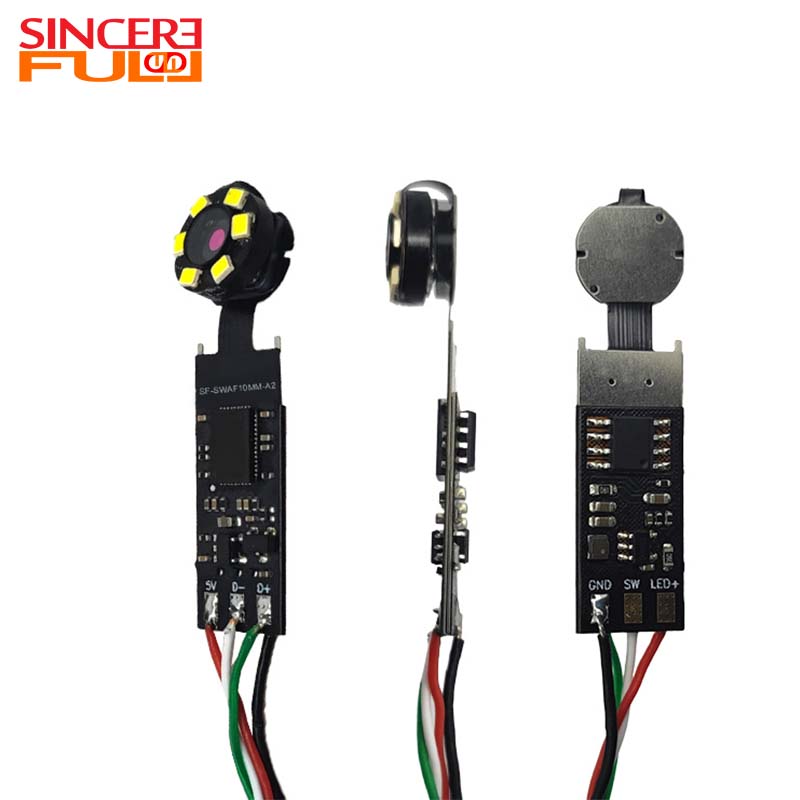
The transition from proprietary MIPI or LVDS interfaces to USB significantly accelerates hardware development. The primary driver behind this speed is the Plug-and-Play advantage of the UVC (USB Video Class) standard. By adhering to UVC protocols, an endoscope camera module usb connects instantly to host operating systems. Windows, Linux, macOS, and Android natively recognize the camera. You entirely eliminate the need to write, test, and maintain custom kernel drivers.
However, engineering teams must acknowledge the bandwidth versus latency realities. A USB 2.0 or USB 3.0 connection offers massive bandwidth. It easily handles 1080p at 60fps or even 4K resolutions. Yet, USB architecture relies on packet-based data transfer and frame buffering. This structure inherently introduces latency.
We can quantify these architectural differences in the following performance table:
Interface Type | Max Bandwidth | Typical Latency | Integration Difficulty | Best Use Case |
|---|---|---|---|---|
MIPI CSI-2 | Very High | < 10ms | Complex (Requires custom drivers) | High-speed surgical intervention |
USB 3.0 (UVC) | High (5 Gbps) | 30ms - 50ms | Low (Plug & Play) | Advanced diagnostic equipment |
USB 2.0 (UVC) | Moderate (480 Mbps) | 50ms - 80ms | Very Low | General medical inspection |
While direct MIPI connections boast sub-10ms latency, a well-optimized USB 3.0 module achieves 30-50ms latency. For most diagnostic and inspection procedures, doctors and technicians cannot perceive this slight delay. The massive reduction in development time easily justifies this minor tradeoff.
Furthermore, USB handles power delivery seamlessly. The protocol transmits both data and power over a single, shielded multi-core cable. USB 2.0 provides up to 500mA, which comfortably powers the CMOS sensor, the ISP chip, and the integrated distal LEDs. Combining power and data reduces internal wire routing complexity within the host medical device, saving valuable space and reducing assembly costs.
Many suppliers market standard inspection cameras as medical devices. True medical-grade modules differ fundamentally in optical tuning, material science, and failure tolerances. You must understand these distinctions to ensure regulatory compliance and patient safety.
Optical tuning and color fidelity represent the most obvious split. A true medical endoscope camera requires specialized ISP tuning. Doctors rely on subtle color variations to diagnose tissue health. The camera must perfectly render reds and accurately display mucosal structures. This requires custom IR-cut filters that prevent infrared light from washing out organic color palettes.
Conversely, an industrial borescope prioritizes entirely different metrics. Industrial engineers need high contrast and aggressive edge detection to spot micro-fractures in metallic pipes. Industrial ISP tuning intentionally suppresses glare from highly reflective surfaces, a feature that would artificially darken wet organic tissue.
Below is a summary chart highlighting these distinct application demands:
Feature Matrix | Medical Endoscope | Industrial Borescope |
|---|---|---|
Color Priority | Precise mucosal reds, high organic fidelity | High contrast, monochromatic clarity |
Lighting Tuning | Soft, diffused to prevent tissue glare | Aggressive glare reduction for metals |
Housing Material | Biocompatible 316L Stainless / Medical Resin | Standard 304 Stainless / Aluminum |
Sterilization | Autoclave, ETO, or Cidex resilient | Oil/Chemical/Water resistant (IP67/IP68) |
Material and sterilization standards enforce a hard barrier between these categories. Medical modules must pass ISO 10993 biocompatibility testing. The housing materials cannot trigger allergic reactions or leach toxic compounds into the body. More importantly, reusable medical devices face brutal sterilization cycles.
True autoclavable modules must survive high heat (134°C) and extreme pressurized steam. This requires sapphire glass lenses and hermetically sealed, laser-welded seams. Cheaper modules rely on epoxy seals that inevitably melt or crack in an autoclave. Even if utilizing Ethylene Oxide (ETO) gas or cold chemical soaking (like Cidex), the outer cable jackets must resist severe chemical degradation.
Because of these harsh realities, medical-grade modules demand incredibly low failure tolerances. Manufacturers must provide strict Quality Control (QC) documentation, batch traceability, and rigorous burn-in testing. Commercial inspection cameras simply do not carry this level of manufacturing liability.
When prototyping a new imaging system, engineering teams need a rigid evaluation framework. You cannot select a camera module based on a glossy brochure. You must define success criteria by mapping datasheet features directly to clinical or industrial outcomes.
Begin by running evaluation units through a strict testing checklist. Do not assume high specifications automatically yield better results.
Resolution & Frame Rate Analysis: Upgrading from 720p to 1080p at 60fps sounds appealing. However, higher frame rates force the ISP and sensor to work harder. Does this higher resolution introduce unacceptable thermal loads? In a confined 10mm space, an overheating camera ruins image quality through thermal noise.
Thermal Dissipation Testing: Analyze how effectively the module sheds heat. Run the camera for continuous 60-minute intervals at maximum LED brightness. Excessive heat degrades sensor performance. In medical applications, distal tip temperatures generally cannot exceed 41°C to prevent patient tissue burns.
Cable Flexibility and Shielding: Assess the physical harness. A multi-core USB camera module cable contains intricate power and data lines. Repeated bending causes micro-fractures in cheap copper wiring. Furthermore, test the shielding against electromagnetic interference (EMI). Clinical settings generate massive EMI from electrocautery devices and MRI machines, which easily disrupt unshielded USB data streams.
Engineers often demand 4K resolution without evaluating the host device's processing ceiling. Pushing a 4K UVC stream into an underpowered Android tablet results in dropped frames, extreme latency, and constant system crashes. Always match the camera output to your CPU capabilities.
Balancing cost versus capability remains the ultimate engineering challenge. Avoid specifying hermetic sapphire glass seals if your device is strictly a single-use consumable. Guide your procurement logic by matching the module strictly to the host device's actual processing ceiling and the precise environmental demands of the end-user.
Transitioning from prototype to mass production exposes teams to significant supply chain risks. Procurement departments must look past the immediate unit cost and evaluate the manufacturer's operational stability.
Component obsolescence acts as the silent killer of hardware projects. Major sensor foundries occasionally issue End-of-Life (EOL) notices for specific CMOS chips. If your chosen module relies on an outdated sensor, your entire product line faces abrupt disruption. Ensure the manufacturer offers long-term supply guarantees. Ask them directly about their buffer stock strategies and their roadmap for next-generation sensor migrations.
Off-the-shelf modules rarely satisfy complex product requirements perfectly. You will likely rely on Customization Capabilities (OEM/ODM). Engage with vendors who own their manufacturing process. You will often need to customize the FOV to match a specific optical focal distance. You might require custom cable lengths, specialized medical-grade connector pins, or a specific LED color temperature to highlight unique chemical dyes during surgery.
Finally, demand ironclad compliance documentation before issuing a Purchase Order. Do not accept verbal assurances. Procurement teams must collect verifiable certifications. Depending on your region, you will need CE, FCC, and RoHS declarations. Crucially, verify the supplier operates an ISO 13485 certified manufacturing environment. This standard proves they utilize medical-grade quality management systems, which your regulatory team will need when submitting the final device for FDA or CE clearance.
Choosing a 10mm USB camera module involves far more than checking a resolution box. You must meticulously align optical capabilities, thermal management, and standard interfaces with your strict end-use environments. A standard plug-and-play USB interface accelerates development, but it demands careful attention to latency limitations and electrical shielding.
Your immediate next step is to initiate physical benchmarking. Request engineering samples from qualified vendors. Ask for their full SDK/API documentation to test how the UVC stream interacts with your specific operating system and processor.
Do not finalize your hardware architecture in a vacuum. Consult directly with a specialized camera module manufacturer early in your design cycle. Let them validate your FOV requirements, thermal dissipation models, and sterilization methods. Proactive collaboration ensures you launch a reliable, compliant, and highly competitive imaging device.
A: It usually ranges from 10mm to 100mm depending on the custom lens configuration. Manufacturers optimize the optics for close-proximity macro imaging, allowing doctors to inspect tissue clearly without manual focus adjustments.
A: USB 3.0 modules equipped with optimized ISPs can achieve sub-50ms latency. This speed is perfectly acceptable for many diagnostic procedures. However, direct MIPI interfaces remain preferred for high-speed surgical interventions where zero delay is critical.
A: Standard IP68 waterproofing is not enough for autoclaving. True autoclavable modules require specialized hermetic sealing, including sapphire glass and laser-welded seams. Buyers must explicitly specify their intended sterilization methods during the procurement phase.
A: Standard USB 2.0 maxes out reliably at 3 to 5 meters without active repeaters. Custom modules can incorporate inline signal amplifiers or fiber-optic extensions to achieve longer reaches, which is especially useful in heavy industrial applications.


