


| Quantity: | |
|---|---|


SF-C1011USB-D3.3-720P60
SINCEREFIRST
This is a 60FPS 720PO 3.3mm CH1A10 Sensor USB Endoscope Camera Module with a 95° ultra-wide-angle optical lens (focal length 1.25mm, aperture F4), enabling high-definition, low-distortion real-time imaging within a 10mm to 100mm focus range. Its compact DSP integrated design supports optional configurations of three sets of 0201-sized LED auxiliary lights, meeting diverse illumination requirements in various cavity environments. This makes it suitable for professional applications demanding both compact size and superior imaging quality, such as medical endoscopy, industrial pipeline inspection, and micro-robot vision systems. | 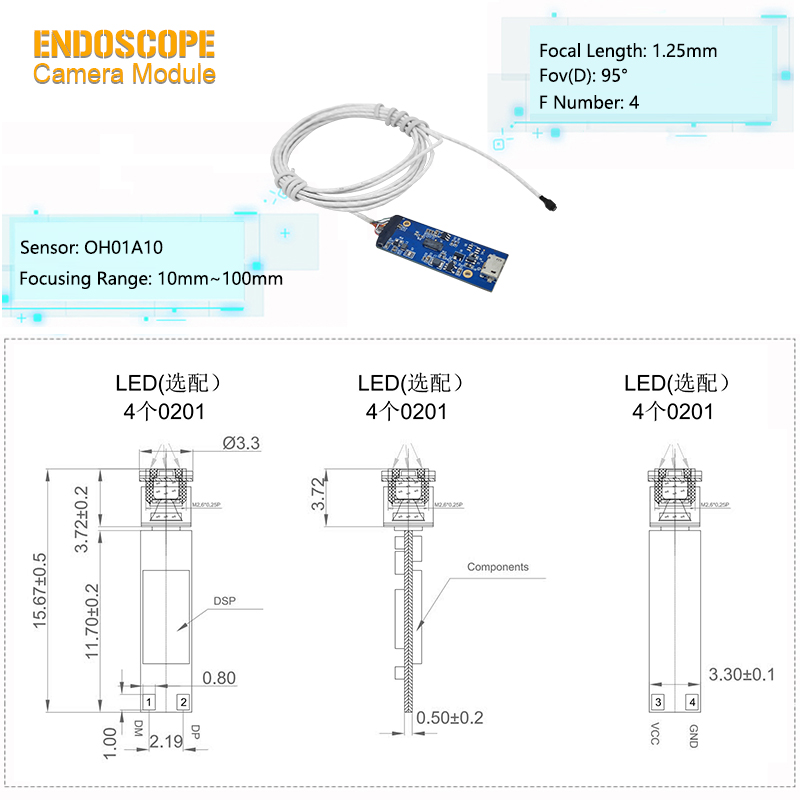 |
1.Wide-angle close-focus imaging: 95° field of view combined with 10mm close-focus distance enables panoramic coverage in confined spaces
2.Optional multi-light source configuration: Supports three-channel LED fill light options to adapt to inspection environments with significant brightness variations
3.Compact plug-and-play design: Integrated DSP and standard electrical interfaces facilitate rapid integration into various endoscopic systems
1. Minimally Invasive Endoscopic Surgery:Featuring a 95° ultra-wide angle and 10mm close-focus capability, this module integrates seamlessly into disposable or reusable endoscope tips. It delivers expansive, crystal-clear real-time intraoperative imaging during minimally invasive procedures in urology, otolaryngology, and other specialties, empowering surgeons with precise diagnostics and manipulation.
2. Industrial Pipeline and Equipment Internal Inspection:Its compact design and optional multi-LED illumination make it ideal for detecting internal defects, monitoring corrosion, and assessing assembly quality in oil/gas pipelines, engine cylinders, precision molds, and similar applications—particularly excelling in confined spaces with limited lighting.
3. Visual Systems for Micro-Robots and Specialized Detection Equipment:The module can be embedded into pipeline crawling robots, laparoscopic surgical robots, or drone inspection probes, providing real-time environmental perception and navigation vision for mobile platforms. It is suitable for detection and operations in complex, unstructured environments.
Product Name | 720P 60FPS endoscope camera module with led |
Basic tolerance | ±0.1mm |
DSP | USB |
Sensor | OH01A10 |
Focusing Range | 10-100mm |
Focal Length | 1.25mm |
F Number | 3.58 |
FOV(D) | 95° |
TV Distortion | <-2% |
Diameter | 3.3mm |
1. What is the difference between medical and industrial endoscope modules?
The medical module emphasizes biocompatibility, sterilization and high image quality, and needs to comply with FDA/CE certification; Industrial modules focus on durability (such as corrosion protection), wide temperature operation (-20°C to 70°C), and special light sources (such as UV).
2. Why do pipeline inspection modules need long cables?
The cable length is usually 10-30 meters, including Kevlar tensile layer and waterproof connector, which supports real-time transmission while resisting internal friction and chemical corrosion of the pipeline.
3. How to evaluate the cost performance of the module?
For comprehensive resolution, durability, and after-sales support (such as medical modules that require calibration services from manufacturers), industrial scenarios can prioritize MTBF (mean time to failure) indicators.
Our company has several advantages that set us apart from our competitors and make us the first choice among our clients. Here are some of our key advantages:
1. Customer Service: Our team of professionals is loyal and proactive towards customers, responding promptly and effectively solving problems.
2. Timely Delivery: We understand the importance of delivering products on time. Our efficient logistics team ensures that we get our products to our customers on time.
3. Innovation: We continually strive to innovate and improve our products and services. We invest in research and development to stay at the forefront of our industry.
This is a 60FPS 720PO 3.3mm CH1A10 Sensor USB Endoscope Camera Module with a 95° ultra-wide-angle optical lens (focal length 1.25mm, aperture F4), enabling high-definition, low-distortion real-time imaging within a 10mm to 100mm focus range. Its compact DSP integrated design supports optional configurations of three sets of 0201-sized LED auxiliary lights, meeting diverse illumination requirements in various cavity environments. This makes it suitable for professional applications demanding both compact size and superior imaging quality, such as medical endoscopy, industrial pipeline inspection, and micro-robot vision systems. | |
1.Wide-angle close-focus imaging: 95° field of view combined with 10mm close-focus distance enables panoramic coverage in confined spaces
2.Optional multi-light source configuration: Supports three-channel LED fill light options to adapt to inspection environments with significant brightness variations
3.Compact plug-and-play design: Integrated DSP and standard electrical interfaces facilitate rapid integration into various endoscopic systems
1. Minimally Invasive Endoscopic Surgery:Featuring a 95° ultra-wide angle and 10mm close-focus capability, this module integrates seamlessly into disposable or reusable endoscope tips. It delivers expansive, crystal-clear real-time intraoperative imaging during minimally invasive procedures in urology, otolaryngology, and other specialties, empowering surgeons with precise diagnostics and manipulation.
2. Industrial Pipeline and Equipment Internal Inspection:Its compact design and optional multi-LED illumination make it ideal for detecting internal defects, monitoring corrosion, and assessing assembly quality in oil/gas pipelines, engine cylinders, precision molds, and similar applications—particularly excelling in confined spaces with limited lighting.
3. Visual Systems for Micro-Robots and Specialized Detection Equipment:The module can be embedded into pipeline crawling robots, laparoscopic surgical robots, or drone inspection probes, providing real-time environmental perception and navigation vision for mobile platforms. It is suitable for detection and operations in complex, unstructured environments.
Product Name | 720P 60FPS endoscope camera module with led |
Basic tolerance | ±0.1mm |
DSP | USB |
Sensor | OH01A10 |
Focusing Range | 10-100mm |
Focal Length | 1.25mm |
F Number | 3.58 |
FOV(D) | 95° |
TV Distortion | <-2% |
Diameter | 3.3mm |
1. What is the difference between medical and industrial endoscope modules?
The medical module emphasizes biocompatibility, sterilization and high image quality, and needs to comply with FDA/CE certification; Industrial modules focus on durability (such as corrosion protection), wide temperature operation (-20°C to 70°C), and special light sources (such as UV).
2. Why do pipeline inspection modules need long cables?
The cable length is usually 10-30 meters, including Kevlar tensile layer and waterproof connector, which supports real-time transmission while resisting internal friction and chemical corrosion of the pipeline.
3. How to evaluate the cost performance of the module?
For comprehensive resolution, durability, and after-sales support (such as medical modules that require calibration services from manufacturers), industrial scenarios can prioritize MTBF (mean time to failure) indicators.
Our company has several advantages that set us apart from our competitors and make us the first choice among our clients. Here are some of our key advantages:
1. Customer Service: Our team of professionals is loyal and proactive towards customers, responding promptly and effectively solving problems.
2. Timely Delivery: We understand the importance of delivering products on time. Our efficient logistics team ensures that we get our products to our customers on time.
3. Innovation: We continually strive to innovate and improve our products and services. We invest in research and development to stay at the forefront of our industry.


