SincereFirst introduces a professional-grade micro-imaging solution featuring the Raysense ES101 sensor, delivering 1000×1000@60FPS and 1000×800@75FPS output. The 3.1mm separated module integrates a 1/9" sensor with 1.4μm pixels, 140° FOV, and six white LEDs, transmitting 10bit RAW data via Type-C (
On December 2, 2025, MicroPort Robotics Group announced that its independently developed "Dragonfly Eye" stereoscopic electronic laparoscope has successfully obtained EU CE certification. This breakthrough not only marks a critical step for China's high-end surgical robot systems entering the intern
# Visual Oral Endoscope: Technical Requirements and Future Development Trends for Endoscope Camera Modules## IntroductionDriven by rising personal health consciousness and the proliferation of mobile healthcare technology, visual oral endoscopes are transitioning from professional dental clinics to
[Industry Insight] On December 1, Xishan Technology unveiled its 4K ultra-high-definition endoscope system at MEDICA International Trade Fair in Düsseldorf, Germany, drawing distributors and clinical experts from 43 countries. While seemingly a routine product showcase, this event marks a landmark m
OCHFA10 sensor, delivering 700×700@60fps (or 90fps at 400×400) with 0.4lux low-light performance. Fixed 0.418mm focal length covers 5-50mm working distance.Key advantage: Dual YUY/MJPEG output via USB2.0 UVC protocol—true plug-and-play on Windows/Linux/macOS/Android, eliminating driver development.M
On March 11, 2025, FUJIFILM Healthcare Americas Corporation announced the official commercialization of its EN-840T double-balloon enteroscopy (DBE) camera module. As a long-standing manufacturer in the endoscope module sector, this new product is specifically designed for small bowel disease diagno
For visual inspection in confined spaces, sharing field-validated specs of a 3.9mm USB endoscope module:Built on OmniVision OV9734 sensor, the module delivers stable 30FPS at 1280×720 resolution, with PureCel® backside-illuminated technology ensuring low-light sensitivity. The optical system feature
Addressing precision inspection needs in fields such as medical care, industry, and aerospace, this endoscope camera module based on the OV2740 sensor has emerged as a core selection solution, leveraging its "compact size + high reliability + wide adaptability". Key technical highlights are as follo
Product Positioning and EvolutionOCHFA10 is the official upgraded model of OVM6946. Both adopt OmniVision's CameraCubeChip® wafer-level packaging technology, specifically designed for disposable medical endoscopes. Although OCHFA10 comprehensively surpasses its predecessor in technical specification
November 26, 2025 — Feiyinuo's Vicyto-6000 endoscope system, unveiled at MEDICA 2025, sets three hard requirements for upstream module vendors: distal outer diameter <5.8mm, latency <15ms, and 120° bendability, signaling medical endoscopes' entry into the "optical-electronic-computational integratio
As a device focusing on visualization needs in narrow spaces, the 3.9mm USB Endoscope Camera Module has become a reliable choice in fields such as medical diagnosis and treatment, industrial inspection, and pet healthcare, thanks to its core performance and practical design. Below is an objective ov
In the world of industrial, medical, and inspection technologies, endoscope camera modules play a pivotal role.
In industrial settings, efficiency and precision are paramount, especially when it comes to equipment inspections.
When choosing inspection tools for industrial purposes, precision, efficiency, and reliability are key. In many industries, the ability to inspect internal components or hard-to-reach areas without dismantling equipment is crucial.
In the fast-paced world of automotive repair and diagnostics, precision, efficiency, and speed are paramount. Traditional methods of engine inspection often require time-consuming disassembly, which leads to longer downtimes and higher costs.
In today's fast-paced industrial environment, precision and efficiency are key factors driving successful operations. One technology that has significantly contributed to achieving these goals is the USB endoscope camera module.
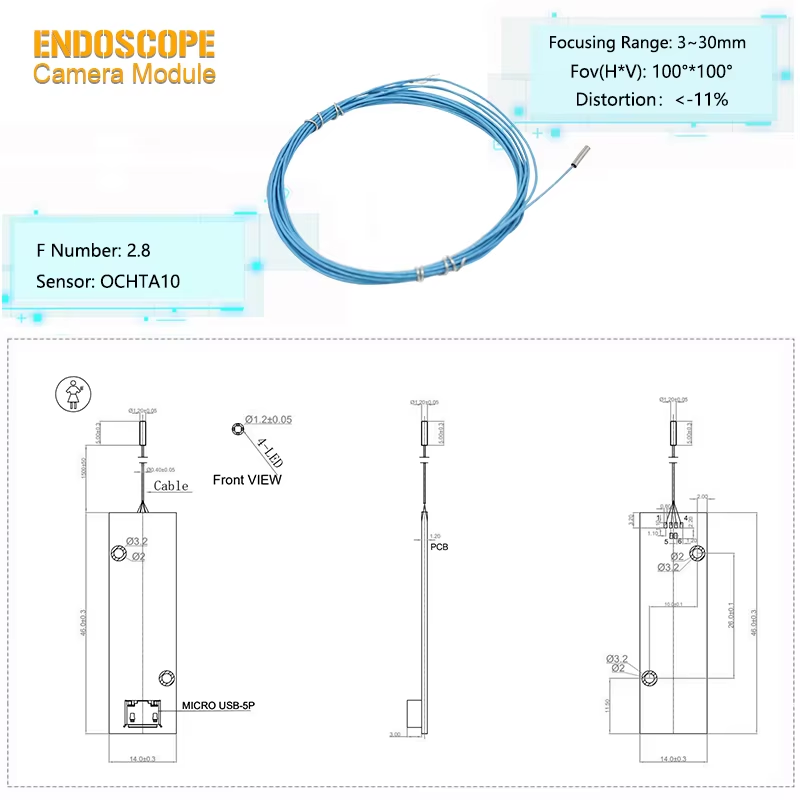
Designed for multi-scenario precision inspection, it is equipped with the core OmniVision OCHTA10 CMOS sensor. Its ultra-slim diameter of 1.2mm±0.05mm breaks through the spatial limitations of traditional tools. Paired with an F/2.8 large aperture and an ultra-close focusing capability of 0.175mm, i
In endoscopic camera modules, lens material is a core factor determining imaging quality, durability, and cost. From a popular science perspective, this article systematically analyzes the key impacts of three materials—plastic, glass-plastic hybrid, and all-glass—on endoscopic modules, helping to u
As a manufacturer specializing in the R&D and production of endoscope camera modules, we often receive questions from customers: Why do two modules labeled with "1080P resolution, 1/4-inch CIS, 2-megapixel" have consistent core parameters but different models? Behind this lies the in-depth design co
| Availability: | |
|---|---|
| Quantity: | |
SF-C016USB-D1.2
SINCEREFIRST
| This is micro endoscope cam OCHTA10 CMOS sensor plumbing 1.2mm endoscope camera module, is a professional device developed to meet the demand for "accurate detection in ultra-narrow spaces". It is core-equipped with an OCHTA10 image sensor, and features "extreme compactness + stable performance" as its core advantages, making it widely suitable for minimally invasive medical and industrial testing scenarios. In terms of size design, the module achieves an impressive overall diameter of 1.2mm (with the camera module being only 0.9mm and the outer diameter 1.2mm). This ultra-micro specification allows it to easily navigate through extremely narrow spaces that traditional endoscopes can hardly reach—whether it is pipes with a diameter of only a few millimeters, dental root canals, or robot slits, it can penetrate flexibly without damaging the detection environment. In terms of imaging, the module supports 400*400 resolution. Combined with the precise signal conversion capability of the OCHTA10 sensor, even in low-light environments, it can supplement light through 4 built-in LED fill lights to clearly capture the detailed features of the detected object, avoiding observation blind spots caused by insufficient light. In terms of optical performance, the module is equipped with a lens with a focal length of 3.75mm and an aperture of F2.8, which can not only ensure the light intake during close-range detection but also control the image depth of field. At the same time, its 100° horizontal field of view (HFOV) and 100° vertical field of view (VFOV) enable wide-range visual coverage, reducing the number of module movements and improving detection efficiency. The TV distortion rate of <-11% effectively reduces image distortion and ensures the accuracy of observation results. The focusing range covers 3mm-50mm, meaning that both micro-details of 3mm (such as the texture of the inner wall of a root canal) and medium-distance scenes of 50mm (such as the overall view of the inside of a pipe) can be clearly displayed without frequent focus adjustments. In addition, the module fully considers the needs of multiple scenarios in its practical design: it supports two structural designs, integrated or separated, which can be flexibly selected according to the installation requirements of the detection equipment; a durable steel sleeve can be optionally equipped to enhance the module's corrosion resistance and wear resistance in oily and humid environments; the supporting cable has a maximum length of 2 meters, which not only meets the needs of long-distance operation but also ensures the stability of signal transmission; the output interface adopts the USB2.0 UVC protocol, which is seamlessly compatible with Windows and Android systems. No additional complex drivers need to be installed, and high-quality video transmission can be achieved with plug-and-play, greatly lowering the threshold for equipment adaptation. |
Ultra-fine Diameter Design: With a micro probe diameter of only 1.2mm, it can penetrate narrow spaces that conventional equipment is difficult to reach, enabling more comprehensive and flexible detection.Slim 1.4mm outer diameter and 0.9mm camera module for easy navigation.
HD Imaging Effect: Equipped with an OCHTA10 CMOS sensor, it supports 400*400 resolution imaging, delivering clear and delicate images. It also supports real-time video output and is compatible with a variety of display devices.
Wide-Angle Side View: The 120° wide angle combined with side view greatly improves detection efficiency and detail capture capability, while effectively reducing viewing blind spots.
Adaptation to Complex Environments: The 3mm-50mm focusing range covers both close-range micro and medium-distance scenarios, eliminating the need for frequent focusing; 4 built-in LED fill lights can cope with low-light environments, avoiding detail omission and adapting to scenarios with insufficient light.
Compatibility with Mainstream Systems: The USB2.0 UVC interface is directly compatible with Windows and Android systems, enabling plug-and-play without complex drivers; the 2-meter long cable supports long-distance operation, adapting to the spatial requirements of different detection scenarios.
Reliable Quality & Flexible Customization: It supports integrated/separated structural design, which can be matched to equipment installation as needed; a durable steel sleeve can be optionally equipped to enhance oil and corrosion resistance, extending its service life in scenarios such as industrial pipelines and medical body fluid contact.
1. Pipe and Narrow Space Detection: Used for blockage location in sewers/ventilation pipes and detection of corrosion or cracks on the inner wall of oil pipelines. The ultra-small diameter of 1.2mm allows it to penetrate thin pipes, and the 120° field of view quickly covers the entire interior of the pipe.
2. Minimally Invasive Medical Assistance: Provides real-time imaging in dental root canal treatment and assists in positioning during ENT (ear, nose, and throat) foreign body removal surgeries. Its ultra-micro size reduces tissue damage, and the 3mm-50mm focusing range clearly displays the details of the lesion.
3. Smart Hardware Integration: Suitable for visual navigation of robot slit cleaning equipment and real-time environmental modeling for AR devices. Its micro design does not affect the flexibility of the hardware, and the USB2.0 interface facilitates integration with smart devices.
Model Number | SF-C016USB-D1.2 |
Image Sensor | OCHTA10 |
Diameter | 1.2mm |
Focusing Range | 3mm-50mm |
Focal Length | 3.75mm |
F No. | 2.8 |
FOV(H*V) | 120°×88.8° |
TV Distortion | <-11% |
Output | USB2.0 UVC |
Features | Endoscope Camera |
FAQ
1. How does the endoscope camera module work?
The endoscope camera module collects the internal image through the front optical lens, converts it into electrical signal by CMOS or CCD sensor, and then optimizes it through image processing chip for noise reduction and enhancement, and finally outputs high-definition video signal. Some modules support wireless transmission or fiber optic signal transmission, suitable for medical or industrial inspection scenarios.
2. What is the significance of the depth of field range of the module?
Large depth of field (such as 5mm to 50mm) can clearly show near and far objects at the same time, reduce the need for frequent focusing, suitable for endoscopic surgery; Shallow depth of field is used to highlight specific plane details, such as skin inspection.
3. What can I do if the module fails to start?
Check the power adapter (for example, 12V output), the port is loose, and the fuse is blown. If the wireless module is used, check the battery level and pairing status.
| This is micro endoscope cam OCHTA10 CMOS sensor plumbing 1.2mm endoscope camera module, is a professional device developed to meet the demand for "accurate detection in ultra-narrow spaces". It is core-equipped with an OCHTA10 image sensor, and features "extreme compactness + stable performance" as its core advantages, making it widely suitable for minimally invasive medical and industrial testing scenarios. In terms of size design, the module achieves an impressive overall diameter of 1.2mm (with the camera module being only 0.9mm and the outer diameter 1.2mm). This ultra-micro specification allows it to easily navigate through extremely narrow spaces that traditional endoscopes can hardly reach—whether it is pipes with a diameter of only a few millimeters, dental root canals, or robot slits, it can penetrate flexibly without damaging the detection environment. In terms of imaging, the module supports 400*400 resolution. Combined with the precise signal conversion capability of the OCHTA10 sensor, even in low-light environments, it can supplement light through 4 built-in LED fill lights to clearly capture the detailed features of the detected object, avoiding observation blind spots caused by insufficient light. In terms of optical performance, the module is equipped with a lens with a focal length of 3.75mm and an aperture of F2.8, which can not only ensure the light intake during close-range detection but also control the image depth of field. At the same time, its 100° horizontal field of view (HFOV) and 100° vertical field of view (VFOV) enable wide-range visual coverage, reducing the number of module movements and improving detection efficiency. The TV distortion rate of <-11% effectively reduces image distortion and ensures the accuracy of observation results. The focusing range covers 3mm-50mm, meaning that both micro-details of 3mm (such as the texture of the inner wall of a root canal) and medium-distance scenes of 50mm (such as the overall view of the inside of a pipe) can be clearly displayed without frequent focus adjustments. In addition, the module fully considers the needs of multiple scenarios in its practical design: it supports two structural designs, integrated or separated, which can be flexibly selected according to the installation requirements of the detection equipment; a durable steel sleeve can be optionally equipped to enhance the module's corrosion resistance and wear resistance in oily and humid environments; the supporting cable has a maximum length of 2 meters, which not only meets the needs of long-distance operation but also ensures the stability of signal transmission; the output interface adopts the USB2.0 UVC protocol, which is seamlessly compatible with Windows and Android systems. No additional complex drivers need to be installed, and high-quality video transmission can be achieved with plug-and-play, greatly lowering the threshold for equipment adaptation. |
Ultra-fine Diameter Design: With a micro probe diameter of only 1.2mm, it can penetrate narrow spaces that conventional equipment is difficult to reach, enabling more comprehensive and flexible detection.Slim 1.4mm outer diameter and 0.9mm camera module for easy navigation.
HD Imaging Effect: Equipped with an OCHTA10 CMOS sensor, it supports 400*400 resolution imaging, delivering clear and delicate images. It also supports real-time video output and is compatible with a variety of display devices.
Wide-Angle Side View: The 120° wide angle combined with side view greatly improves detection efficiency and detail capture capability, while effectively reducing viewing blind spots.
Adaptation to Complex Environments: The 3mm-50mm focusing range covers both close-range micro and medium-distance scenarios, eliminating the need for frequent focusing; 4 built-in LED fill lights can cope with low-light environments, avoiding detail omission and adapting to scenarios with insufficient light.
Compatibility with Mainstream Systems: The USB2.0 UVC interface is directly compatible with Windows and Android systems, enabling plug-and-play without complex drivers; the 2-meter long cable supports long-distance operation, adapting to the spatial requirements of different detection scenarios.
Reliable Quality & Flexible Customization: It supports integrated/separated structural design, which can be matched to equipment installation as needed; a durable steel sleeve can be optionally equipped to enhance oil and corrosion resistance, extending its service life in scenarios such as industrial pipelines and medical body fluid contact.
1. Pipe and Narrow Space Detection: Used for blockage location in sewers/ventilation pipes and detection of corrosion or cracks on the inner wall of oil pipelines. The ultra-small diameter of 1.2mm allows it to penetrate thin pipes, and the 120° field of view quickly covers the entire interior of the pipe.
2. Minimally Invasive Medical Assistance: Provides real-time imaging in dental root canal treatment and assists in positioning during ENT (ear, nose, and throat) foreign body removal surgeries. Its ultra-micro size reduces tissue damage, and the 3mm-50mm focusing range clearly displays the details of the lesion.
3. Smart Hardware Integration: Suitable for visual navigation of robot slit cleaning equipment and real-time environmental modeling for AR devices. Its micro design does not affect the flexibility of the hardware, and the USB2.0 interface facilitates integration with smart devices.
Model Number | SF-C016USB-D1.2 |
Image Sensor | OCHTA10 |
Diameter | 1.2mm |
Focusing Range | 3mm-50mm |
Focal Length | 3.75mm |
F No. | 2.8 |
FOV(H*V) | 120°×88.8° |
TV Distortion | <-11% |
Output | USB2.0 UVC |
Features | Endoscope Camera |
FAQ
1. How does the endoscope camera module work?
The endoscope camera module collects the internal image through the front optical lens, converts it into electrical signal by CMOS or CCD sensor, and then optimizes it through image processing chip for noise reduction and enhancement, and finally outputs high-definition video signal. Some modules support wireless transmission or fiber optic signal transmission, suitable for medical or industrial inspection scenarios.
2. What is the significance of the depth of field range of the module?
Large depth of field (such as 5mm to 50mm) can clearly show near and far objects at the same time, reduce the need for frequent focusing, suitable for endoscopic surgery; Shallow depth of field is used to highlight specific plane details, such as skin inspection.
3. What can I do if the module fails to start?
Check the power adapter (for example, 12V output), the port is loose, and the fuse is blown. If the wireless module is used, check the battery level and pairing status.