Views: 0 Author: Site Editor Publish Time: 2026-05-20 Origin: Site


Miniaturization in medical visualization often forces a compromise between image clarity, thermal safety, and integration complexity. Device engineers constantly battle extreme space constraints. When you shrink optical sensors, heat dissipation and signal integrity usually suffer. Finding a reliable component that delivers true HD resolution in sub-4mm dimensions is a complex challenge. We must also maintain safe operating temperatures and ensure reliable connectivity throughout long procedures. How do you bridge this gap without risking patient safety or extending your development cycles?
The answer lies in a balanced ecosystem design. We will explore how integrating the OmniVision sensor into a protective stainless steel sleeve solves these exact engineering hurdles. Pairing this silicon with calibrated LED illumination creates a robust, compliance-ready foundation. You will learn how to navigate physical wire limits, meet strict thermal safety thresholds, and specify the ideal optical parameters for your next diagnostic or surgical visualization tool.
Sensor Efficiency: The OV9734 CMOS sensor utilizes PureCel® technology to reduce power consumption by 25%, minimizing heat generation in sensitive clinical environments.
Engineering Realities: Signal distance is physically bound by wire diameter—achieving a 3–5 meter reach requires a Φ1.85mm cable, whereas ultra-thin Φ0.85mm cables are limited to 2 meters.
Durability & Compliance: Stainless steel housing provides critical resistance to ethylene oxide sterilization and mechanical stress.
Plug-and-Play Integration: Modular designs featuring UVC compliance and Type-C connectivity accelerate time-to-market for medical camera module developers.
Optical form factor dictates the limits of any minimally invasive medical device. The 1/9-inch optical format currently dominates this space for very specific reasons. It achieves an incredibly low z-axis height of just 2.5mm. This microscopic footprint makes it the industry standard for narrow anatomical pathways. When integrating a medical endoscope camera, every millimeter dictates patient comfort and procedural safety. The 1/9-inch design allows you to fit high-fidelity imaging into ultra-thin catheters and scopes without bulking up the distal tip.
Power management is another critical advantage of this silicon. The OV9734 CMOS sensor relies on OmniVision’s proprietary PureCel® architecture. This underlying technology dramatically curbs electrical draw. Active power consumption hovers around just 69 mW, while sleep mode drops to an astonishing 0.9 µW. Compared to previous generations, you get a 25% power reduction. This drop directly translates to prolonged operation times. It ensures the device will not exceed strict thermal limits during lengthy diagnostic sessions.
You cannot sacrifice imaging capabilities for small size. The baseline specifications deliver 720p HD video at a smooth 30 frames per second. At 1MP resolution, doctors view fluid, real-time tissue dynamics without tearing or lag. Furthermore, advanced on-chip features like automatic black level calibration (ABLC) and defect pixel correction (DPC) refine the raw feed. ABLC stabilizes the dark areas of an image, preventing noise from obscuring critical details. DPC automatically masks dead pixels that might occur from manufacturing or prolonged wear. Together, they help clinical professionals discern subtle tissue boundaries seamlessly.
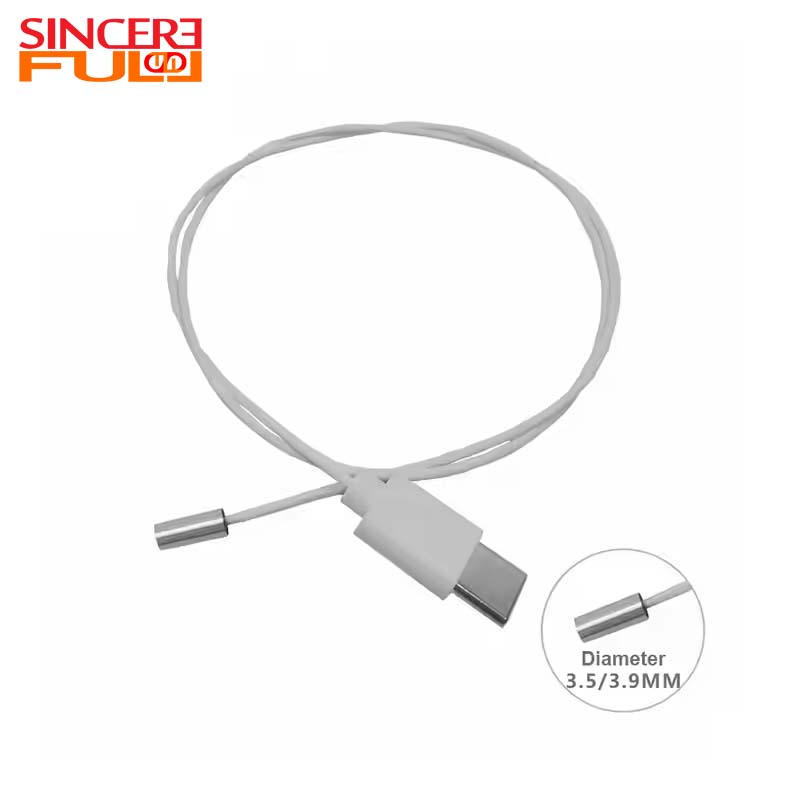
Designing an effective viewing tool requires balancing the physics of wire sizing against clinical utility. Cable diameter strictly dictates signal integrity over long distances. While an ultra-thin Φ0.85mm wire seems ideal for minimal invasiveness, it presents severe engineering limits. High-frequency video signals attenuate rapidly across thin copper lines. Therefore, a Φ0.85mm wire restricts stable, interference-free transmission to a maximum of 2 meters.
Scaling up your device reach requires deliberate physical trade-offs. Extending a clinical endoscope to 3 or 5 meters is common for deep gastrointestinal tracts or specialized industrial testing. To support this length without signal degradation or frame drops, engineers must step up to a Φ1.85mm wire. This thicker shielding minimizes crosstalk and preserves power delivery to the distal tip. You must decide early whether your primary goal is maximum reach or maximum flexibility.
Thermal constraints add another layer of complexity to this balancing act. Patient safety standards mandate that any internal medical device must operate strictly under +40°C. Human tissue begins to suffer thermal damage above 42°C, making heat dissipation a zero-tolerance engineering parameter.
To meet these rigorous standards, you must focus on the following design choices:
Component selection: Utilize low-power silicon to minimize baseline heat generation.
Material conductivity: Leverage the thermal transfer properties of the external housing to dissipate heat evenly.
Current regulation: Implement intelligent LED power throttling when the device detects internal temperature spikes.
Cable resistance management: Match your wire gauge to your operational length to prevent localized resistive heating.
Viewing narrow anatomical cavities demands optimized micro-illumination. Dark, highly absorptive environments require intense but uniform light. The integrated lighting unit typically utilizes 0402 specification white LEDs. These micro-components are arranged in a ring array around the lens. They emit a daylight-balanced color temperature between 5500K and 6500K. This specific temperature spectrum helps doctors accurately judge tissue perfusion and spot anomalies. A reliable LED endoscope turns these confined, dark spaces into clearly observable diagnostic fields.
Optical alignment goes hand-in-hand with this illumination. You cannot just throw light into a cavity; it must match the sensor's optical baselines. An advanced LED endoscope camera pairs its lighting array with a specific field of view (FOV). A typical baseline includes a 100° FOV combined with a 10–50mm depth of field (DOF). This exact calibration is tailored for gastrointestinal or ENT observation. It ensures everything within a few centimeters of the lens remains sharply in focus while the LEDs uniformly light that specific zone.
Beyond optics, physical durability is paramount. The stainless steel shell provides extraordinary mechanical protection for the fragile internal optics. This outer sleeve guarantees structural rigidity against accidental impact during fast-paced surgical environments.
More importantly, the stainless steel shell resists harsh chemical sterilization. Reusable medical equipment must endure intense cleaning cycles. Ethylene oxide (EtO) sterilization exposes devices to toxic gas under vacuum. Standard plastics and weak alloys degrade rapidly under these conditions. Stainless steel provides critical resistance to this corrosion, extending the lifecycle of your hardware and meeting crucial compliance benchmarks.
Modern clinical environments demand immediate, frictionless integration. Platform agnosticism solves many software deployment headaches. By enforcing UVC (USB Video Class) compliance, manufacturers eliminate the need for proprietary driver installations. You can plug a well-designed Type-C camera module natively into Linux, Android, or Windows platforms. This versatility accelerates time-to-market and allows hospitals to use off-the-shelf medical tablets for viewing.
Raw sensor data requires sophisticated interpretation before it hits the screen. Image Signal Processing (ISP) handles this heavy lifting. You must implement high-performance decoding boards and advanced ISP algorithms near the connection interface. These boards translate raw pixel data into viewable video streams while minimizing latency. In surgical settings, even milliseconds of visual delay can cause procedural errors. A powerful ISP ensures real-time hand-eye coordination.
Deploying a camera in a clinical setting requires precise ISP tuning. The factory default settings rarely suit the complex lighting conditions of human tissue. Engineers must engage in extensive calibration steps:
Format Selection: Choose between YUV2 for uncompressed, high-fidelity color or MJPEG for efficient, low-bandwidth transmission.
White Balance Adjustment: Calibrate the ISP to prevent the red-heavy environment of internal organs from washing out the image.
Saturation Control: Fine-tune color intensity so subtle variations in mucosal membranes remain highly visible.
Edge Enhancement: Apply sharpening algorithms selectively to define tissue borders without introducing digital artifacts.
Procuring the right hardware demands a structured approach. You must select modular building blocks based on your target anatomical pathway. The Outer Diameter (OD) is your primary limiting factor. A medical camera module can be scaled up or down depending on the internal components you need. Thicker diameters allow for extra LED rings or complex lens arrays, while thinner diameters prioritize minimal invasiveness.
Outer Diameter (OD) | Primary Application | Component Constraints |
|---|---|---|
3.1mm | Bronchoscopy / Pediatric Scopes | Strict LED limits; requires ultra-thin steel shell. |
3.3mm | Laryngoscope / ENT Diagnostics | Balanced space for 4-LED arrays and standard wiring. |
3.5mm | Urology / Cystoscopy | Accommodates thicker cables for longer insertion depths. |
3.9mm | Gastroscope / Veterinary Uses | Allows robust DSP integration and maximum illumination. |
You must also decide between customized bare boards and pre-assembled modules. Off-the-shelf modules package the sensor, lens, LED array, steel shell, and DSP into one verified unit. This approach slashes R&D time. Conversely, bare PCB/FPC customization offers total control. It lets you integrate the sensor into entirely proprietary housings, though it drastically increases your compliance and testing workload.
Finally, carefully evaluate your supplier's core capabilities. You need a partner who understands medical regulatory frameworks. Vet suppliers on their ability to handle rigorous environmental testing and compliance pre-checks, such as IP68 waterproofing and extreme temperature cycling. Furthermore, clarify their minimal order quantities (MOQs) for custom FPC lengths. A supplier capable of low-MOQ prototype runs will save you immense capital during the early validation phases.
The OV9734 CMOS LED endoscope functions not just as a sensor, but as a balanced ecosystem. It brings together low-power silicon, precisely calibrated optics, and highly durable mechanical housing. Mastering the integration of these elements ensures your device remains safe, compliant, and clinically effective.
By understanding physical limits like wire diameter attenuation and rigid thermal thresholds, your engineering team can avoid costly late-stage redesigns. UVC compliance and platform-agnostic output ensure your hardware interfaces smoothly with modern hospital IT infrastructure.
To move your project forward, encourage your engineers and product managers to request detailed technical spec sheets from your manufacturing partners. Evaluate specific cable-length trade-offs against your device requirements. Finally, initiate a prototype dev-kit order. Having the physical hardware allows your team to perform vital internal ISP tuning tailored to your exact clinical use case.
A: Can be customized down to 3.1mm or 3.3mm depending on the inclusion of the steel shell and LED ring.
A: It provides corrosion resistance critical for ethylene oxide gas sterilization processes without degrading the optical lens.
A: Yes, standard UVC compliance allows plug-and-play functionality on modern Android tablets and specialized clinical displays.
A: Typically calibrated for 10mm to 50mm, which is optimal for close-range clinical observation in restricted anatomical spaces.


