Research on Lightweight Integration of Low-Power Imaging Modules in Children’s Educational MicroscopesAbstractScientific enlightenment tools designed for young children must ensure both operational safety and engagement while providing intuitive and clear observational experiences. Traditional optic
Deconstructing the Design Philosophy and Application Boundaries of a Compact Endoscope Camera ModuleAgainst the backdrop of the increasing miniaturization and integration of professional-grade image acquisition equipment, a compact endoscope camera module tailored for close-range, confined-space ins
Technical Evolution and Clinical Empowerment of Hysteroscopic Imaging Systems Abstract With the deepening application of minimally invasive diagnostic and therapeutic techniques in gynecology, hysteroscopy has become a core tool for diagnosing and treating intrauterine lesions. Its clinical efficacy
January 27, 2026 — Mindray has been granted a patent for a novel "endoscopic camera and endoscopic camera system," introducing a dedicated anti-collision terminal structure. This innovation directly addresses a critical and often overlooked challenge in the precise assembly process of high-end endos
How to Select the Right Ultra-Short-Throw HD Camera Module for Confined Spaces? When integrating vision systems into industrial endoscopes, pipeline inspection tools, minimally invasive surgical instruments, or compact devices, choosing the right camera module is critical to success. Faced with chal
{"text":"The medical imaging landscape is rapidly shifting from Full HD (1080p) to Ultra HD (4K) as the new gold standard for high-end visualization. While marketing departments often demand 4K specifications to compete in premium segments, engineering teams face a complex reality. Integrating a hig
{"text":"In minimally invasive surgery (MIS), the monitor acts as the surgeon’s eyes, introducing a unique physiological challenge known as \"Hand-Eye Decoupling.\" Even millisecond delays between a physical hand movement and the visual confirmation on the screen can disrupt surgical flow. This late
{"text":"The landscape of medical and industrial inspection is rapidly shifting. We are moving away from bulky, cart-based units toward handheld, battery-operated IoT devices. This transition empowers professionals to perform diagnostics in remote or constrained environments with unprecedented ease.
{"text":"The medical device industry is currently navigating a fundamental restructuring. For decades, endoscopy relied on the \"asset\" model, where hospitals purchased expensive capital equipment designed to last for years. Today, the sector is rapidly shifting toward a \"consumable\" model, drive
{"text":"Accessing sub-2mm cavities presents a significant engineering hurdle across both medical and industrial sectors. Surgeons navigating bronchial peripheries and maintenance crews inspecting turbine blade cooling channels often face a physical wall: traditional 3mm borescopes simply cannot fit
January 19, 2026 — Ofilm has announced the completion of its 1×1mm ultra-miniature endoscopic camera module, marking a pivotal step in advancing minimally invasive medical diagnostics. This breakthrough addresses a core challenge in the industry by dramatically reducing the size constraints of tradi
Building Competitive Advantage in Compact Industrial Vision: Strategic Considerations for Micro HD Camera ModulesWith rapid advancements in industrial automation, endoscopic inspection, and consumer electronics, market demand for ultra-compact, highly integrated, reliable, and durable HD camera modu
In the optical technology iteration of camera modules, liquid lenses, as a new type of component breaking the limitations of traditional solid-state lenses, are gradually changing the design logic and application scenarios of modules with their dynamically adjustable optical characteristics. Unlike
From "Seeing" to "Seeing Clearly, Understanding and Penetrating"In the field of medical devices, the development of endoscope technology has profoundly changed the way of diagnosis and minimally invasive surgery. As the "eyes" of the endoscope system, camera modules are undergoing a profound transfo
The Profound Transformation of Medical Imaging Through the Lens of 10MP Endoscope ModulesIn an era where precision medicine and minimally invasive surgery are increasingly prevalent, endoscopes serve as the doctor's “extended eyes.” Their technological evolution directly impacts diagnostic accuracy
When Full HD resolution becomes a standard specification for miniature image sensors, Rayshun Micro's ES101 and OmniVision's OH01A10 have developed distinctly different technical characteristics within the same resolution framework.
5MP HD autofocus module empowers the Rhino XT duct cleaning system: Clear vision drives professional cleaning and transparent service.In professional HVAC duct cleaning, service value lies not only in cleaning results but also in the visualization, verifiability, and trustworthiness of the cleaning
Industry Analysis of Miniature HD Camera Modules: Core Perception Components in the Era of Intelligent VisionIntroductionAmidst the wave of universal connectivity and intelligent upgrades, machine vision has emerged as a pivotal technology empowering countless industries. As the “eyes” of visual sys
The development of high-resolution industrial endoscopes with an extremely small diameter is not merely a matter of component miniaturization, but a system-level engineering challenge that necessitates a sophisticated trade-off among optics, sensor performance, mechanical structure, and signal integ
High-Definition Micro Modules Empower Flexible Veterinary EndoscopesIn modern veterinary diagnostics, achieving precise internal examination, foreign body removal, and diagnostic sampling with minimal trauma is crucial for enhancing animal welfare and clinical standards—especially when dealing with
| Availability: | |
|---|---|
| Quantity: | |
SF-C1019USB-D3.9-PRO-95D V1.2 OV9734
SINCEREFIRST
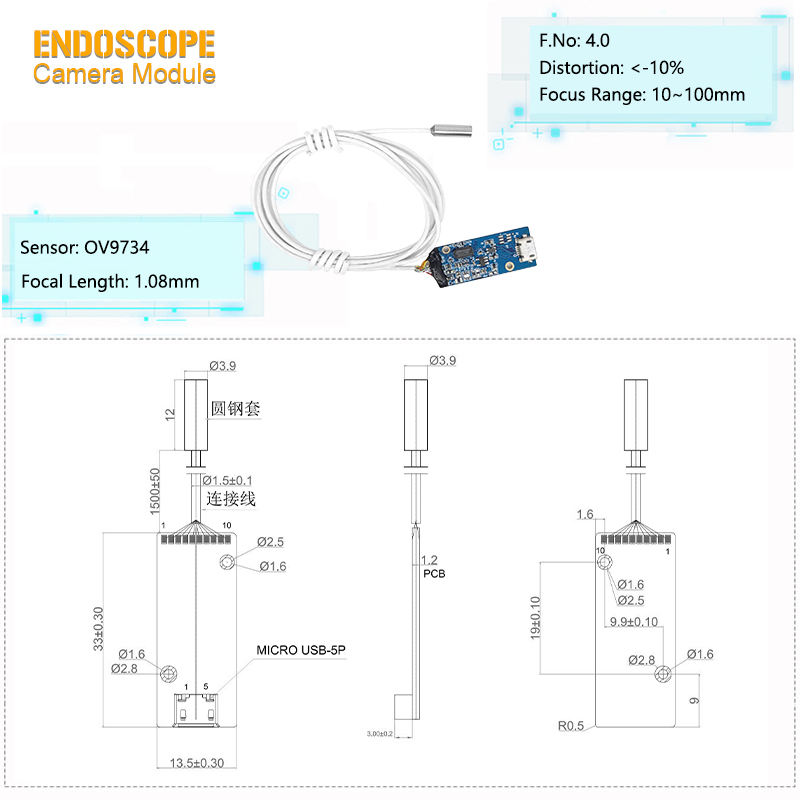
| This high-performance medical endoscope camera module is built around the OmniVision OV9734 CMOS color image sensor, integrating advanced imaging technology and robust structural design to meet the rigorous requirements of medical diagnosis and treatment scenarios. It features a 1MP pixel resolution, supports 720 resolution output, and delivers a maximum frame rate of 30FPS, ensuring smooth and clear real-time image transmission—critical for capturing dynamic tissue movements during procedures. The sensor, with a size of 1/9 inch and pixel dimensions of 1.4μm×1.4μm, is equipped with OmniVision’s exclusive PureCel® technology. This technology optimizes pixel-level light-sensing efficiency, significantly enhancing light collection capabilities to improve imaging quality in low-light environments—addressing the challenge of dim visibility in deep body cavities. The module offers a precise field of view (FOV) of D95°×H85°×V43.5°, enabling comprehensive coverage of inspection areas while maintaining image clarity without edge distortion (distortion rate <10%). Structurally, it adopts a Separated design that allows flexible integration with different medical devices, simplifying assembly and maintenance for healthcare facilities. The module’s lens is fitted with a Steel Shell, protecting the internal optical components from mechanical damage and ensuring durability during repeated use and disinfection. With an ultra-compact diameter of 3.9mm, it can easily access narrow anatomical spaces while minimizing patient discomfort. It also meets IP67-level dust and water resistance, making it suitable for use in humid clinical environments and compatible with common medical disinfection processes. For connectivity and compatibility, the module uses a USB 2.0 interface and supports the UVC protocol, enabling plug-and-play functionality with mainstream operating systems (Windows, macOS, Linux) without the need for additional drivers—greatly reducing deployment time in medical settings. Manufactured via SMT and AA (Active Alignment) processes, it ensures high optical precision and consistent performance across batches. Additionally, it has passed international certifications including CE, FCC, RoHS, and Reach, verifying its compliance with global safety, electromagnetic compatibility, and environmental protection standards for medical devices. | ![]() |
Superior Low-Light Imaging Performance: Leveraging the OV9734 sensor’s PureCel® technology and 6 integrated high-brightness LED fill lights, the module effectively reduces noise generation in low-light environments. Even under weak lighting conditions, it captures clean, clear images, ensuring clinicians can clearly observe subtle lesions or tissue details.
Accurate Color Reproduction: The sensor’s optimized color processing algorithm, combined with the high-quality optical lens, accurately reproduces the true colors of human tissues. This intuitive color feedback helps clinicians make more accurate judgments about tissue health status, supporting precise diagnosis and treatment planning.
High-Speed Response & Dynamic Capture: With a maximum frame rate of 30FPS and fast signal transmission via USB 2.0, the module enables high-speed continuous shooting and rapid response to dynamic scenes. It can reliably capture transient tissue movements, avoiding missed critical visual information.
Flexible Separated Design: The Separated structure allows independent installation and maintenance of the module’s imaging unit and control unit, adapting to the layout requirements of different medical devices and improving deployment flexibility.
Robust Protection & Durability: The 3.9mm-diameter lens with a Steel Shell enhances structural strength, while IP67 dust and water resistance ensures the module remains functional after exposure to moisture, dust, or routine medical disinfection. This extends the module’s service life and reduces replacement costs.
High Precision & Compliance Assurance: The SMT + AA manufacturing process guarantees precise alignment between the sensor and lens, minimizing optical deviations and ensuring stable image quality. Compliance with international certifications (CE, FCC, etc.) also eliminates safety and regulatory risks for medical institutions during use.
Wide Compatibility: Support for the UVC protocol and USB 2.0 interface enables seamless connection to various medical workstations, laptops, or display devices. This plug-and-play capability eliminates the need for specialized software development, reducing the technical threshold for clinical application.
Minimally Invasive Surgery: Compatible with laparoscopic and arthroscopic devices—its 3.9mm compact size fits through small surgical incisions, and the high-definition image transmission helps surgeons observe delicate tissue structures for precise operation.
Otolaryngology (ENT) Examination: Ideal for otoscopes and nasoscopes. The ultra-short focal length and narrow 3.9mm diameter allow easy access to narrow ear canals and nasal cavities, reducing patient discomfort while capturing clear images of minor lesions.
Veterinary Diagnosis & Treatment: Used with pet digestive tract endoscopes and respiratory endoscopes to examine the gastrointestinal tract or respiratory tract of companion animals, helping veterinarians identify inflammation, foreign bodies, or ulcers.
Scientific Research Observation: Integrated into microbial sample high-definition recording devices—its low noise and high resolution support clear imaging and data analysis of micro-biological samples, meeting the needs of life science research.
Specialized Medical Auxiliary Detection: Adaptable to small-size gynecological endoscopes or urological endoscopes. The IP67 protection and corrosion-resistant Steel Shell ensure reliability in humid clinical environments, while the PureCel® technology ensures clear imaging even in low-light areas of the body.
Product Name | OV9734 Sensor USB Endoscope Camera Module |
Focal Length | 1.08mm |
DSP | USB |
Sensor | OV9734 |
Focusing Range | 10-30mm |
Diameter | 3.9mm |
F Number | 4.0 |
LED: | 6pcs |
Resolution | 30fps |
FOV(D) | 95° |
1.Why does otorhinolaryngology need ultra-fine diameter modules?
When the space of the ear canal/nasal cavity is narrow, a module with a diameter of ≤3mm can reduce the patient's discomfort. At the same time, it is necessary to maintain high resolution (such as ≥300 line pairs /mm) to identify minor lesions.
2.What could be the possible reasons for noise in an image?
It might be due to sensor overheating, signal transmission interference, or excessively high ISO in low light conditions. It is necessary to check the heat dissipation design, cable shielding, or enable the noise reduction mode.
3.Why does the image show color cast?
It may be due to uncalibrated white balance, mismatched color temperature of the light source (such as mixed use of LED and sunlight), or aging of the sensor. Software correction or replacement of the filter is required.
Our company has several advantages that set us apart from our competitors and make us the first choice among our clients. Here are some of our key advantages:
1. Customer Service: Our team of professionals is loyal and proactive towards customers, responding promptly and effectively solving problems.
2. Timely Delivery: We understand the importance of delivering products on time. Our efficient logistics team ensures that we get our products to our customers on time.
3. Innovation: We continually strive to innovate and improve our products and services. We invest in research and development to stay at the forefront of our industry.
| This high-performance medical endoscope camera module is built around the OmniVision OV9734 CMOS color image sensor, integrating advanced imaging technology and robust structural design to meet the rigorous requirements of medical diagnosis and treatment scenarios. It features a 1MP pixel resolution, supports 720 resolution output, and delivers a maximum frame rate of 30FPS, ensuring smooth and clear real-time image transmission—critical for capturing dynamic tissue movements during procedures. The sensor, with a size of 1/9 inch and pixel dimensions of 1.4μm×1.4μm, is equipped with OmniVision’s exclusive PureCel® technology. This technology optimizes pixel-level light-sensing efficiency, significantly enhancing light collection capabilities to improve imaging quality in low-light environments—addressing the challenge of dim visibility in deep body cavities. The module offers a precise field of view (FOV) of D95°×H85°×V43.5°, enabling comprehensive coverage of inspection areas while maintaining image clarity without edge distortion (distortion rate <10%). Structurally, it adopts a Separated design that allows flexible integration with different medical devices, simplifying assembly and maintenance for healthcare facilities. The module’s lens is fitted with a Steel Shell, protecting the internal optical components from mechanical damage and ensuring durability during repeated use and disinfection. With an ultra-compact diameter of 3.9mm, it can easily access narrow anatomical spaces while minimizing patient discomfort. It also meets IP67-level dust and water resistance, making it suitable for use in humid clinical environments and compatible with common medical disinfection processes. For connectivity and compatibility, the module uses a USB 2.0 interface and supports the UVC protocol, enabling plug-and-play functionality with mainstream operating systems (Windows, macOS, Linux) without the need for additional drivers—greatly reducing deployment time in medical settings. Manufactured via SMT and AA (Active Alignment) processes, it ensures high optical precision and consistent performance across batches. Additionally, it has passed international certifications including CE, FCC, RoHS, and Reach, verifying its compliance with global safety, electromagnetic compatibility, and environmental protection standards for medical devices. | ![]() |
Superior Low-Light Imaging Performance: Leveraging the OV9734 sensor’s PureCel® technology and 6 integrated high-brightness LED fill lights, the module effectively reduces noise generation in low-light environments. Even under weak lighting conditions, it captures clean, clear images, ensuring clinicians can clearly observe subtle lesions or tissue details.
Accurate Color Reproduction: The sensor’s optimized color processing algorithm, combined with the high-quality optical lens, accurately reproduces the true colors of human tissues. This intuitive color feedback helps clinicians make more accurate judgments about tissue health status, supporting precise diagnosis and treatment planning.
High-Speed Response & Dynamic Capture: With a maximum frame rate of 30FPS and fast signal transmission via USB 2.0, the module enables high-speed continuous shooting and rapid response to dynamic scenes. It can reliably capture transient tissue movements, avoiding missed critical visual information.
Flexible Separated Design: The Separated structure allows independent installation and maintenance of the module’s imaging unit and control unit, adapting to the layout requirements of different medical devices and improving deployment flexibility.
Robust Protection & Durability: The 3.9mm-diameter lens with a Steel Shell enhances structural strength, while IP67 dust and water resistance ensures the module remains functional after exposure to moisture, dust, or routine medical disinfection. This extends the module’s service life and reduces replacement costs.
High Precision & Compliance Assurance: The SMT + AA manufacturing process guarantees precise alignment between the sensor and lens, minimizing optical deviations and ensuring stable image quality. Compliance with international certifications (CE, FCC, etc.) also eliminates safety and regulatory risks for medical institutions during use.
Wide Compatibility: Support for the UVC protocol and USB 2.0 interface enables seamless connection to various medical workstations, laptops, or display devices. This plug-and-play capability eliminates the need for specialized software development, reducing the technical threshold for clinical application.
Minimally Invasive Surgery: Compatible with laparoscopic and arthroscopic devices—its 3.9mm compact size fits through small surgical incisions, and the high-definition image transmission helps surgeons observe delicate tissue structures for precise operation.
Otolaryngology (ENT) Examination: Ideal for otoscopes and nasoscopes. The ultra-short focal length and narrow 3.9mm diameter allow easy access to narrow ear canals and nasal cavities, reducing patient discomfort while capturing clear images of minor lesions.
Veterinary Diagnosis & Treatment: Used with pet digestive tract endoscopes and respiratory endoscopes to examine the gastrointestinal tract or respiratory tract of companion animals, helping veterinarians identify inflammation, foreign bodies, or ulcers.
Scientific Research Observation: Integrated into microbial sample high-definition recording devices—its low noise and high resolution support clear imaging and data analysis of micro-biological samples, meeting the needs of life science research.
Specialized Medical Auxiliary Detection: Adaptable to small-size gynecological endoscopes or urological endoscopes. The IP67 protection and corrosion-resistant Steel Shell ensure reliability in humid clinical environments, while the PureCel® technology ensures clear imaging even in low-light areas of the body.
Product Name | OV9734 Sensor USB Endoscope Camera Module |
Focal Length | 1.08mm |
DSP | USB |
Sensor | OV9734 |
Focusing Range | 10-30mm |
Diameter | 3.9mm |
F Number | 4.0 |
LED: | 6pcs |
Resolution | 30fps |
FOV(D) | 95° |
1.Why does otorhinolaryngology need ultra-fine diameter modules?
When the space of the ear canal/nasal cavity is narrow, a module with a diameter of ≤3mm can reduce the patient's discomfort. At the same time, it is necessary to maintain high resolution (such as ≥300 line pairs /mm) to identify minor lesions.
2.What could be the possible reasons for noise in an image?
It might be due to sensor overheating, signal transmission interference, or excessively high ISO in low light conditions. It is necessary to check the heat dissipation design, cable shielding, or enable the noise reduction mode.
3.Why does the image show color cast?
It may be due to uncalibrated white balance, mismatched color temperature of the light source (such as mixed use of LED and sunlight), or aging of the sensor. Software correction or replacement of the filter is required.
Our company has several advantages that set us apart from our competitors and make us the first choice among our clients. Here are some of our key advantages:
1. Customer Service: Our team of professionals is loyal and proactive towards customers, responding promptly and effectively solving problems.
2. Timely Delivery: We understand the importance of delivering products on time. Our efficient logistics team ensures that we get our products to our customers on time.
3. Innovation: We continually strive to innovate and improve our products and services. We invest in research and development to stay at the forefront of our industry.
