In the world of medical diagnostics and precision industrial inspection, "space" is a luxury that engineers rarely have. When you are designing a tool to navigate a human artery or a jet engine turbine, every tenth of a millimeter matters.As a Camera Module manufacturer with over 30 years of experti
IntroductionIf you're designing something that needs to see into tight spaces—a medical scope, an industrial inspection tool, or even a DIY gadget—size is everything. The camera module has to fit through whatever opening you have. Too big, and it won't go where it needs to. Too small, and you might
What is an Endoscope Camera Module? A Complete Technical OverviewIn the fields of modern medicine and industrial maintenance, the ability to see into inaccessible spaces is not just a convenience—it is a necessity. At the heart of this capability lies a remarkably sophisticated piece of technology:
1. Introduction: When High-Definition Imaging Meets Confined SpacesIn the intersection of minimally invasive medical procedures and industrial precision inspection, a common technical challenge increasingly arises: how to obtain sufficiently clear, smooth, and realistic visual information within a c
IntroductionIf you're buying an endoscope—for medical use, industrial inspection, or DIY projects—you'll probably wonder about resolution. How clear will the image be? Can you see small details? The answer depends on what you're using it for. Resolution standards have come a long way, from basic sta
IntroductionAn endoscope camera module is the tiny camera that lets doctors see inside your body or inspectors look inside machinery. At the core of most modern endoscopes is a CMOS image sensor. CMOS technology has made these cameras smaller, cheaper, and more efficient. This article explains what
1. Introduction: When Detection Space Meets Device Volume ConstraintsIn the development of automated inspection equipment, specialized robots, and portable instruments, imaging system selection faces a fundamental contradiction: the target is deep inside narrow cavities, while control equipment is b
In the field of minimally invasive surgery, the "eye" of the instrument—the endoscope camera—is perhaps the most critical component. It must be small enough to navigate the human body's delicate pathways, yet powerful enough to provide surgeons with crystal-clear, lag-free imagery.At the heart of th
If you are sourcing imaging components or developing a vision-based product, you have likely come across two terms: endoscope and camera module. They are closely related, but they are not the same thing. Mixing them up can lead to the wrong purchasing decision or unnecessary development work.This ar
In both modern medicine and high-end industrial maintenance, the ability to see into inaccessible spaces is critical. Whether a surgeon is performing a minimally invasive procedure or an aerospace engineer is inspecting a turbine blade, the primary tool at work is the endoscope.At the heart of these
IntroductionIn industrial nondestructive testing, medical device development, and embedded vision systems, a recurring challenge arises when the target lies on the sidewall of a pipe or within narrow cavities, particularly at millimeter-scale diameters. Traditional forward-view endoscopes fail in su
IntroductionAn endoscope camera module is the small imaging system inside every borescope or medical scope. It lets you see into tight spaces—inside engines, behind walls, or inside the human body. Despite its tiny size, this module contains several precision parts that work together to capture and
IntroductionA USB endoscope camera module is a small camera designed to look into tight spaces. Plumbers use them to check inside pipes. Mechanics use them to inspect engines without taking things apart. Homeowners use them to see inside walls. If you need to see somewhere you can't physically fit y
OV9734 Sensor 3.6mm Micro HD Endoscope Camera Module: Engineering Guide for Confined-Space Vision SystemsIntroductionIn the realm of industrial inspection, precision equipment maintenance, and embedded vision systems, the ability to visualize the interior of narrow structures often determines the su
Technical Logic and System Integration Considerations for Selecting 8mm 2MP Endoscope ModulesIn the practice of medical endoscope equipment development and industrial inspection system integration, the selection of imaging modules often faces a set of coupled engineering constraints: physical dimens
In the imaging technology spectrum of medical endoscopes and industrial inspection equipment, the evolution of product specifications has always followed two parallel development paths: one continuously ascends toward higher resolution, wider dynamic range, and greater intelligence in the high-end m
Technical Selection and System Adaptation Considerations for 2MP HD UVC Camera ModulesIn the development practices of consumer electronics peripherals, industrial vision terminals, and open-source hardware projects, the selection of imaging modules often faces a set of interrelated engineering const
In the industrial landscape of vision imaging technology, products at different resolution levels occupy distinct ecological niches. While market attention increasingly gravitates toward frontier areas such as tens-of-megapixel sensors, multi-camera fusion, and computational photography, 2MP (1080P)
In applications such as industrial nondestructive testing, precision equipment maintenance, and medical diagnostics, selecting an imaging system often involves balancing a set of interdependent engineering constraints: the physical diameter of inspection channels restricts the module’s front-end siz
In the evolution of endoscopic imaging technology, the continual reduction of sensor size and module diameter has consistently been a key driver of industry innovation. The 4.5mm-diameter miniature USB endoscope module, centered on the BF2013 sensor, represents a critical node along this technologic
| Availability: | |
|---|---|
| Quantity: | |
SF-C1019USB-D6.0-SV-L25-D110
SINCEREFIRST
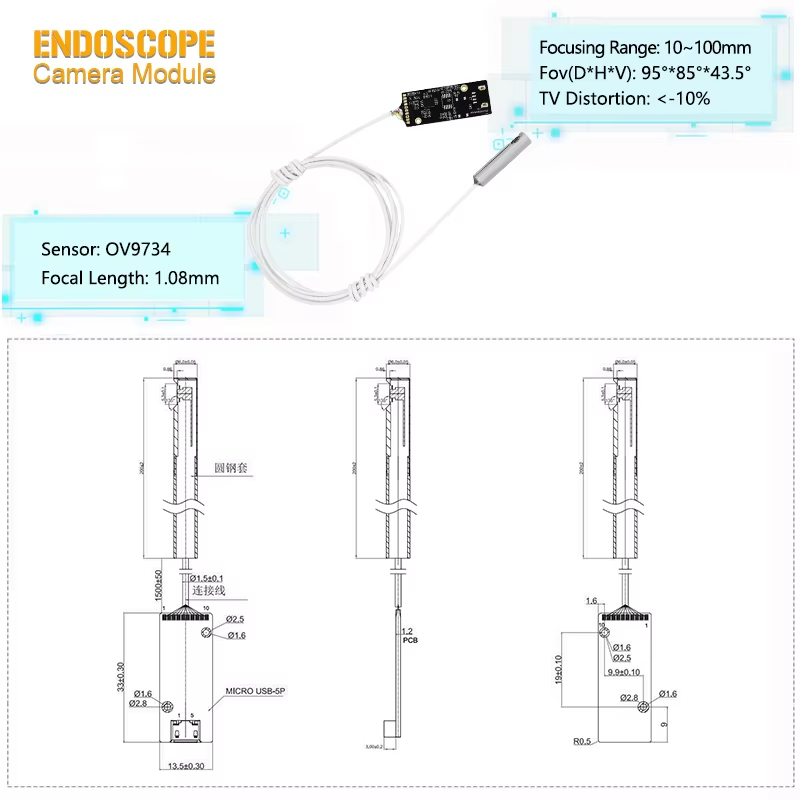
| This is a micro 1MP OV9734 sensor wide-angle side-view inspection endoscope camera module. Equipped with the OV9734 sensor and combined with an exquisite structural design, its overall diameter is controlled to a mere 6mm, allowing it to easily penetrate various narrow spaces to complete inspection tasks. In terms of field of view, the module offers three selectable diagonal field angles: 95°, 110°, and 140°, which can be flexibly switched according to the field-of-view requirements of different inspection scenarios. Whether focusing on local details or capturing large-range scenes, it can adapt efficiently. The module adopts a fixed-focus lens design, with a stable depth of field ranging from 10mm to 100mm. There is no need for frequent focus adjustment, and clear details of objects within this range can be presented, effectively improving inspection efficiency. At the same time, the module is equipped with 4 brightness-adjustable LED fill lights. Even in dimly lit inspection environments, the clarity of the field of view can be enhanced by adjusting the fill light brightness, preventing the omission of key inspection details due to insufficient light. In terms of image output, the module can stably capture images at a resolution of 1280×720 and output videos smoothly at a frame rate of 30fps. The images are clear and free of stuttering, enabling accurate reproduction of the real state of the inspected object. In addition, the module features IP67-level waterproof performance, which allows it to cope with humid, water-rich, or even short-term water-immersed inspection environments. Whether in medical scenarios involving contact with body fluids or industrial pipeline inspection in humid environments, it can maintain stable operation, demonstrating excellent durability and adaptability. It is a reliable choice for various precision inspection tasks. | ![]() |
Ultra-small Diameter: With a diameter of only 6mm, it can easily enter narrow spaces and expand the inspection range.
Multi-level Field Angles: 95°, 110°, and 140° options are available to flexibly adapt to the field-of-view requirements of different inspection scenarios.
HD Stable Output: 1280×720 resolution plus 30fps frame rate, combined with a fixed-focus lens with a depth of field of 10-100mm, ensuring clear details and efficient inspection.
Durable with Adjustable Fill Light: IP67 waterproof rating for stain resistance and durability; 4 LED fill lights with adjustable brightness to adapt to dim environments.
Product Name | Side View Wide Angle endoscope camera module |
Features | endoscope camera module |
Pixel Size | 1MP |
Sensor | OV9734 |
TV Distortion | <-10% |
Focal Length | 1.08mm |
FOV(D) | 95°, 110°, 140° |
Trademark | SINCERE FIRST |
Interface | USB2.0 |
Focusing Range | 10-100mm |
1. Precision dental treatment: In 3D root canal navigation, the 140° wide angle covers multiple root canals, and the 6mm diameter can penetrate the molar area to assist in precise treatment.
2. Automobile manufacturing quality control: Inspect for blockages, wear, and other issues in direct fuel injection nozzles; maintain transmission valve bodies and check for cracks in engine cylinder walls.
3. Aviation precision maintenance: Resistant to aviation kerosene corrosion for inspecting aircraft engine turbine disks; penetrate deep into actuators for detailed inspections to ensure the safe operation of aerospace equipment.
The endoscope camera module collects the internal image through the front optical lens, converts it into electrical signal by CMOS or CCD sensor, and then optimizes it through image processing chip for noise reduction and enhancement, and finally outputs high-definition video signal. Some modules support wireless transmission or fiber optic signal transmission, suitable for medical or industrial inspection scenarios.
In case of insufficient light in the body or pipeline environment, the module needs a high sensitivity sensor and a large aperture lens, and the noise reduction algorithm ensures the clarity of the dark field. Some products use infrared fill light or HDR technology to improve low light performance.
Large depth of field (such as 5mm to 50mm) can clearly show near and far objects at the same time, reduce the need for frequent focusing, suitable for endoscopic surgery; Shallow depth of field is used to highlight specific plane details, such as skin inspection.
| This is a micro 1MP OV9734 sensor wide-angle side-view inspection endoscope camera module. Equipped with the OV9734 sensor and combined with an exquisite structural design, its overall diameter is controlled to a mere 6mm, allowing it to easily penetrate various narrow spaces to complete inspection tasks. In terms of field of view, the module offers three selectable diagonal field angles: 95°, 110°, and 140°, which can be flexibly switched according to the field-of-view requirements of different inspection scenarios. Whether focusing on local details or capturing large-range scenes, it can adapt efficiently. The module adopts a fixed-focus lens design, with a stable depth of field ranging from 10mm to 100mm. There is no need for frequent focus adjustment, and clear details of objects within this range can be presented, effectively improving inspection efficiency. At the same time, the module is equipped with 4 brightness-adjustable LED fill lights. Even in dimly lit inspection environments, the clarity of the field of view can be enhanced by adjusting the fill light brightness, preventing the omission of key inspection details due to insufficient light. In terms of image output, the module can stably capture images at a resolution of 1280×720 and output videos smoothly at a frame rate of 30fps. The images are clear and free of stuttering, enabling accurate reproduction of the real state of the inspected object. In addition, the module features IP67-level waterproof performance, which allows it to cope with humid, water-rich, or even short-term water-immersed inspection environments. Whether in medical scenarios involving contact with body fluids or industrial pipeline inspection in humid environments, it can maintain stable operation, demonstrating excellent durability and adaptability. It is a reliable choice for various precision inspection tasks. | ![]() |
Ultra-small Diameter: With a diameter of only 6mm, it can easily enter narrow spaces and expand the inspection range.
Multi-level Field Angles: 95°, 110°, and 140° options are available to flexibly adapt to the field-of-view requirements of different inspection scenarios.
HD Stable Output: 1280×720 resolution plus 30fps frame rate, combined with a fixed-focus lens with a depth of field of 10-100mm, ensuring clear details and efficient inspection.
Durable with Adjustable Fill Light: IP67 waterproof rating for stain resistance and durability; 4 LED fill lights with adjustable brightness to adapt to dim environments.
Product Name | Side View Wide Angle endoscope camera module |
Features | endoscope camera module |
Pixel Size | 1MP |
Sensor | OV9734 |
TV Distortion | <-10% |
Focal Length | 1.08mm |
FOV(D) | 95°, 110°, 140° |
Trademark | SINCERE FIRST |
Interface | USB2.0 |
Focusing Range | 10-100mm |
1. Precision dental treatment: In 3D root canal navigation, the 140° wide angle covers multiple root canals, and the 6mm diameter can penetrate the molar area to assist in precise treatment.
2. Automobile manufacturing quality control: Inspect for blockages, wear, and other issues in direct fuel injection nozzles; maintain transmission valve bodies and check for cracks in engine cylinder walls.
3. Aviation precision maintenance: Resistant to aviation kerosene corrosion for inspecting aircraft engine turbine disks; penetrate deep into actuators for detailed inspections to ensure the safe operation of aerospace equipment.
The endoscope camera module collects the internal image through the front optical lens, converts it into electrical signal by CMOS or CCD sensor, and then optimizes it through image processing chip for noise reduction and enhancement, and finally outputs high-definition video signal. Some modules support wireless transmission or fiber optic signal transmission, suitable for medical or industrial inspection scenarios.
In case of insufficient light in the body or pipeline environment, the module needs a high sensitivity sensor and a large aperture lens, and the noise reduction algorithm ensures the clarity of the dark field. Some products use infrared fill light or HDR technology to improve low light performance.
Large depth of field (such as 5mm to 50mm) can clearly show near and far objects at the same time, reduce the need for frequent focusing, suitable for endoscopic surgery; Shallow depth of field is used to highlight specific plane details, such as skin inspection.
