


| Quantity: | |
|---|---|


SF-C1019USB-D6.0-SV-L200-95D V1.0
SINCEREFIRST
This 1mp OV9734 CMOS 720P USB side-view endoscope camera module, integrates the OmniVision OV9734 CMOS color image sensor, supporting 720P resolution, 30FPS frame rate, and 1MP pixel count. It features a 1/9-inch sensor with a 1.4μm×1.4μm pixel size, delivering a wide-angle side-view imaging capability with DFOV 95°, HFOV 85°, and VFOV 43.5° to meet multi-angle observation needs in confined spaces. Its F4.0 aperture, 1.08mm focal length, and 10-100mm focusing range ensure clear imaging, with distortion controlled below -10%. Equipped with manual focus and four integrated LED fill lights, it adapts to complex lighting environments. The module utilizes a USB 2.0 interface supporting UVC protocol for broad compatibility. Its detachable design combines a 6mm diameter lens with a 200mm extra-long steel shell, significantly enhancing stability and maneuverability for deep-cavity inspections. Manufactured using SMT processes and Active Alignment (AA) technology, the device ensures precision and durability. | 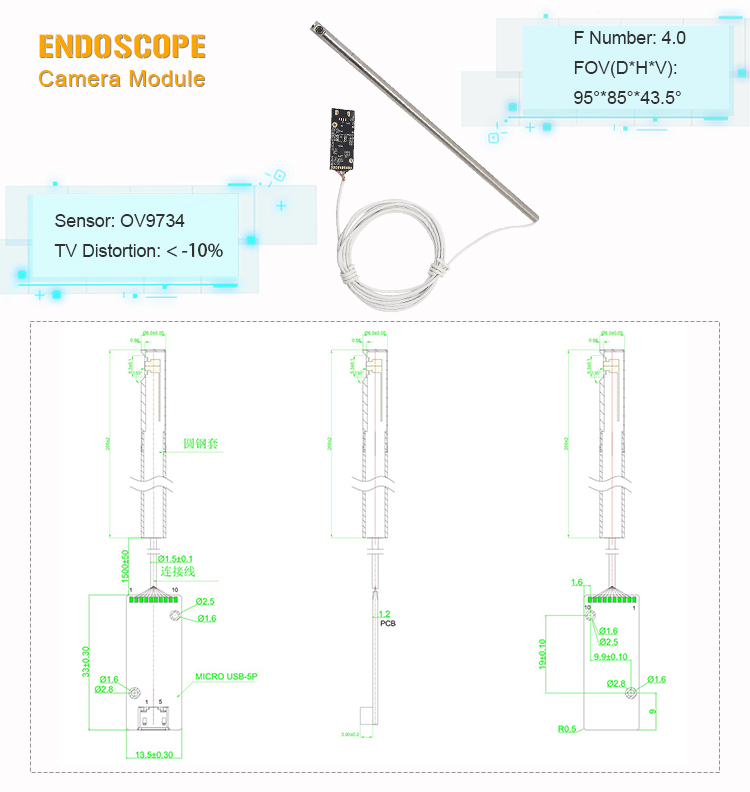 |
Superior Imaging Performance: Utilizing the OV9734 sensor fromOmniVision, it supports 720P high-definition resolution and 30FPS smooth frame rate. With a 1.4μm large pixel size and an F4.0 aperture, it ensures clear imaging even in low-light conditions, with distortion control of <-10% and a picture that is true and without distortion.
Side-View Wide-Angle Observation: The unique 95° diagonal field of view (DFOV) and 85° horizontal field of view (HFOV) design, combined with a 6mm ultra-thin lens, enables easy multi-angle side-view detection in narrow spaces, solving the problem of traditional front-view mirror blind areas.
Deep-Cavity Adaptation with Extended Shell: The 200mm extended steel sleeve design significantly improves the stability and control of deep cavity detection, especially suitable for complex scenarios such as industrial pipelines and internal machinery.
Robust Environmental Adaptability: Integrated with 4 high-brightness LED lighting fixtures, supporting manual focusing of 10-100mm, it can handle complex working conditions such as low light and reflection; USB2.0 UVC protocol plug-and-play, compatible with mainstream operating systems.
Industrial-Grade Reliability: SMT process and AA manufacturing process, with a precise and durable structure; separated design facilitates maintenance and upgrades, reducing usage costs.
1. Deep-Cavity Inspection: 200mm steel shell is suitable for detecting cracks/corrosion on the inner walls of generator pipeline and hydraulic system. Minimally invasive surgery assistance: 6mm lens + LED lighting is applicable for narrow cavity inspections in ear-nose-throat departments.
2. Minimally Invasive Surgery Assistance: 6mm lens + LED lighting is applicable for narrow cavity inspections in ear-nose-throat departments.
3. Power Facility Maintenance: F4.0 aperture + LED lighting is used to complete the corrosion detection of busbars in dim substations, with -10% distortion control to ensure measurement accuracy.
Product Name | ENDOSCOPE Camera Module |
Image Sensor | OV9734 |
Pixel | 1MP |
Focusing Range | 10-100mm |
Focal Length | 1.08mm |
F NO | 5.0 |
Product Type | Endoscope Camera Module |
Led | 0402 Led |
TV Distortion | <-10% |
Feature | Side-View Endoscope Camera Module |
FAQ
1. Possible causes of noise in the image?
If the sensor is overheating, signal transmission interferes, or the ISO is too high in low light, check the heat dissipation design, cable shielding, or enable the noise reduction mode.
2. Why does the image appear color bias?
The filter may need to be corrected or replaced by software due to uncalibrated white balance, mismatch of light source color temperature (such as LED mixed with daylight), or aging of the sensor.
3. What should I do if the module fails after high temperature sterilization?
Check whether the tolerance temperature is exceeded (for example, some are only 120°C), turn off the power and remove the battery before sterilization, damage may involve sealant failure or circuit board deformation.
This 1mp OV9734 CMOS 720P USB side-view endoscope camera module, integrates the OmniVision OV9734 CMOS color image sensor, supporting 720P resolution, 30FPS frame rate, and 1MP pixel count. It features a 1/9-inch sensor with a 1.4μm×1.4μm pixel size, delivering a wide-angle side-view imaging capability with DFOV 95°, HFOV 85°, and VFOV 43.5° to meet multi-angle observation needs in confined spaces. Its F4.0 aperture, 1.08mm focal length, and 10-100mm focusing range ensure clear imaging, with distortion controlled below -10%. Equipped with manual focus and four integrated LED fill lights, it adapts to complex lighting environments. The module utilizes a USB 2.0 interface supporting UVC protocol for broad compatibility. Its detachable design combines a 6mm diameter lens with a 200mm extra-long steel shell, significantly enhancing stability and maneuverability for deep-cavity inspections. Manufactured using SMT processes and Active Alignment (AA) technology, the device ensures precision and durability. | |
Superior Imaging Performance: Utilizing the OV9734 sensor fromOmniVision, it supports 720P high-definition resolution and 30FPS smooth frame rate. With a 1.4μm large pixel size and an F4.0 aperture, it ensures clear imaging even in low-light conditions, with distortion control of <-10% and a picture that is true and without distortion.
Side-View Wide-Angle Observation: The unique 95° diagonal field of view (DFOV) and 85° horizontal field of view (HFOV) design, combined with a 6mm ultra-thin lens, enables easy multi-angle side-view detection in narrow spaces, solving the problem of traditional front-view mirror blind areas.
Deep-Cavity Adaptation with Extended Shell: The 200mm extended steel sleeve design significantly improves the stability and control of deep cavity detection, especially suitable for complex scenarios such as industrial pipelines and internal machinery.
Robust Environmental Adaptability: Integrated with 4 high-brightness LED lighting fixtures, supporting manual focusing of 10-100mm, it can handle complex working conditions such as low light and reflection; USB2.0 UVC protocol plug-and-play, compatible with mainstream operating systems.
Industrial-Grade Reliability: SMT process and AA manufacturing process, with a precise and durable structure; separated design facilitates maintenance and upgrades, reducing usage costs.
1. Deep-Cavity Inspection: 200mm steel shell is suitable for detecting cracks/corrosion on the inner walls of generator pipeline and hydraulic system. Minimally invasive surgery assistance: 6mm lens + LED lighting is applicable for narrow cavity inspections in ear-nose-throat departments.
2. Minimally Invasive Surgery Assistance: 6mm lens + LED lighting is applicable for narrow cavity inspections in ear-nose-throat departments.
3. Power Facility Maintenance: F4.0 aperture + LED lighting is used to complete the corrosion detection of busbars in dim substations, with -10% distortion control to ensure measurement accuracy.
Product Name | ENDOSCOPE Camera Module |
Image Sensor | OV9734 |
Pixel | 1MP |
Focusing Range | 10-100mm |
Focal Length | 1.08mm |
F NO | 5.0 |
Product Type | Endoscope Camera Module |
Led | 0402 Led |
TV Distortion | <-10% |
Feature | Side-View Endoscope Camera Module |
FAQ
1. Possible causes of noise in the image?
If the sensor is overheating, signal transmission interferes, or the ISO is too high in low light, check the heat dissipation design, cable shielding, or enable the noise reduction mode.
2. Why does the image appear color bias?
The filter may need to be corrected or replaced by software due to uncalibrated white balance, mismatch of light source color temperature (such as LED mixed with daylight), or aging of the sensor.
3. What should I do if the module fails after high temperature sterilization?
Check whether the tolerance temperature is exceeded (for example, some are only 120°C), turn off the power and remove the battery before sterilization, damage may involve sealant failure or circuit board deformation.


